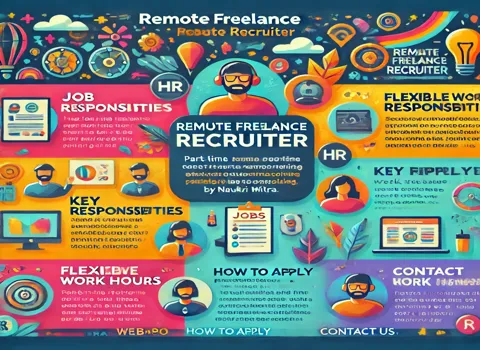
There's someone out there who's exactly right for a role that doesn't officially exist yet, and they have no idea it's coming. Finding that person — and doing it in a way that feels like a conversation instead of a transaction — is more or less the whole job. We're looking for a
Remote Freelance Recruiter who puts the person ahead of the pipeline metric without ever losing track of either.
What this role is
You'd work as an independent freelance recruiter, helping high-growth teams scale by sourcing across functions such as marketing, development, and customer support. It's fully remote, project-based, and pays $45,000 annually with real room to grow depending on how many searches you take on and how they go. Your hours are yours to set. What we actually care about is whether the right people are getting hired, not whether you were logged in at 9 am.
This also isn't a role where a job description lands in your inbox, and you're told to fill it fast. You're expected to question a vague brief, push back when a hiring manager's ask doesn't match reality, and shape a search rather than just run someone else's checklist.
What you'll be doing
- Source candidates across roles and industries, looking for people with real skill and curiosity rather than a resume that just checks boxes
- Have actual conversations instead of sending generic outreach blasts — ask better questions, listen more than you talk, treat candidates like people instead of leads in a funnel
- Rewrite vague job postings into something that explains why a role actually matters, so the right people self-select in instead of scrolling past
- Track response rates, interview conversion, and time-to-offer, and use those numbers to adjust your approach instead of just reporting them upward
- Work directly with hiring managers to figure out what matters most for a given search, and pivot quickly when priorities change mid-stream
- Say something when a process is broken — a funnel losing strong candidates after round two is worth flagging, not quietly working around
- Stay close enough to each client's world that you can make small calls yourself instead of waiting on sign-off for everything
What we're looking for
A bachelor's degree, or recruiting experience substantial enough to make that question beside the point, plus at least 2 years of recruiting work — freelance or contract experience is a plus, though not required. You should be comfortable moving fast between industries and seniority levels, from a junior support hire one week to a senior technical search the next. Good instinct, backed by real data, matters more than either alone; knowing when a metric is telling you something true and when it's just noise is half the job. On top of that: clear communication whether you're writing in Slack or on a live call, and enough organizational discipline to run several client searches at once without letting any of them slip.
What sets a strong application apart
- A mix of past searches spanning both engineering-heavy roles and roles outside of tech entirely
- Comfort working async-first with tools like Loom, Slack, and Notion
- A specific example of a job posting you rewrote that started actually performing
- Prior work juggling multiple clients simultaneously as an independent contractor
Curiosity about what actually makes a team's culture work goes further than matching keywords off a resume ever will. We notice the difference.
How the work actually runs
Nobody's tracking your hours here or expecting you online at a set time. Collaboration runs async-first — Loom recordings, Slack threads, and Notion docs provide enough context that a live call usually isn't necessary. What matters more than speed is clarity: a search that quietly stalls with no update is worse than one that hits a real obstacle and says so out loud. Postings like this one tend to end up on platforms such as
Naukri Mitra, mostly because freelance recruiters with genuine client-facing chops aren't easy to find through a generic job board.
Since you're likely handling more than one client at once, staying organized carries as much weight as your sourcing instinct. A recruiter who can't keep three parallel searches straight burns goodwill fast, no matter how sharp their instincts are on any single one.
What the first two months should look like
- Launch 3 to 5 new role searches within your first 60 days
- Rewrite or meaningfully improve at least one job posting per team you support
- Set up recurring, clear reporting for hiring leads using whatever tools work best for you
Pay and flexibility
- $45,000 annually, project-based, with room to grow as you pick up more searches
- Real schedule flexibility — work when you're actually sharp, not on someone else's clock
- Creative control over how you approach sourcing and outreach on each search
- A remote-first setup built around async collaboration from day one, not bolted onto an office-first process
Why any of this matters
Filling a seat fast isn't the point. Getting the wrong person into a role costs a team far more than the search itself ever would — morale takes a hit, projects slip, and whatever culture the company was trying to build quietly erodes a little. Every match you get right compounds outward long after the offer's signed, in ways that don't show up on a dashboard.
The recruiters who do best here tend to remember that a candidate who's wrong for today's search might be exactly right for a different one six months out. Burning a relationship for a quicker close rarely pays off, and candidates talk to each other more than most companies realize.
Ready to talk?
If you're the kind of recruiter who pushes back on a vague job post instead of quietly filling it as written, and can look at a stalled funnel and say plainly where it's breaking, we'd like to hear from you. Send a resume along with a short note on one search you're genuinely proud of and why it worked. Candidates from the United States, Canada, the United Kingdom, the European Union, Australia, India, and other eligible regions worldwide are welcome to apply.