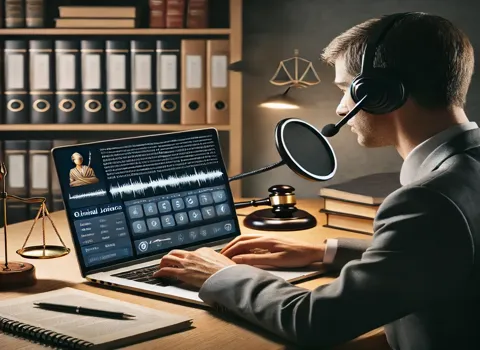
A court transcript doesn't get a rewrite. Whatever gets recorded in a hearing, a deposition, or a police interview becomes the official record, permanently, so it has to land right the first time. This Remote Criminal Justice Transcriptionist role is for people who take that seriously and want to do it from home.
The Role in Brief
Full-time. Fully remote. $130,094 a year. You'd be transcribing material directly tied to the justice system — interviews, hearings, depositions, law enforcement communications — and turning it into written documentation that meets legal formatting standards.
Where Your Attention Goes
- Transcribing and editing audio from interviews, hearings, depositions, and law enforcement communications
- Turning those transcriptions into legal documents formatted the way courts actually expect
- Meeting legal and regulatory requirements, including confidentiality that isn't negotiable and deadlines that aren't either
- Reviewing finished transcripts closely enough to catch errors before they go anywhere
- Checking in with attorneys, court reporters, or law enforcement contacts when accuracy needs confirming
- Keeping digital files organized enough that anyone can find what they need quickly
Staying current matters too — terminology shifts, procedures change, and transcription software keeps evolving whether you keep up with it or not.
What You Need to Qualify
Minimum education is a high school diploma or equivalent. Beyond that:
- 2 to 3 years working as a transcriptionist, legal or criminal justice settings preferred
- Typing speed of 70+ words per minute without accuracy dropping to hit that number
- Real familiarity with legal and criminal justice terminology, not just passing exposure
- Comfort with transcription software plus standard tools like Word and Excel
- The kind of eye that catches errors other people scroll right past
- Strong written and spoken English
- Enough discipline to juggle multiple deadlines without someone checking in on you
What Sets Strong Candidates Apart
None of this is required. It just helps:
- A degree or certification in criminal justice, legal studies, or something close
- Prior exposure to court systems or law enforcement agencies specifically
- Comfort figuring out new software on your own instead of waiting for support
- Experience handling confidential material under real compliance pressure
Compensation & Perks
Naukri Mitra placed this role, and it comes with $130,094 annually along with a remote setup that's actually flexible, not flexible in name only. Beyond pay, there's access to ongoing training, real paths for growth, and work that carries genuine weight within the justice system. The compensation reflects that the output here matters.
What Success Looks Like
People who do well here tend to work independently without needing constant check-ins, adapt quickly when new software or standards are rolled out, and remain reliable under deadline pressure rather than cutting corners when things get tight. Interpersonal skills still matter, even remotely — you'll coordinate with attorneys, court reporters, and other stakeholders regularly, and clear communication is what keeps that from turning into a mess.
Your Home Workspace
A few things need to be in place before day one: a reliable computer with the right transcription and productivity software installed, stable high-speed internet, and noise-canceling headphones — detailed audio work doesn't forgive background noise. A quiet, dedicated space to work matters just as much as the equipment itself.
Ready to Apply
Naukri Mitra is building an inclusive team, and applications are welcome from candidates of all backgrounds, regardless of gender, ethnicity, disability, or any other legally protected characteristic. If precision and reliability sound like things you actually bring to work, not just things you claim on a resume, apply today.