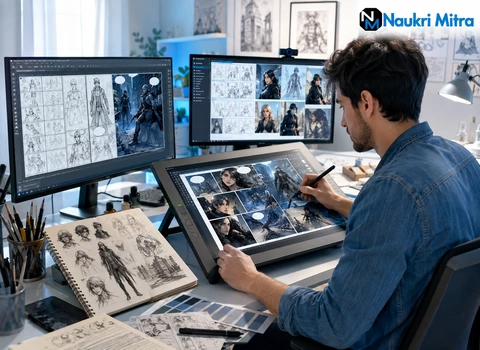
A script arrives in your inbox on a Tuesday. Twelve pages, no artwork yet. By the time you're done, it needs to breathe — panels that pull the eye where the story wants it, faces that carry weight without a caption underneath. That's the job. We're hiring a Remote Comic Book Illustrator to turn scripts into finished, published pages, working from wherever you draw best.
The Short Version
You'll take raw scripts and build them into sequential art — pencils, inks, color, the whole pipeline — for original series and graphic novels produced across a distributed, international team. Some weeks you're deep in a single issue. Other weeks you're juggling revisions on one book while sketching character concepts for another. Both happen. Annual pay for this role is $70,000.
What You'd Actually Be Doing
- Turning scripts into finished panels — composition, pacing, and the emotional beats that make a page land.
- Designing characters and environments, and keeping them consistent from issue eleven back to issue one.
- Delivering thumbnails through final color on the timeline the project needs.
- Sitting in on art reviews, taking notes, and revising without ego getting in the way.
- Prepping print-ready and web files so they don't bounce back from production.
Naukri Mitra lists this position for candidates who want remote creative work without giving up on craft — the deadlines are real, but so is the room to make something good.
What Gets You in the Door
Two years of professional illustration experience, at minimum — comics, graphic novels, or something close enough that the skills transfer. A portfolio that actually shows sequential storytelling, not just single illustrations. Beyond that:
- Proficiency in Photoshop, Clip Studio Paint, or Procreate — pick your tool, we're not precious about it.
- Comfortable on a drawing tablet (Wacom, XP-Pen, whatever you've trained your hand on).
- Some familiarity with Drive, Dropbox, or Notion for file handoffs.
- You can hit a deadline without someone checking in on you every other day.
Minimum education: high school diploma or equivalent. That's the floor — what matters far more is the portfolio.
Nice to Have, Not Required
- InDesign or Illustrator experience for layout work.
- Range across art styles when a project calls for it.
- A track record juggling more than one ongoing series at once.
How the Team Actually Works
Fully remote, and not in the loose sense where "remote" secretly means constant check-ins. Draw at 6 am if that's when your hand is steadiest, or midnight — nobody's tracking hours, just output and communication. There's a shared Slack for the day-to-day back-and-forth, occasional live art sessions where people work side by side on camera, and a monthly call where the team talks through what they're reading, watching, or stuck on. It's informal. It works because people show up for it anyway.
Pay and Perks
- $70,000 annually.
- Flexible hours, genuinely — not just on paper.
- Paid time off, because burned-out artists draw worse pages.
- Mentorship access from art directors already on staff.
- Training support when you want to pick up a new tool or technique.
- Milestone bonuses tied to project delivery.
Where People Go From Here
A few illustrators on this team started exactly where you'd be starting and are now art directing entire books. Others moved into mentoring newer artists, or took on world-building work that shapes a series before a single script is written. There's no fixed ladder — it tends to follow whatever you're good at and want more of.
One Thing Worth Knowing
Feedback here is direct. If a panel isn't working, someone will say so, and you're expected to say the same back when a note doesn't land right. Nobody's precious about it. One illustrator on the team grew up reading manga, and it bleeds into every panel transition she draws. Another cut his teeth on Silver Age superhero books and still lays out pages that way. Nobody's asked to sand off those differences — they're what make the books not all look interchangeable.
Send Us Something
A portfolio that shows range — sequential pages, consistent characters across a spread, a sense of pacing that doesn't need a script to make sense of. If it makes an editor want to see the next page, that's what we're looking for. Open to applicants in the USA, Canada, the UK, the EU, Australia, India, and beyond — the work travels wherever you do.