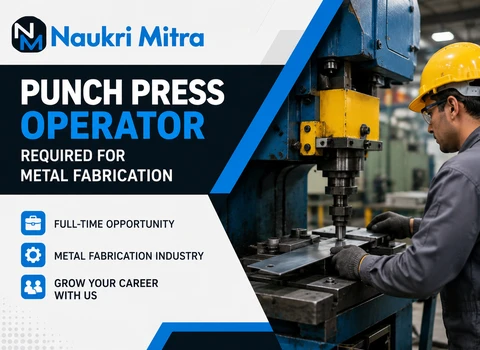
Understanding the Work of a Hydraulic Press Operator
A Hydraulic Press Operator is a skilled worker who runs machines that shape, bend, punch, or form metal sheets using controlled pressure. This role is currently open in Ludhiana, Punjab, India, and is offered on a Full-time basis. People searching for this career often want to know what the job actually involves beyond the title, and this guide explains the daily work, required skills and realistic expectations in simple terms.
Why Metal Forming Plants Need This Role
Metal forming plants convert raw sheets or blocks of metal into usable components for industries such as automobile parts, hardware, machinery and general engineering goods. A hydraulic press applies steady, controlled force to shape metal without cracking it. Since this force must be applied accurately, plants rely on trained operators who understand pressure settings, die alignment, and material behavior.
A Typical Day on the Shop Floor
The day usually begins with checking the machine, inspecting the die or mould, and confirming that raw material is ready at the workstation. As a production worker on the press line, the operator loads metal sheets or blanks, sets the pressure according to the job card, and runs test pieces before starting full production. Throughout the shift, the machine operator monitors output quality, watches for unusual sounds or vibrations, and keeps a steady production pace.
Main Duties Handled Daily
- Loading and unloading metal sheets or components
- Setting and adjusting hydraulic pressure levels
- Checking dies, punches, and molds for wear
- Inspecting finished parts for dimensional accuracy
- Recording production numbers and rejection counts
- Performing basic cleaning and lubrication of the machine
Machines and Instruments Used in This Trade
The core equipment is the hydraulic press itself, which may be single-action, double-action or deep-drawing type depending on the product. Alongside this, the equipment operator commonly works with dies, punches, hydraulic power packs, and pressure gauges. For quality checks, measuring instruments such as vernier calipers, micrometers, and dial gauges are used to confirm that formed parts match the required specifications.
Skills That Employers Look For
Employers usually prefer candidates who have completed an ITI course in a machining-related trade, or a Diploma in Mechanical or Tool and Die Engineering. Equivalent vocational training is also considered suitable. Beyond formal qualifications, practical exposure to reading engineering drawings, handling precision measuring tools, and basic knowledge of EDM machines is often valued just as much as certificates. Freshers with strong technical training and experienced technicians with hands-on press experience are both considered for such roles.
Practical Workplace Abilities
- Reading and interpreting job cards and drawings
- Judging material thickness and pressure requirements
- Quick troubleshooting of minor machine faults
- Maintaining consistent quality under production targets
Physical Demands and Working Environment
This job involves standing for long periods, lifting metal sheets or components, and working close to moving machine parts. The shop floor environment can be noisy and warm, especially near forming and pressing sections. A reasonable level of physical fitness, alertness and hand-eye coordination is important for anyone considering this profession.
Shift Work and Timings
Since this is a Full-time position, operators are generally expected to work fixed factory hours, and many metal forming plants also operate rotational shifts to maintain continuous production. New joiners should be prepared for shift-based schedules depending on plant requirements.
Safety Practices and Protective Gear
Working around a hydraulic press demands strict safety discipline, since careless handling can cause serious injury. Operators are trained to keep hands clear of the die area, use safety guards correctly, and never bypass interlocks. Common protective equipment includes safety shoes, hand gloves, safety goggles, and ear protection in high-noise sections.
Challenges Faced in This Profession
Repetitive motion, machine downtime pressure, and the need to maintain accuracy across large production batches are common challenges. Operators also need to stay alert to avoid fatigue-related errors during long shifts, especially when handling heavy or sharp-edged metal pieces.
Building a Long-Term Career in Press Operations
With experience, a press operator can grow into roles such as senior operator, shift in-charge, or quality checker within the same production line. Gaining knowledge of multiple press types, die setting, and preventive maintenance often opens doors to supervisory responsibilities over time within the metal forming and tool room industry.
Salary and Benefits
The monthly salary for this Hydraulic Press Operator position in Ludhiana, Punjab, India is ₹27,500. Depending on the employer, additional benefits may include overtime pay, PF, ESI, bonuses, uniforms, transport facilities, or canteen access, though these vary by company and are not guaranteed.