
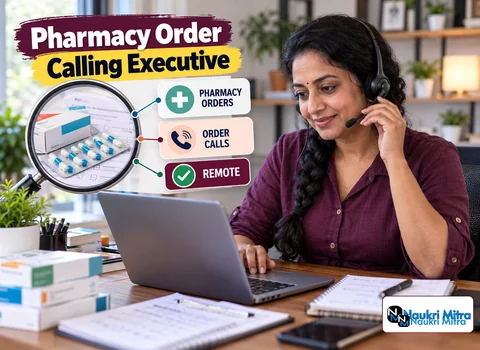
An order caller must never suggest, swap or recommend a medicine on their own judgement, not even a brand the customer says is "the same thing". These remote pharmacy order calling executive jobs carry a full-time salary of $300 per month (USD), accept applicants from any country, and ask you to phone customers who have placed medicine orders online, confirm what they ordered, check that a prescription is on file where one is needed, and record every detail in the CRM so the pharmacist and the delivery team can act on it.
After years at a dispensing counter, I now train call staff, and the errors I see are rarely rudeness. They are one wrong letter in a drug name, or a caller being helpful in a way only a pharmacist may be.
So what does a pharmacy order calling executive do in practice? You receive a queue of orders flagged for confirmation. You call each customer, verify their identity with the details on the order, read back the medicines, strengths and quantities, and confirm the delivery address and slot. If something needs a prescription and none is uploaded, you explain what is needed. If a medicine is out of stock, you pass on only what the pharmacist has already approved.
The pharmacy order calling executive job description is narrow on purpose. You are the accurate link between the customer and the pharmacist, not an adviser. When a customer asks about doses or alcohol, your answer is always the same: "Our pharmacist will call you back on that," followed by a ticket raised in the CRM.
Prescription medicines need a valid prescription. In India, drugs listed under Schedules H, H1 and X are sold only against a prescription, and other countries have their own rules, so follow your employer's process exactly. Your part is practical: confirm a prescription has been uploaded, that it is readable, that the patient name matches the order, and that it shows a doctor's name, registration details and a date. You do not decide whether it is valid. You flag gaps, and the pharmacist decides.
A typical gap: a cropped photo with no signature. You ask for a clearer upload and mark the order pending.
Medicine names and CRM skills matter more here than speaking speed. Many brands differ by a letter or two, and one molecule comes in several strengths. Confusing 5 mg with 50 mg can start a serious error. Habits I train every batch on:
Pharmacy order calling executive skills, then, include patience with elderly customers and the discipline to say "I will check" instead of guessing.
Here is an invented case. Mr Kulkarni, 64, in Nagpur, has ordered a month of a branded blood pressure tablet, 5 mg. The warehouse has none. Brand substitution rules in India are not simple, so many e-pharmacies offer only a same-composition, same-strength substitute with the customer's consent, sometimes after checking with the prescribing doctor. In this case, before you dial, the pharmacist has reviewed the order and approved one alternative: another brand with the same molecule and strength, which the CRM shows as "pharmacist approved substitute".
On the call you confirm his identity, explain that his usual brand is out of stock, and tell him the pharmacist has approved a brand with the same medicine and the same strength. He asks whether it is "as good". You do not offer an opinion. You tell him the pharmacist can speak to him before dispatch if he would like that. He agrees to the substitute, so you record his consent, the approved item and the time, and the order moves to packing. Had he refused, you would mark the item cancelled, update the bill and confirm the rest.
Some items, insulin for example, have to be kept cold. Where the system marks an item as cold-chain, confirm that someone will be home to receive it during the slot and tell the customer to refrigerate it on arrival, as the pharmacist's note instructs. When a customer reports a missing item after delivery, check the invoice in the CRM, raise a ticket with the order number and the item name exactly as billed, and give the timeline your process allows, never a date you have invented.
Expect five or six shifts a week, weekends often among them, because people order medicines on Sundays too. Mornings clear the overnight queue; afternoons go to stock callbacks and missing-item tickets. Your employer fixes the exact hours; this listing does not commit to any. Pharmacy order calling executive work from home jobs still need a proper desk:
Treat prescription privacy as a duty. No screen photos, no names or medicines noted on paper or your own phone, and lock the system when you leave.
Candidates with 12th pass in science, or a D.Pharm or B.Pharm, can apply. Is D.Pharm needed? A pharmacy qualification helps you read prescriptions and recognise drug names faster, but it is not always mandatory for the calling role. Freshers are considered, so a pharmacy order calling executive job with no experience is realistic if you prepare.
As for the pharmacy order calling executive salary, the figure is exactly $300 per month (USD), full-time. Whether any incentive exists is the employer's decision, and none is promised. Tata 1mg, PharmEasy and Netmeds are well-known e-pharmacies with order and support desks; they illustrate the sector and are not this listing's employer. Where you live does not rule you out.
Wondering how to become a pharmacy order calling executive? Expect a short voice screening, then a typing or CRM test, then a role-play. Pharmacy order calling executive interview questions often include: "A customer asks you to change his dose. What do you do?" and "Read back this order" with two look-alike names in it. The right answer is always escalation to the pharmacist.
A dedicated pharmacy order calling executive course is not required. A basic pharmacy assistant certificate or a customer service course can strengthen your profile, though any certification is optional unless the employer says otherwise. For your pharmacy order calling executive resume, put your science or pharmacy education at the top, then any chemist shop or call centre experience, your typing speed and your languages, on one page.
A lab test booking executive schedules blood tests and home sample collection, confirms fasting instructions the lab provides, and assigns a phlebotomist slot. A pharmacy order caller deals with medicines, prescriptions and substitutes, so accuracy around drug names and pharmacist sign-off is heavier.
Career growth in e-pharmacy customer support can lead to quality analyst, team leader, escalation desk or training roles. If you hold a D.Pharm or B.Pharm, some employers move experienced callers towards pharmacist support or prescription review teams, subject to local licensing rules.
It costs nothing to apply. If remote pharmacy order calling executive jobs match your background, send your resume with your education, languages and a line on your home setup. Selection depends on the employer's screening, and nothing here guarantees a job.