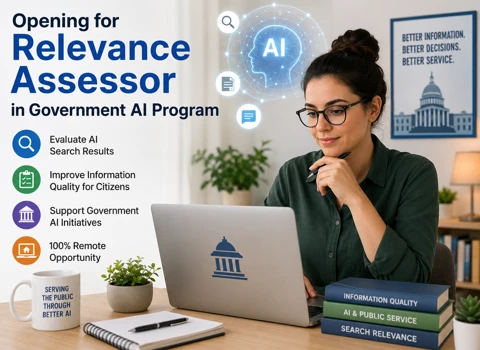
Exploring a Career as a Relevance Assessor in a Government AI Program
Government agencies are investing heavily in artificial intelligence to improve how people find information, access services, and interact with public programs. As these systems become more common, there is a growing need for people who can review AI outputs and determine whether they actually help users. That is the purpose of an
Opening for Relevance Assessor in the Government AI Program.
In this role, you are not building AI models or writing software. Instead, you evaluate how well AI systems perform when responding to real-world questions and requests. Your feedback helps improve the quality of search results, recommendations, and automated responses used by government organizations.
This is a
remote opportunity with a pay rate of
$46 per hour, making it attractive to professionals who enjoy research, analysis, and working with information in a structured environment.
Why Government AI Initiatives Need Relevance Assessors
Artificial intelligence can process enormous amounts of data in seconds, but speed does not always guarantee quality. A system may return information that is technically related to a query while still missing what the user actually needs.
Government agencies hire Relevance Assessors to provide the human judgment that AI lacks. Their reviews help determine whether information is:
- Accurate
- Current and reliable
- Relevant to the user's intent
- Easy for the public to understand
- Consistent with official policies
- Useful in solving a specific problem
Imagine someone searching for unemployment benefits. If the AI system highlights outdated guidance or overlooks the official application process, the result may create confusion. Human reviewers help identify these issues before they affect large numbers of users.
The Human Role Behind Better AI Performance
Artificial intelligence improves through data, testing, and feedback. Human evaluation remains one of the most important parts of that process.
Professionals working in an
Opening for Relevance Assessor in a Government AI Program examine AI-generated content and assign ratings based on established quality standards. Their assessments help teams understand whether a system is meeting expectations.
For instance, a government search tool may receive a query about passport renewal requirements. If the system ranks unofficial sources above government resources, the assessor flags the issue. That feedback can then be used to improve future rankings.
Over time, thousands of these evaluations help AI systems become more accurate and dependable.
What the Work Looks Like Day to Day
Most days involve reviewing information, applying evaluation guidelines, and documenting findings. The work is generally independent, although assessors may collaborate with project teams when discussing quality standards or unusual cases.
Tasks often include:
- Reviewing search results
- Evaluating AI-generated responses
- Comparing outputs against official sources
- Assigning relevance scores
- Recording observations
- Identifying errors or inconsistencies
- Following detailed rating instructions
- Participating in quality calibration sessions
The role requires focus because even small differences in wording or ranking can affect the usefulness of a result.
A Practical Example
Suppose a citizen asks:
"How do I replace a lost Social Security card?"
The assessor reviews the AI response and considers questions such as:
- Does the answer address the request directly?
- Is the information still valid?
- Are official government resources included?
- Are important steps missing?
- Would an average user understand the instructions?
The goal is not simply to judge correctness but also usefulness.
Skills That Make a Strong Relevance Assessor
People from different professional backgrounds can succeed in this field, but certain abilities are especially valuable.
Critical Thinking
Assessors regularly compare information, identify gaps, and determine whether content truly satisfies a user's needs.
Research Skills
Government information often exists across multiple websites and databases. Knowing how to verify facts and locate authoritative sources is important.
Attention to Detail
A small error in a date, requirement, or policy reference can affect the quality of an AI response.
Reading and Interpretation
Many government documents contain technical language or legal terminology. Assessors must understand these materials accurately before evaluating them.
Written Communication
Feedback should be clear and concise so that analysts, developers, and project managers can act on it.
Organization and Time Management
Remote work requires the ability to manage tasks independently while maintaining quality standards.
Educational Background and Relevant Experience
There is no universal degree requirement for becoming a Relevance Assessor. Employers typically place greater value on analytical ability, communication skills, and the capacity to follow detailed guidelines.
Educational backgrounds that often align well with the role include:
- Information Technology
- Computer Science
- Public Administration
- Political Science
- Communications
- Journalism
- English
- Library and Information Science
- Data Analytics
Experience in research, content moderation, quality assurance, information management, or digital evaluation can also be highly relevant.
Certifications That May Add Value
Although certifications are usually optional, they can strengthen a candidate's qualifications.
Examples include:
- Google Data Analytics Certificate
- AI Fundamentals programs
- Information Governance certifications
- Data Quality training
- Digital Research courses
- Search Quality Evaluation programs
Because AI technologies evolve quickly, ongoing education can be beneficial throughout a career.
Tools and Technology Used in the Role
The software used depends on the agency and project, but most assessors work with digital evaluation platforms designed to collect ratings and feedback.
Common tools include:
- AI evaluation systems
- Search quality platforms
- Data annotation software
- Content management systems
- Reporting dashboards
- Workflow tracking applications
Many teams also rely on collaboration tools such as:
- Microsoft Excel
- Microsoft Teams
- Google Workspace
- Jira
- Confluence
Organizations typically provide training on project-specific systems, so extensive technical experience is not always necessary.
Working Remotely as a Relevance Assessor
A major advantage of an
Opening for Relevance Assessor in the Government AI Program is the ability to work remotely.
Most responsibilities can be completed from a home office using secure online platforms. Because government-related information may be sensitive, assessors are expected to follow strict security and confidentiality procedures.
Remote work can offer several benefits:
- Flexible work arrangements
- Less commuting time
- Greater independence
- Access to opportunities from different locations
- Collaboration with distributed teams
At the same time, success often depends on maintaining a productive routine and staying engaged with project requirements.
Habits That Support Remote Success
Many experienced remote workers rely on a few simple practices:
- Set up a dedicated workspace
- Reduce distractions during work hours
- Follow a consistent schedule
- Take short breaks to maintain concentration
- Monitor deadlines carefully
- Communicate regularly with team members
These habits help maintain both productivity and evaluation quality.
Challenges You May Encounter
Like many analytical roles, relevance assessment requires patience and consistency.
One of the most difficult aspects is understanding user intent. A search query may be brief, unclear, or open to multiple interpretations.
Other challenges include:
- Reviewing large volumes of information
- Applying guidelines consistently
- Adjusting to changing evaluation criteria
- Handling ambiguous requests
- Distinguishing between similar levels of relevance
- Balancing speed with accuracy
Professionals who remain objective and methodical generally perform best in these situations.
Where Relevance Assessors Are Employed
While this opportunity focuses on government AI programs, similar positions exist across a wide range of industries.
Employers may include:
- Government agencies
- Public service organizations
- Technology companies
- Artificial intelligence firms
- Search engine providers
- Research institutions
- Universities
- Data annotation companies
- Digital information services
As organizations continue adopting AI-powered tools, the need for human evaluation remains strong.
Who Often Thrives in This Profession?
Not everyone enjoys reviewing information for long periods, but for the right person, the work can be highly engaging.
Individuals who often excel in this role tend to:
- Enjoy research and investigation
- Read carefully and critically
- Appreciate structured processes
- Notice details others miss
- Think logically
- Work independently
- Adapt to new technologies
- Have an interest in AI systems
People who like improving information quality and solving information-related problems often find the role rewarding.
Opportunities for Career Growth
Experience gained through an
Opening for Relevance Assessor in the Government AI Program can lead to several specialized career paths.
Possible next steps include:
- AI Quality Analyst
- Search Quality Evaluator
- Data Annotation Specialist
- Information Governance Analyst
- Research Analyst
- Machine Learning Operations Specialist
- Trust and Safety Analyst
- Content Quality Manager
- Data Quality Lead
- AI Project Coordinator
As organizations place greater emphasis on responsible AI development, professionals with evaluation experience are becoming increasingly valuable.
Expanding Into Specialized AI Roles
Many assessors eventually develop expertise in areas such as:
- AI model evaluation
- Human-in-the-loop systems
- Data governance
- Algorithm auditing
- Responsible AI practices
- Information quality management
These skills can support advancement into both technical and operational positions.
Building a Successful Future in the Field
People who build long-term careers in this area usually stay curious about technology while continuing to strengthen their analytical skills. Understanding search relevance, information quality, public-sector communication, and AI evaluation methods can create opportunities for advancement.
For professionals interested in research, technology, public service, and remote work, an
Opening for a Relevance Assessor in the Government AI Program offers a meaningful way to contribute to modern digital services. By reviewing and improving AI-generated information, Relevance Assessors help ensure that citizens receive accurate, trustworthy, and useful guidance when interacting with government systems.