
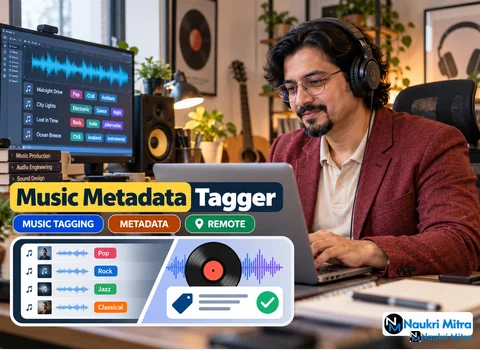
Take an invented track called "Harbour Lights at Four". It exists three times: the 2009 studio original, a 2024 remaster with a brighter low end, and a live take from a festival stage where the band stretches the bridge to six minutes. A listener hears one song. A catalogue sees three separate recordings, each with its own entry and, normally, its own ISRC. Mix them up and royalties for the live take land on the original, and a playlist meant for the clean remaster serves crowd noise. Preventing that kind of confusion is the daily business of online music metadata tagger jobs. This listing is remote, open worldwide, part-time, and pays $5 per hour (USD).
The International Standard Recording Code is a 12-character identifier attached to a specific recording, not to the song as written. It breaks down into a two-letter country code, a three-character registrant code, two digits for the year of reference and a five-digit designation code. The composition behind the recording has a different identifier, the ISWC, so all three versions of the invented track share one ISWC while carrying different ISRCs.
Whether a remaster receives a new ISRC depends on how much the audio changed and on the label's own policy, so you follow the style guide rather than guessing. A live recording is always a separate performance. Your job is to check that each file points at the right code, flag codes that appear twice in a catalogue, and never invent a code to fill a blank cell.
Most of the listening part of the role is descriptive tagging. You play a track and record its main genre and subgenre, two or three moods from a fixed list, an approximate tempo in BPM, the lead instruments and whether the vocals are male, female, mixed or absent.
Good tagging means sticking to the controlled vocabulary. If the guide offers "melancholic" and "reflective" but not "sad", you choose from what is offered. Knowing deep house from tech house saves correction notes.
Credits are where small errors cause the most trouble. You enter the main artist, any featured artist, songwriters, composers, producers and, where asked, the label and release date. A featured artist usually sits in a separate field, not stuffed into the title, and the spelling must match the artist's established entry exactly, including accents and capitals. Songwriter splits are not yours to decide.
The plain music metadata tagger job description, then, is part listener, part data clerk: hear the track, describe it consistently, and keep the identity and credits correct.
MusicBrainz is an open music encyclopaedia that separates recordings, releases and works, which suits this work well. Picard is its free desktop tagger. You load a folder of files, let Picard cluster them and look them up using AcoustID audio fingerprints or existing tags, then compare the suggested release against the files before saving. Picard writes ID3 tags to MP3s and Vorbis comments to FLAC files.
Treat the match as a suggestion. Picard may offer the original album when your file is the remaster, and the track length is often the quickest clue. Some employers also give access to their own ISRC databases or distributor portals; you work inside those systems only, using the login they issue.
Many clients skip audio files altogether and send a spreadsheet with streaming links or preview clips. Here is a realistic invented batch: forty tracks from a small instrumental library, with columns for title, version, ISRC, genre, mood, BPM, instruments and notes.
You return the sheet with a short summary of queries.
Decent headphones reveal a faint shaker or a live recording's room sound that laptop speakers miss. Beyond that you need a computer that runs Picard and a spreadsheet program smoothly, stable broadband for streaming previews and downloading batches, and a cloud folder where files carry version names like batch07_v2_checked.
A typical part-time week might involve receiving one or two batches with a deadline, tagging in short focused sessions, sending queries early, handling one revision round when the reviewer returns notes, and then submitting. Volume rises and falls with the client's catalogue, so no hours are promised.
Work only with audio the client supplies or links through licensed services. Never download pirated copies to speed up a lookup, and never share unreleased tracks, previews or catalogue sheets with anyone. Keep files inside the approved folders and systems, delete local copies when the client asks, and treat artist contact details and royalty data as confidential.
Music metadata tagger jobs for freshers do exist, because the core skill is careful listening plus tidy data entry. To show that you can do it, create a free MusicBrainz account and make a few well-sourced edits, or tag your own legally bought music in Picard. A small sample sheet of twenty tracks with genre, mood and BPM filled in makes a practical portfolio piece.
Expect a tagging test: a short batch scored against the client's guide. A fair test is small and clearly a sample. Common music metadata tagger interview questions ask how ISRC differs from ISWC, how you would tag a track that blends two genres, and what you do when sources disagree on a credit.
On your music metadata tagger resume, list the genres you know well, the tools you have used, your English level and any data entry or proofreading work. No specific music metadata tagger course or certification is required; free MusicBrainz documentation and the label's own guide teach most of it.
Core music metadata tagger skills include:
A curator chooses which tracks belong together on a playlist and why; the tagger supplies the facts and descriptors that make those choices searchable. Curating is editorial and taste-led, while tagging is about consistency.
From here, people move into senior tagging or quality review, catalogue management at labels and distributors, rights and royalty data work, or music data analysis, where tagged catalogues feed reports on listening trends. Streaming services, metadata providers such as Gracenote, distributors and production music libraries are examples of the kind of organisations that rely on this data, mentioned here only as market context.
Freelance music metadata tagger jobs attract fake offers, so watch for these signs:
If any of these appear, stop and report the post.
This opening suits someone who wants music metadata tagger work from home on a flexible, part-time basis. On this listing the music metadata tagger salary is $5 per hour (USD). Bonuses are not part of the stated terms. Applying is free: send your resume, a few lines about your strongest genres and, if you have one, a sample tagging sheet. Part time music metadata tagger jobs reward patience and precise ears, so mention the last time you caught an error others missed.