
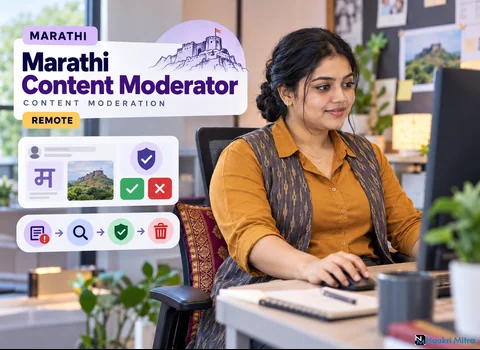
Marathi and Hindi are both written in Devanagari, so a comment in either language can look almost the same at a glance. The difference lives in the vocabulary and the grammar. A Marathi sentence settles on "आहे" where Hindi would use "है", says "नाही" instead of "नहीं", and asks "काय" where Hindi asks "क्या". This listing is for online Marathi content moderator jobs: home-based review shifts on part-time hours, paid at $6 per hour (USD), for fluent Marathi readers in any country.
That distinction matters in moderation. A reader who knows only Hindi can follow the outline of a Marathi post and still miss what it says. Some words look identical in both languages and carry different senses. In Hindi, "शिक्षा" points to education. In Marathi it means punishment, and education is "शिक्षण". A comment saying someone deserves "शिक्षा" reads very differently depending on which language the reviewer hears. Marathi also uses the letter ळ, which standard Hindi spelling does not, and writes ॲ for the English "a" sound in borrowed words such as "ॲप".
Tone adds another layer. Marathi speakers move between the respectful आपण and तुम्ही and the familiar तू, and a sudden switch to तू in a reply can signal contempt rather than warmth. Puneri bluntness, Varhadi turns of phrase and Malvani vocabulary each carry their own humour, and some users type Marathi in Roman letters. A fluent Marathi reader catches sarcasm, a veiled threat or a local insult that a translation tool or a Hindi-only reader could pass straight over.
The central task is checking Marathi comments, posts and videos against a set of community guidelines. In a video, the spoken Marathi, on-screen captions and description all count. You read or watch the item, compare it with the written rules and choose the action that fits.
Through a shift, the work of a Marathi content moderator comes down to this: look closely, match what you see to a policy, act, and note the action. That is different from data annotation, where a Marathi data annotator labels text, audio or images so the material can be used to train or test software. Moderators decide whether content can stay in front of real users, which asks for more judgement and brings more contact with harmful material.
This listing names four categories you will act on. Abuse covers insults, harassment and hateful language aimed at people. In Marathi it can hide inside a polite verb form or a regional slang word, so reading the whole sentence matters more than hunting for one bad word. Violence covers threats, graphic injury and content that praises or encourages harm. Nudity covers explicit images and videos. Misinformation covers false claims presented as fact, especially about health or safety.
The guidelines you receive will define each category. Your job is to apply those definitions, not personal taste. A rude opinion that stays inside the rules may be allowed to stand.
The responsibilities include removing or labelling content. Removal fits material that clearly breaks the rules, such as a direct threat or explicit nudity. A label suits content that can stay visible with added context, for example a warning screen on a graphic but newsworthy image, or a note on a post carrying a disputed claim. A methodical reviewer reads the item, finds the matching rule and only then chooses, instead of acting on a first impression.
Misinformation needs extra care because it can look harmless. A few patterns are worth knowing:
You are not expected to investigate every claim yourself. The task is to recognise these signals, apply the misinformation rules you are given and escalate when you cannot tell.
Some items will not sit neatly under any rule. A joke in Malvani might read as a threat without context. A video might mix a news report with a claim you have no way to verify. This listing asks you to escalate uncertain cases, which means passing them to a reviewer or team with more authority instead of guessing. A calm, honest "I am not sure, and this is why" protects users and keeps the queue reliable. A short note on what made the case unclear helps the next person decide quickly.
Every action you take is recorded in the review tool. Clear records let a quality checker see why a post was removed or labelled. When a Marathi phrase drove your decision and your note is in English, a brief gloss of what it means makes your reasoning easy to follow for someone who does not read Marathi.
This listing mentions quality and speed targets, set as accuracy and daily review volume. The exact figures are not stated here, so ask how they are measured before you begin. Accuracy comes first, since a fast queue full of wrong calls helps no one.
Reviewers here earn $6 per hour (USD) on part-time hours, working remotely from any country, and this listing describes no second pay arrangement. As an illustration only, a 22-hour week at that rate totals $132 before tax; your own figure follows the hours you actually review. Anyone comparing Marathi content moderator salary per hour figures should treat this hourly rate as the only one stated for this role.
An honest word: content moderation means looking at material other people are spared, including abuse, graphic violence and explicit images. Some of it will be upsetting, and meeting it in your own language can make it feel closer to home.
Look after yourself deliberately. Step away from the screen at regular intervals, especially after a hard item. Ask what wellbeing support, if any, is available to remote moderators when you join, and use whatever is offered. If one kind of content keeps affecting you, raise it early.
Fluent Marathi reading and focus are what count. Neither a degree nor earlier work history is asked for, so this counts among genuine Marathi content moderator jobs for freshers. You do need to understand simple English guidelines, because the rules are written in English even when the content is Marathi.
Expect a language assessment. This listing does not describe its format, but reading Marathi accurately, following meaning and tone, and telling Marathi from Hindi written in the same script are the skills it is likely to probe. You will not find any Marathi content moderator course or certification among the requirements here. Reading Marathi news and comment threads from different regions is good preparation.
You will also need a computer and a stable internet connection.
While searching you may see names such as ShareChat, Moj, TaskUs or Genpact, which are among the kinds of platforms and outsourcing firms people look at for Marathi moderation work. They appear here only as examples, not as the employer of this listing.
A Marathi content moderator work from home job can be genuine, but fraudsters copy the format. Be wary of anyone asking you to pay for a "moderator ID", a refundable security deposit, a paid Marathi test, a training kit or a review software licence before you start. Legitimate listings do not charge applicants to work. Be equally cautious about offers made only through private chat or requests for one-time codes. If anything feels wrong, stop and check before sharing personal details.