
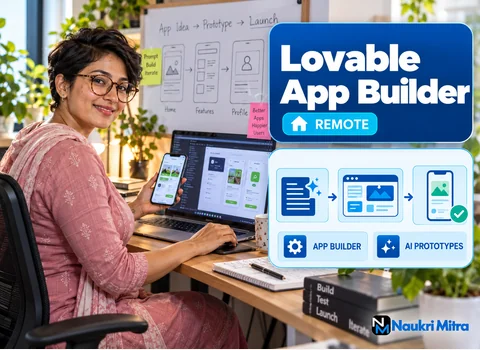
The demo looks finished. Lovable turned one paragraph of prompt into a dashboard with rounded cards, a login screen and a pricing page, and the founder is thrilled. Then they create an account, add three records, refresh the tab, and everything has vanished, because the login was decoration and the records lived in browser memory. Nothing was connected to a real database or real authentication. Closing that gap between a demo and a product is the whole job. Pay on these online lovable app builder jobs is $30 per hour (USD), and the arrangement is lovable app builder work from home on a part-time basis, with builders accepted from any country. In plain terms, the lovable app builder job description is this: take a startup idea, build the MVP through careful prompting, wire it to Supabase and GitHub, fix what the AI gets wrong, and ship it on the founder's domain.
Founders arrive with a vision that would take a funded team a year. Your first call is about cutting it down to the smallest version that proves something. Ask who the first ten users are, what single action they must complete, and what data has to survive a refresh. A hypothetical booking tool for yoga teachers might need only this on day one: teachers list classes and students book a slot.
Write that scope down in plain English and get a yes before building. It protects the budget and gives you a list to test against. Good English matters here, because most misunderstandings start in scoping, not in code.
The fastest way to wreck a Lovable project is one enormous prompt asking for auth, payments, an admin panel and email notifications at once. You will spend the afternoon working out which of its many changes broke the sidebar.
Good builders work in slices. Ask for the class list page and check it. Ask for the form and confirm it writes a row. When a request goes sideways, revert to the last good version rather than stacking a correction prompt on a broken base. Every message usually draws on someone's plan allowance, so sloppy prompting has a real price.
This is where the demo becomes a product. Lovable connects to Supabase, and you should understand what it creates there. That means:
One security rule is non-negotiable: never put secret keys in the front end. The public anon key is designed to be visible; service-role keys and third-party API secrets belong in server-side functions or environment settings. If an AI-generated file pastes a secret into client code, you catch it and move it before anything goes live.
Lovable can sync a project to a GitHub repository, and you should switch that on early. It gives the founder their code outside the tool and an exit route if they later hire a developer. Lovable's version history handles quick rollbacks; GitHub is the record that outlives a subscription. Basic comfort with commits, branches and reading a diff is part of the expected toolkit.
AI-generated code is confident and frequently wrong in small ways. A component imports something that does not exist. A query fetches every user's rows because a filter got dropped. A form submits twice.
You need enough React and JavaScript to read an error, find the file it points to, and describe the fix precisely, either in a targeted prompt or by editing the code yourself. Knowing when to stop prompting and just change three lines by hand is one of the most useful lovable app builder skills you can have.
Deploying means publishing the app and pointing the founder's domain at it, which involves DNS records at their registrar and a bit of patience while things propagate. Do not buy domains in your own name for a client.
Lovable runs on a credit or message-based plan, and custom domains typically depend on the tier. Agree at the start whose account the project lives in and who pays for the plan and for Supabase. Often the client owns and pays for both, which keeps the handover clean. Sometimes you build on your own and transfer later. Pricing tiers get revised, so look at Lovable's site on the day you quote.
Every project ends with a short written guide, a page or two rather than a manual. It should say where the code lives, how to log into Supabase, which tables hold what, how to add an admin user, how to redeploy, and which known rough edges are left. A clear handover often brings a client back for the next feature; a missing one tends to bring panicked emails.
Clients sometimes ask which tool to use, and a fair answer beats a fan's answer. Lovable is strong at polished React front ends with a fairly smooth Supabase connection and GitHub sync. Bolt gives you a browser-based development environment that feels closer to working in code, which suits builders who like to see and edit files directly. Base44 leans towards an all-in-one setup where hosting and data come bundled, which can mean fewer moving parts but less control over the backend. All three change quickly, so for client work ask who owns the code, how easily someone else can take it over, and what the plan will cost to keep running.
The route into this work is short but not effortless. A CS degree is not needed. Hands-on Lovable experience is, and links to live MVPs you built are expected. So build two or three small apps that persist data, use row-level security properly and sit on a real domain. Free tutorials, the tool's documentation and no-code or AI-building courses help with the basics, but no lovable app builder certification carries much weight with clients compared with a working link they can click.
Founders post this kind of gig on Upwork, Contra and Fiverr, among others, and startup communities and founder forums supply more leads. Your lovable app builder resume or profile should lead with live projects, a line on what each one does, and what you wired up behind it. Lovable app builder jobs for freshers do exist on these terms, but clients want proof, so an empty profile rarely wins work.
Freelance lovable app builder jobs can be steady or patchy depending on how you position yourself. A pretty front end is getting easier to generate, and founders can do that part alone. What stays valuable is the part this role is built around: data models, security policies, debugging and clean deployments. Builders who handle that and explain it clearly have a real service to sell.
The freelance realities still apply. Part time lovable app builder jobs come without guaranteed hours, project flow is uneven, and sample builds run on plans you fund yourself. Marketplaces revise their fees and rules, so reread them before relying on one. Treat the $30 per hour figure as this role's pay, not a promise about the wider market.
Send links to live MVPs, ideally with a test login, and a sentence on what you set up in Supabase for each. Describe one AI-introduced bug you tracked down; it is more convincing than a tool list. Expect lovable app builder interview questions like how you would structure tables for a given idea, how you write a row-level security policy, and what you would do if a client's key ended up in the front end.