What It Actually Means to Work on a Power Loom
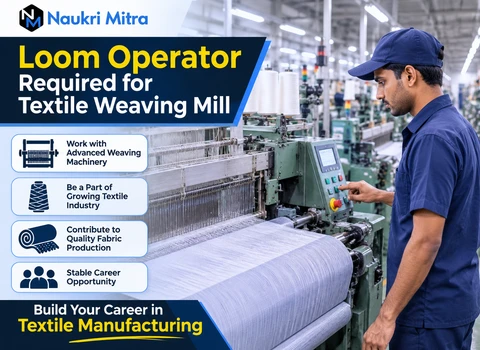
Walk into any weaving unit in Bhiwandi, and the first thing that hits you is the sound — rows of looms running at once, threads snapping through at speed, fabric building up inch by inch on the take-up roller. A Loom Operator in a textile weaving mill is the person standing in front of that machine, keeping it fed, watching it closely, and stepping in the moment something goes wrong. It's a full-time role, and one that rewards people who don't mind being on their feet and paying attention for hours at a stretch.
Why Mills Keep Hiring for This Role
Looms don't run themselves, not really. Yarn snaps. Tension drifts. A shuttle jams or a warp thread frays right in the middle of a run. Mills need someone physically present who can catch these problems within seconds, because a few minutes of downtime on a single machine adds up fast when you're running production targets across dozens of looms. That's the plain reason this job exists and keeps getting advertised across Maharashtra's textile belt.
How the Shift Usually Goes
Most operators start by checking the machine before it even moves — yarn tension, warp beam alignment, and whether the shuttle or rapier mechanism looks right. Once the loom is running, the actual work becomes less about starting things and more about noticing things:
- spotting a broken thread and tying it back in before it ruins the weave
- adjusting tension when the fabric starts looking uneven
- clearing lint and fluff that builds up around moving parts
- logging output at the intervals the mill asks for
Since production doesn't stop when the sun goes down, shift rotations are common, and night duty comes up regularly. Anyone taking this job should go in expecting that.
The Machines You'll Actually Touch
Depending on the mill, this could mean anything from older shuttle looms to newer rapier or airjet machines. Alongside the loom itself, operators use basic hand tools for small repairs, tension gauges to check yarn feed, and sometimes a simple measuring scale to verify fabric width matches spec.
Who Tends to Do Well in This Job
You don't need a stack of certificates for this trade. Plenty of mills hire people straight out of school and train them on the floor. That said, an ITI background in a textile or mechanical trade helps, and it's not unusual for such candidates to get preference. What actually separates a good operator from a struggling one comes down to a handful of practical things:
- fast hands when tying a broken thread
- an eye that catches a fabric defect before it spreads across the roll
- basic mechanical sense — knowing which part does what
- enough patience to handle a repetitive, hours-long shift without losing focus
The Floor Itself
This isn't a desk job by any stretch. Expect to be standing for most of your shift, sometimes moving between two or three looms if that's how the mill assigns work. The noise is constant, and cotton or yarn dust hangs in the air more than you'd think. It's a physically demanding environment, and new workers usually feel it in their legs and ears before anything else.
Staying Safe Around Moving Parts
Loose sleeves, dupattas, or anything that could catch on a moving component need to stay well clear of the machine. Ear protection is worth using in the noisier sections, a dust mask helps on long shifts, and closed shoes are non-negotiable — loose threads and stray bits of yarn on the floor make it easy to slip otherwise.
What Trips Up Newcomers
The repetition gets to people in the first few weeks — same motions, same sounds, hour after hour. Combine that with the noise and the standing, and it's genuinely tiring at first. Most operators say it stops feeling overwhelming once the body adjusts and the work becomes muscle memory rather than something you have to think through constantly.
Where This Can Lead
Stick with it long enough, produce consistent quality, and mills do notice. Operators who show reliability often get moved into shift-in-charge positions, overseeing a section of looms and newer workers instead of running just one machine. Gaining familiarity with any new machines the mill brings in also tends to open doors within the same unit over time.
Pay and What Might Come With It
This position, based in Bhiwandi, Maharashtra, India, is full-time and pays ₹28,800 a month. Some mills also offer extras — overtime pay, PF, ESI coverage, a festival bonus, uniforms, or a canteen — though none of these are guaranteed and vary from one employer to the next.
Should You Take This Up
If you're comfortable with shift work, don't mind noise and standing, and want a factory job with a real path to something more senior, working as a Loom Operator is a reasonable place to start. Freshers and ITI candidates, especially, tend to find it an accessible entry point into India's textile industry, with room to grow if you stay on the floor long enough to learn it properly.