
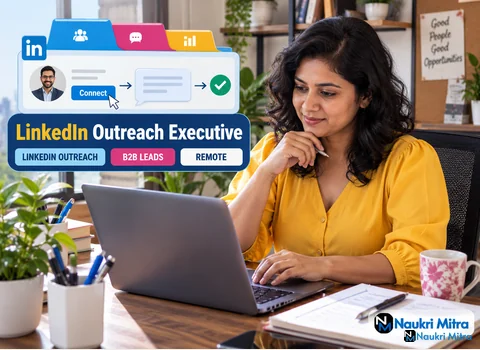
Before accepting a request from a stranger, a prospect may well tap the sender's name and glance at the profile. A blank headline or a pitch in the About section can end things there. So the first job in this role is unglamorous: keep a credible profile, then send a short, specific note that shows you read theirs. This listing is for online LinkedIn outreach executive jobs, part-time, paid at $12 per hour (USD), with no country left out.
A prospect has only a headline, a photo, a summary and some activity to judge you by. Before a campaign goes live, check the profile that will send the invitations, yours or one the employer asks you to manage. A clear photo, a headline that says who you help and an About section written for the reader make a request feel less like a cold knock.
Volume-focused outreach skips this step, and more requests from a weak profile tend to mean more ignored requests.
Research happens inside LinkedIn Sales Navigator, LinkedIn's paid prospecting tool. Its lead and account searches let you combine filters such as job title, seniority, function, company size, industry and geography to describe the buyer the sales team wants. A loose search gives you names who will never care. A tight one gives a shorter list of people who might. The keyword box also accepts simple Boolean terms such as AND, OR and NOT, which helps when a title is written several ways. Spot-check a few profiles from every search before saving it, because a filter that looks right on paper can still pull in students, recruiters or retired people.
You then save people worth contacting into lead lists and their companies into account lists. Saved lists keep work organised, show who has been contacted and are easy to share. Keeping them tidy, by removing people who changed roles and splitting lists by campaign, is steady background work.
The core daily work is sending connection requests and messages to LinkedIn prospects. A connection note has very little room, so every word has to earn its place. The best ones mention something real, such as a recent post, a shared group or a role change, and they never paste a pitch into the invitation.
After someone accepts, a short thank-you or a relevant question tends to land better than a calendar link in the first line. One polite follow-up after a sensible gap is fine; repeated nudging is not. The employer will usually supply templates and the offer, and you personalise them honestly for each person. Clear, short, professional English is the main writing skill here, and it is one of the core LinkedIn outreach executive skills recruiters look for on a resume.
You are not expected to close deals. When a prospect shows real interest, you hand them to the sales team with context: who they are, what they said and which campaign reached them. A warm lead passed on without notes can go cold again.
You will also track acceptance rates (how many invitations were accepted) and reply rates (how many accepted connections wrote back) in a tracker such as Excel, Google Sheets or the employer's CRM. Low acceptance usually points to targeting, the profile or the note. Low replies after acceptance usually point to the follow-up or the offer. Reporting both honestly is part of the job description.
This listing asks you to be comfortable with automation tools like Expandi. Expandi, HeyReach and Dripify are all used to schedule connection requests and follow-up messages as sequences, so a campaign runs steps over time instead of you clicking each one by hand. HeyReach is built around managing several sender accounts from one place, and Dripify around drip-style campaigns. In this listing, Expandi is the tool named.
LinkedIn's User Agreement restricts automated activity and scraping on the platform, including the use of third-party software that automates actions or pulls data from profiles. So automation here is not a way to send as much as possible. Sequences should run carefully, within LinkedIn's rules and limits, and only as the employer directs. If a setting feels aggressive, raise it before launching.
LinkedIn limits how many invitations an account can send and can change those limits or apply them differently by account. Figures repeated online are not promises, and this listing sets none. A pattern of ignored or declined requests can also lead LinkedIn to restrict an account.
No one can promise that an account used for outreach is safe, and no tool can make it so. You can lower the risk: keep targeting tight, write notes that do not read like spam, pace sequences gently, withdraw old pending invitations and pause a campaign if warnings appear. Patience protects an account better than any clever setting.
A cold email outreach executive writes to an address, and the message stands on its own. On LinkedIn, the prospect sees your face, your history and your mutual connections before reading a single line. The rules come from LinkedIn's own agreement and limits, and relationships build more slowly, through accepted invitations, comments and short exchanges.
People often wonder whether this work is legitimate and sustainable. It can be, when it is done the way described here: real people, honest notes, modest pacing and automation used within LinkedIn's rules. It becomes shaky as a numbers game, because spammy campaigns tend to damage both the account and the brand.
No degree is required. Six months or more of LinkedIn prospecting or sales support is preferred, not mandatory. You should know Sales Navigator well, be comfortable with tools like Expandi and write short, professional English.
To get a LinkedIn outreach job without experience, treat your own profile as a portfolio piece, practise sample searches, draft connection notes for imaginary campaigns and track your own networking acceptance rates. Sales support work, such as updating a CRM, also counts.
For learning Sales Navigator, LinkedIn's own help centre explains Sales Navigator searches, filters and lists, and LinkedIn Learning carries courses on Sales Navigator and social selling. Some of these lead to certificates of completion you can add to your profile. No certification appears among this listing's requirements, and a well-run sample search often tells an employer more.
Every hour worked earns $12 per hour (USD). The seat is part-time and fully remote, with no fixed location. Purely to illustrate, before tax: a 9-hour week at that rate adds up to $108, though the hours themselves are whatever the employer offers. Per-lead payments, incentives and commissions are absent from this listing, so budget on the hourly figure alone. Agencies and in-house sales teams both hire for this kind of seat.
Bring a laptop and stable internet. Everything runs in a browser tab, so connection quality counts for more than processor speed.
An honest outreach employer will not ask for a registration fee, push a training kit on you or make you fund your own Sales Navigator seat before day one. Watch for a trick seen in this field: a recruiter asking you to buy or rent aged LinkedIn accounts, or pay for "account warm-up". Renting or sharing accounts also breaks LinkedIn's rules. If a payment request arrives before any written offer, walk away and keep your details to yourself.