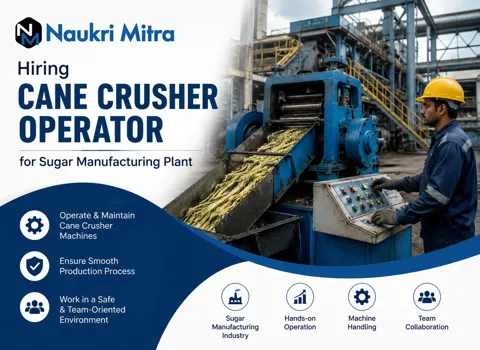
What Happens at the Crushing Stage of a Sugar Mill
Before sugarcane becomes the sugar sitting in your kitchen, it has to go through crushing — the stage where juice gets squeezed out of the raw cane. A sugar plant in Muzaffarnagar, Uttar Pradesh, is hiring for exactly this role: Cane Crusher Operator, full-time, paying ₹32,600 a month. If you've never looked closely at how a sugar mill runs, this is a good place to start, because crushing is where the whole production line begins.
So what does a crusher operator actually do all day?
Trucks and tractors keep arriving through the day loaded with harvested cane. Someone has to get that cane onto the feeding line, keep it moving at the right pace, and run the mill that presses juice out of it. That someone is the crusher operator. It's not a desk job by any stretch — you're on your feet, watching the machine, adjusting as things change.
Why this role matters more than it looks
A crusher that's fed unevenly or run too fast loses juice yield. Run it too slow and the whole plant backs up behind you. That's the real reason mills care about who they put on this machine — a careless operator can quietly cost the plant money every single shift, while a sharp one keeps things flowing without anyone noticing.
Walking through a typical shift
Before the mill even starts, there's a check — rollers, conveyor belts, hydraulic lines, all of it. Once cane starts coming in, the operator handles the feeding table and keeps an eye on juice extraction as it happens. If something feels off — an odd vibration, a slowdown, cane piling up where it shouldn't — that gets flagged to maintenance right away instead of waiting.
What the job includes day to day
- Running the crushing mill and keeping it steady through production hours
- Feeding cane evenly so the line doesn't jam
- Watching roller pressure and juice output
- Basic lubrication and cleaning between batches
- Staying in touch with the boiler house and clarification section downstream
- Logging crushing volumes and machine readings each shift
The equipment you'll be working around
Multi-roller crushing mills sit at its center, backed by hydraulic loading systems and conveyors that carry cane in. Before crushing even begins, cutters and shredders prepare the raw cane. Day-to-day, operators also handle pressure gauges, flow meters, and hand tools for small adjustments. Knowing your way around the control panel that sets mill speed is genuinely useful here, not just a nice-to-have.
Who tends to get hired for this
Most mills look for an ITI background in mechanical or electrical trades. That said, plenty of experienced hands without a formal certificate get considered too, especially if they've already worked around milling machinery. A Diploma in Mechanical Engineering helps with understanding hydraulics and roller mechanics more quickly, but it's not the only path in. What matters just as much is being able to think on your feet, stay physically fit for long shifts, and not mind working in a hot, loud environment.
The environment you'd be stepping into
This is full-time work, and shifts are common since crushing operations tend to run around the clock during the season. Expect heat, humidity, noise, and cane dust in the air. You'll be standing for long stretches and lifting moderate loads, so a reasonable level of physical fitness helps more than people expect going in.
Staying safe around the mill
Rotating rollers and heavy machinery mean safety isn't optional here. Safety shoes, gloves, ear protection, and a helmet are the basics workers are expected to wear. Lockout procedures before any maintenance work, and simply staying clear of moving parts during operation, are habits that need to become automatic rather than something you remember only after a close call.
What trips up new operators
Getting the feed speed right takes longer to learn than most people expect — too fast and the mill jams, too slow and output drops. During peak crushing months, hours can stretch longer than usual, which catches some newcomers off guard. None of this is unusual for the job; it just takes a season or two before it starts feeling routine.
Where this can lead over time
Operators who stick with it often move up to shift-in-charge or mill house supervisor roles as they gain experience. Some shift toward maintenance-focused work instead, supporting the crushing section from a technical side rather than running the machine directly. What tends to open these doors is consistency — showing up, staying safe, and actually understanding how the section runs beyond just your own station.
What the pay looks like
For this specific opening in Muzaffarnagar, Uttar Pradesh, India, the salary is ₹32,600 per month, on a full-time basis.
Other things that sometimes come with the job
Depending on the employer, workers in roles like this may also get overtime during peak season, PF and ESI coverage, bonuses, uniforms, or canteen and transport facilities. None of these are guaranteed — they vary from one plant to another, so it's worth confirming directly with the employer.