
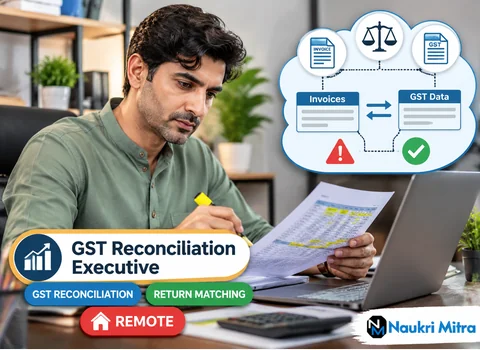
Case file: a packaging supplier. One invoice for corrugated boxes from a packaging supplier sits in our client's purchase register, tax charged, credit pencilled into the draft. The GSTR-2B for that period has no trace of it. Did the vendor forget to upload? Did they report it against the wrong GSTIN? Is the bill even genuine? That single missing line is the whole job in miniature, and it is the reason remote GST reconciliation executive jobs exist at all.
This posting is for a Full-time executive who will chase cases like that one every month. It pays $450 per month (USD), with remote work possible from any country. You will compare what the client's books say they bought with what suppliers have reported, and explain every gap before the return goes in. If your search for GST reconciliation executive jobs remote worldwide turned up mostly filing roles, this one is different.
Your real job is to protect input tax credit. A business can generally claim credit only for tax its suppliers have reported, so the purchase register and GSTR-2B need to agree. When they don't, you find out why.
The plain GST reconciliation executive job description: download GSTR-2B from the GSTN portal, match it against purchase registers in ClearTax or Excel, identify missing, mismatched and ineligible ITC, follow up with vendors on corrections, and prepare monthly reconciliation reports before return filing. In practice each unmatched line is a case. Some close quickly. Others need several emails and a phone call.
This is the packaging supplier problem from the opening. The client holds a bill and wants the credit, but the supplier's filing hasn't reached 2B. The usual suspects: the vendor filed late and the invoice will appear in a later period; the vendor typed the wrong GSTIN; the vendor reported the sale as a consumer sale; or the vendor never filed at all.
Your task is to sort these into buckets. A timing difference gets tracked and carried forward. A wrong GSTIN or misclassified sale needs the vendor to amend their filing. A non-filer goes on a risk list for the client's finance team, because credit on that invoice may have to wait until the supplier fixes things. The reviewing manager gets a clean list with evidence attached.
The reverse case is quieter but just as interesting. A supplier has reported a sale to the client, yet nobody has booked the purchase. Maybe the bill is sitting in someone's drawer, or belongs to another branch, or the supplier billed the wrong customer entirely.
You check with the accounts team, request the invoice copy, and get it booked or corrected. Every line ends with a status, not a shrug.
The invoice appears in both places, but the taxable value differs slightly, the invoice number carries an extra slash, the date is a day off, or IGST was charged where CGST and SGST should have been. Good work separates genuine ITC mismatch issues from formatting noise. Fuzzy matching clears much of the noise; a wrong tax head usually needs a credit note or amendment from the vendor.
Some credit fails not because of a mismatch but because the law blocks it. Certain kinds of spending are restricted, credit on some supplies depends on how the goods or services are used, and there are time limits for claiming. You will be expected to recognise these lines and tag them in the report so they stay out of the claim.
The categories and limits get amended, so check the current law and official notifications on the GST portal, and confirm with the reviewing manager whenever a line is borderline.
Here reconciliation stops being a spreadsheet exercise. You will write to suppliers' accounts teams explaining exactly which invoice is missing or wrong and what correction is needed. Specific emails get answers: invoice number, date, amount, the client's GSTIN and the fix requested.
Keep a dated follow-up log so no vendor is chased twice in a day or forgotten for a month. Some vendors reply the same day; others need reminders across several cycles.
The work follows the GST calendar, so each month has a rhythm. Dates get revised, so the team works from the current due-date calendar on the GST portal. A typical cycle runs like this:
Expect to use all four. The GSTN portal is where 2B comes from and where you check a vendor's filing status. Tally holds many clients' purchase entries. ClearTax handles bulk matching, and Excel is the fallback and audit trail.
The core GST reconciliation executive skills on the spreadsheet side are VLOOKUP or XLOOKUP, pivot tables, conditional formatting and a few text functions for cleaning invoice numbers.
The requirement: a B.Com or M.Com plus six months to two years of GST experience. A GST certification course is a plus. You also need strong knowledge of GSTR-2B, ITC rules and purchase registers, hands-on ClearTax, Tally and Excel skills, and a laptop with stable internet for portal work.
Why does a course help? A good GST reconciliation executive course gives you structured practice on 2B downloads, matching and ITC eligibility, which is exactly what interviews test. Pick one with hands-on portal and Tally exercises, and check its current syllabus. A GST reconciliation executive certification won't replace experience, but it shows intent.
Be straight with yourself: this posting asks for six months to two years of GST experience. If you have none yet, the usual route is a trainee or assistant seat at a CA firm or in a company accounts team, where you post purchase entries and watch reconciliation being done. Meanwhile, practise on sample data and build a matching workbook you can show. Many entry level remote GST reconciliation executive jobs come from CA firms that handle GST for several clients and need extra hands each month, so that background carries over well.
On your GST reconciliation executive resume, name the tools you used, describe the kind of clients you handled, and give one concrete mismatch you resolved. Likely GST reconciliation executive interview questions include how you would treat an invoice present in the books but absent from 2B, and how you would spot a wrong tax head.
A return filing executive prepares and submits the return: outward supplies, tax payable, credit claimed, payment. A reconciliation executive works one step earlier and decides, with evidence, what credit is safe to claim. At smaller firms one person may do both. Filing rewards accuracy against a deadline. Reconciliation rewards curiosity about why two numbers disagree.
The GST reconciliation executive salary per month on this posting: $450 per month (USD), on a Full-time remote basis. Other employers set different rates, but this is the one on offer.
Because the work happens on portals and shared files, it suits people looking for GST reconciliation executive work from home jobs. You need a dependable connection and availability during the busy stretch of each cycle. Among remote GST reconciliation executive jobs hiring now, this one is for people who like tracing why two numbers disagree. Apply with your resume and a short note on your GST experience.