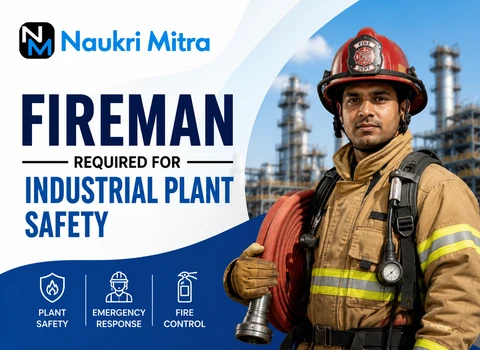
Standing Watch Over a Working Plant
Ask most people what a fireman does, and they'll picture someone rushing into a burning house. Inside an industrial complex, the job looks a little different. A plant fireman spends most of the shift preventing fires from starting in the first place, not just fighting them once they've broken out. The position being offered here, Fireman Required for Industrial Plant Safety, is a Full-time opening in Jamnagar, Gujarat, and it is central to a facility's day-to-day safety routine.
How the Role Differs from Regular Firefighting
A municipal firefighter reacts to whatever call comes in - a house, a vehicle, a roadside accident. A plant fireman works at one location and knows every corner of it: where the flammable stock is kept, which valves occasionally leak, and where the electrical load runs hottest. That familiarity is what makes the job effective. You're not walking into an unknown building; you're watching over ground you cover every single day.
What a Shift Usually Looks Like
Rounds come first - walking the site to look at extinguisher pressure gauges, hydrant valves, hose reel condition, and whether exit paths are actually clear or blocked by stacked material. Logs get updated after each check. If a contractor is doing hot work, such as welding or cutting, that day, a fireman is often posted nearby with a standby extinguisher, watching until the job is finished and the area has cooled down.
Why Plants Keep This Position Filled
Units handling fuel, gas lines, solvents, or heavy electrical equipment can't treat fire risk as an occasional concern. Indian safety regulations require industries conducting such operations to keep trained fire personnel on-site rather than relying solely on external emergency services, since response time matters when flammable material is involved. That's why petrochemical units, power plants, and large engineering workshops keep dedicated firemen on their books instead of leaving it to the general staff.
Where the Work Actually Happens
Expect to move between production floors, tank farms, storage yards, and workshop sheds within the plant boundary. Some of it is under a roof; a good part is outdoors, in heat, near machinery noise, sometimes with the smell of fuel or chemicals nearby. Plants don't stop running at night, so this job comes with shift rotations - day, evening, and night duty are all part of the schedule.
Equipment You'll Get to Know Well
The gear isn't complicated once you've handled it a few times, but knowing when to reach for what matters:
- CO2, DCP, and foam-type extinguishers, each suited to different fire classes
- Hydrant systems and hose reels laid out across the site
- Breathing apparatus for entering smoke-filled or oxygen-poor areas
- Fire alarm panels and smoke detection points
- Fire-resistant suits and helmets for close-range response
Picking foam over water on a fuel fire, for instance, isn't optional knowledge - it's the difference between putting a fire out and spreading it.
What Employers Look For
Fitness matters, but so does temperament - staying level-headed when an alarm goes off is harder than it sounds until you've actually done it. Candidates who've completed an ITI course or have some background in industrial safety tend to settle into plant routines faster, since they already understand basic hazard classification and equipment handling. That said, many units also bring in freshers who are physically fit and willing to go through on-the-job training.
The Physical Side of the Job
This isn't a desk job. There's climbing, carrying hose lines, moving fast when a drill or a real call comes in. Full protective gear adds noticeable weight, so stamina and general fitness aren't just preferred - they're necessary to do the job safely, day after day.
Staying Ahead of Fire Risk
Mock drills happen on a set schedule, not just when someone remembers to run one. Equipment logs get checked regularly, and during shutdowns or major maintenance windows - when fire risk tends to climb - firemen coordinate closely with plant supervisors. None of this works if procedures get treated as optional; the whole point is consistency, not improvisation.
Gear Issued on the Job
Depending on the employer, staff are typically provided with uniforms, safety shoes, helmets, gloves, and fire-resistant clothing designed for high-heat conditions. Wearing the full kit isn't just for actual emergencies - it applies to routine inspections too.
What Makes the Job Hard
Working around gas cylinders, chemical drums, and live electrical panels means the risk never fully disappears. Add long shifts and the mental alertness needed for sudden emergencies, and it's clear this work asks a lot. Most people who do well in this field say the same thing: experience builds confidence, and sticking to training rather than cutting corners is what keeps things manageable.
Where Experience Can Take You
Time on the job opens doors to senior fire watch positions, shift-in-charge roles, or fire safety supervisory duties within the same plant. Picking up additional certifications - in fire safety management or hydrant system upkeep, for example - tends to speed that progression along.
Pay for This Position
This Full-time role in Jamnagar, Gujarat, India, comes with a monthly salary of ₹28,000. Actual take-home pay can vary slightly depending on how an employer structures allowances.
Other Benefits That May Apply
Some employers in this sector offer overtime pay, PF, ESI, an annual bonus, uniforms, or transport and canteen facilities. None of these are guaranteed across every company, so it's worth confirming directly with the employer once you're in the hiring process.