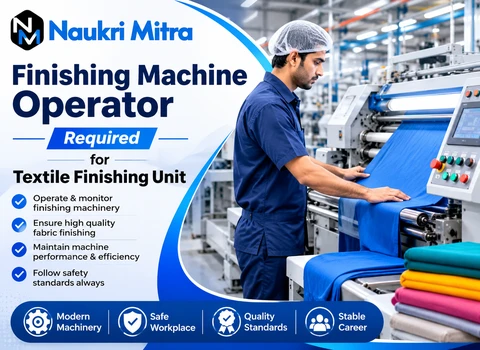
What a Finishing Machine Operator Actually Does
Nobody thinks about fabric finishing until they touch a shirt and notice how smooth it feels. That smoothness, the even width, the shrinkage that's already been accounted for - all of it happens at the finishing stage, run by an operator who spends the day next to a machine most people have never heard of. A textile finishing unit in Ludhiana, Punjab, India, is hiring for this exact role right now. It's Full-time, pays ₹28,500 a month, and honestly, it's a decent entry point whether you're fresh out of an ITI course, holding a diploma, or already have a few years on some other machine.
Why This Position Keeps Getting Filled
Raw fabric off a loom or knitting machine is nowhere near sale-ready. It's stiff in places, the width shifts, and there's often a crease pattern that won't come out on its own. Stenters, calendars, compactors - these machines sort that out, but they need a person who knows what they're doing. Get the temperature wrong or feed a roll at the wrong tension and you can ruin a whole batch, not just a few meters. That's the actual reason units keep this position staffed rather than automated end-to-end.
How a Shift Tends to Play Out
The start of the shift usually means checking the rollers, confirming steam pressure, and setting the machine to whatever the batch card says. After that, it's mostly watching. Speed, tension, whether the cloth is coming through clean or picking up marks. Every so often the operator pulls out a GSM cutter or a width scale just to confirm the output actually matches what the order sheet wants. It's not glamorous work, but it does need attention the whole time - you can't really zone out for twenty minutes and expect nothing to go wrong.
The Actual Responsibilities
- Running the machine and adjusting settings for whatever fabric is loaded
- Feeding rolls without folds or misalignment
- Watching temperature, speed, and chemical dosing where it applies
- Logging batch numbers and telling the supervisor when something's off
- Basic cleaning and upkeep between runs
Where Jobs Like This Usually Sit
Dyeing houses, processing units, integrated textile mills - that's roughly where you'll find this kind of work. Ludhiana has a good number of them given its reputation in hosiery and textile manufacturing across Punjab. It's not office work by any stretch. There's steam overhead, fabric moving constantly, and the floor stays busy for most of a shift.
Equipment Worth Knowing Before You Start
You might end up on a stenter, a calendar machine, a compactor, or a raising machine, depending on the unit. Beyond the main equipment, there's usually a GSM cutter around, a tension gauge, maybe a shrinkage testing kit. Knowing how heat and pressure change fabric by having actually watched it happen matters more than knowing it from a textbook. That's the difference between someone who fixes a problem in thirty seconds and someone who's still figuring out what went wrong.
What Actually Gets Someone Hired
Technical know-how helps, sure, but a lot of this comes down to habits picked up on the floor. Can you spot a defect just by looking at fabric moving past you at speed? Do you stay sharp three hours into a run that's basically the same thing over and over? Units tend to prefer ITI holders in a relevant trade or Diploma candidates in Textile or Mechanical fields, mostly because they pick up machine handling faster. That said, plenty of experienced hands without formal papers do just fine here too.
Physical Demands and Shift Timing
You're on your feet a lot. Lifting rolls, standing close to running machinery, moving around the same station for hours. Since it's Full-time, standard factory shift hours apply, and some units rotate shifts if production picks up.
Safety Around This Kind of Machinery
There's heat, moving rollers, sometimes chemical exposure - none of it forgiving if you're careless. Gloves, safety shoes, aprons, all standard. Loose clothing near rollers is a real hazard, not a theoretical one. Lock-out steps before any maintenance work matter, and if a machine starts making a sound it shouldn't, that gets reported, not ignored.
Where New Operators Usually Struggle
Tension judgment takes time - almost nobody gets it right in week one. The heat and constant machine noise take some getting used to as well. Give it a few weeks under supervision, and most of this will settle down on its own.
Growing Within This Line of Work
Operators who stay put and do the job well tend to move toward handling bigger finishing machines, taking on quality checks, or eventually stepping into a shift supervisor role at the same unit. The experience also carries over reasonably well to other finishing units across Punjab if someone decides to move on later.
Pay and What Might Come With It
The role pays ₹28,500 a month, Full-time, in Ludhiana, Punjab, India. Some units throw in overtime pay, PF, ESI, bonuses, uniforms, transport, or canteen access on top of the base pay - though that varies a lot from place to place, so it's better to ask directly than assume.
For someone who wants steady, skill-based factory work, this is a reasonable way into Punjab's textile industry, with room to grow if you stick around.