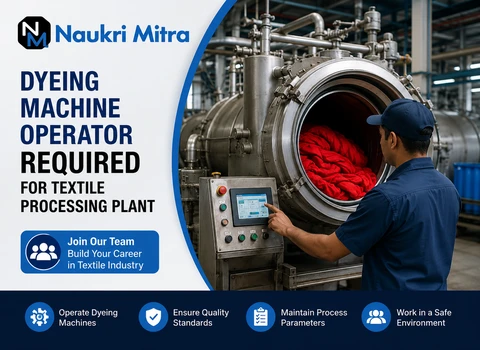
What Does a Dyeing Machine Operator Actually Do?
Walk into any textile processing unit, and you'll notice the dyeing section long before you reach it — the smell of chemicals, the hiss of steam, rows of drums turning fabric through coloured liquid. The person running that machine is the Dyeing Machine Operator. Their job is straightforward to describe but not always easy to do well: take grey or undyed fabric and turn it into the exact color a buyer or brand has asked for, batch after batch, without wasting material or missing the shade.
It's a hands-on production role, not a desk job, and it works well for people who like machinery, don't mind heat and chemicals, and can stay focused even when a shift stretches long.
Why Erode's Textile Units Keep Hiring for This Role
Erode has been a textile processing hub for decades, and dyeing units here run almost continuously to keep up with orders from spinning mills, garment exporters and local weaving clusters. A single wrong reading on the machine — wrong temperature, wrong time, wrong chemical quantity — can ruin an entire lot of fabric. That's expensive. So plants would rather hire and train someone properly than risk repeated losses, which is exactly why this Full-time role in Erode, Tamil Nadu, India keeps appearing on hiring boards.
A Rough Sketch of the Working Day
No two batches behave the same way, but the broad rhythm of the day looks similar. The operator starts by checking the machine — valves, temperature settings, whether the previous batch left any residue. Fabric or yarn goes in, the dye recipe gets prepared according to what's written on the batch card, and the cycle begins.
Once it's running, most of the job is watching. Temperature climbing too fast? Slow it down. Pressure reading looks off? Check the line. When the cycle finishes, the material comes out, gets checked against a shade card, and either moves forward to washing and drying or goes back for correction if the color isn't right.
What the Job Actually Involves, Day to Day
- Loading and unloading fabric or yarn from the dyeing machine
- Weighing and mixing dyes, salts and chemicals as per the batch recipe
- Watching temperature, time and liquor ratio through the cycle
- Comparing finished shade against approved samples
- Filling batch logs — what went in, what came out, any deviation
- Cleaning the machine and reporting anything that needs repair
The Machines and Instruments You'll Work Around
Depending on which unit you land in, the machine itself could be a jet dyeing machine, a jigger, a package dyeing unit, or a winch. Each handles fabric a little differently, but the operating logic is similar — controlled heat, controlled chemical dosing, controlled time. Beyond the main machine, you'll be using dosing pumps, steam valves, pH meters, weighing scales, and shade-comparison charts fairly often. Knowing why the machine does what it does — not just which button to press — is what separates someone who can run a shift confidently from someone who's still guessing.
Skills That Actually Matter on the Floor
Plenty of people can memorize button sequences. Fewer can catch a problem before it wrecks a batch. That difference comes down to a mix of technical grounding and shop-floor instinct.
On the technical side
- Understanding of the dyeing process and how different chemicals behave
- Comfort reading machine panels, gauges and process sheets
- Basic knowledge of fabric types and how each one takes color
On the practical side
- Careful, consistent measuring — a small error compounds fast
- Staying calm and quick when an alarm goes off mid-cycle
- Working smoothly with helpers, checkers and the shift supervisor
Do You Need a Diploma, or Just Experience?
Both paths exist. Many units are happy to hire someone with an ITI certificate in a relevant trade, and a Diploma in Textile Technology tends to open doors faster if you're aiming for supervisory roles later. But plenty of operators on the floor today learned on the job, starting as helpers and picking up the machine over months. Employers generally care less about the certificate on paper and more about whether you can actually read a batch card and run the cycle without supervision.
It's Physical Work — Be Ready for That
You'll be on your feet for most of the shift, lifting fabric rolls, carrying chemical containers, and standing near machines that emit heat and steam. It's not desk-level comfortable. Most textile plants run rotational shifts to keep production going around the clock, so this Full-time position will likely mean night shifts every so often, not just a fixed nine-to-five.
Inside the Dyeing Section: What the Environment Feels Like
Expect humidity, warmth, and background machine noise for most of the shift. Chemical handling is a regular part of the work, so plants generally require gloves, an apron, gumboots, and safety goggles when you're near dye baths or steam lines. Skipping PPE because "it's just a quick check" is how minor accidents happen — most experienced operators will tell you that the habit of gearing up every time, without exception, is what keeps a long career injury-free.
Where Things Go Wrong
Shade mismatches are probably the most common headache — a batch that comes out slightly darker or lighter than the approved sample, and now it needs correction or, worse, gets rejected. Machine breakdowns mid-cycle are another. Operators who log details carefully and flag problems to their supervisor early tend to lose far less time chasing these issues than those who wait and hope they sort themselves out.
Where This Role Can Lead
Stay with it a few years, and the path forward is fairly visible — senior operator, then shift in-charge, and eventually dyeing supervisor with responsibility for quality and production planning across shifts. Operators who take the trouble to learn new dyeing techniques or newer machine types tend to move up the ladder faster than those who stick to one process for years without expanding their knowledge.
What the Pay Looks Like
For this Dyeing Machine Operator position in Erode, Tamil Nadu, India, the salary is ₹28,000 a month. Beyond the fixed pay, some units also offer overtime, PF, ESI, bonus, uniforms, or transport and canteen facilities — though this depends entirely on the employer and shouldn't be assumed. If you're looking for steady, skill-based factory work with room to grow through experience rather than just a degree, this is a reasonably solid place to start.