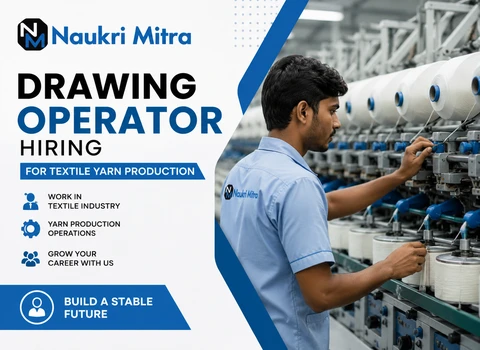
What a Drawing Operator Actually Does in a Yarn Mill
Walk into the drawing section of any spinning mill, and you'll notice something odd: it's one of the quietest-looking departments, yet almost everything downstream depends on it. Loose, wavy strands of fiber come in from carding. What leaves the drawing frame has to be straighter, more even, and ready to hold together under tension. That's the job. A Drawing Operator runs and adjusts the drawing frames that do this work, and right now, this Full-time position is open in Ichalkaranji, Maharashtra — a city where textile and powerloom activity has shaped the local job market for decades.
Why Mills Won't Skip This Stage
Here's the thing about yarn quality — it's mostly decided before spinning even starts. Feed the spinning machine an uneven sliver, thick in one stretch and thin in another, and you get frequent breakages or yarn that varies in strength batch to batch. That's expensive. So mills rely on operators who can read the drafting rollers, catch irregularities early, and maintain steady fiber alignment. Skip this step or do it poorly, and everything that follows slows down, waste increases, and fabric quality suffers.
A Shift on the Floor
Most shifts start the same way — checking the frame before it's switched on, making sure cans are positioned correctly, confirming sliver ends are pieced properly. After that, it's a matter of staying alert. Breakages happen. So does uneven doubling and roller slippage, and each needs a quick fix before it turns into a stoppage.
Through the shift, the work usually includes:
- Loading and swapping sliver cans as they empty
- Watching the drafting rollers for uneven fiber distribution
- Piecing broken slivers fast, before it costs output
- Noting production counts and any stoppages
- Flagging odd noise, vibration, or heat from the machine
Beyond Just Running the Machine
There's cleanup too — clearing fiber fly and waste around the frame is part of the job, not an afterthought. Operators often help supervisors during doffing or can changes. Many mills also want a rough shift log of output, mainly so supervisors can spot efficiency declines before they become bigger problems.
Where This Kind of Work Is Found
Spinning mills, composite textile units, yarn manufacturing plants — that's where drawing operators end up. Around Ichalkaranji in Maharashtra specifically, a good number of these units supply yarn straight to nearby weaving and powerloom clusters, so the role fits naturally into the region's textile economy. As for the floor itself: expect rows of drawing frames, a steady hum of machinery, and fiber dust in the air. It's a normal part of working in a spinning section, not something unusual to this one plant.
The Equipment You'll Be Working With
The drawing frame is the star of the show — a series of rollers spinning at different speeds, drafting and aligning the fiber as it passes through. Around it, operators handle sliver cans, can trolleys, and occasionally basic measuring tools for checking sliver weight per unit length (mill workers usually just call this hank or count checking). Some plants have moved to auto-leveler drawing frames, which automatically adjust the draft based on sliver thickness — reducing manual correction, though the operator still has to watch for anything the machine misses.
What Makes Someone Good at This Job
You need the technical basics down — drafting principles, roller settings, how sliver piecing actually works. But honestly, the practical side matters just as much: fast hands for fixing breaks, an ear for when something in the machine sounds off, and enough patience to stay sharp through repetitive stretches of the shift. Terms like draft ratio, doubling, and sliver count come up often enough that it helps to know them before day one.
An ITI in textile technology or a mechanical trade background tends to make machine settings click faster for freshers. Diploma holders in textile engineering are often considered too, particularly for auto-leveler frames or quality-check duties. And workers who've already spent time around carding and drawing processes usually get first pick when it comes to handling trickier machine adjustments.
The Physical Side of the Job
Long hours on your feet, plenty of walking along the frame, repetitive piecing motions — this isn't a desk job by any measure. Shift work is standard in textile units too, so be ready for rotational shifts, including night duty, depending on how the plant schedules its floor.
Staying Safe Around the Machine
Drawing frames have moving rollers and rotating parts, so safety isn't optional. Most workers wear ear protection against machine noise, cotton dust masks to reduce fiber inhalation, and safety shoes in case cans or equipment fall. Loose clothing and anything dangling — scarves, loose sleeves — stays away from the rollers, for obvious reasons.
What Trips Up New Operators
Speed is usually the first hurdle. Piecing under time pressure takes practice, and delays there ripple through the whole shift's output. Beyond that, fiber dust builds up over long shifts, and the repetitive movement can strain hands and shoulders over time — both fairly common complaints among people who've worked this floor a while.
Getting Better at the Job, Faster
Catching machine faults early, keeping the work area tidy, and building real speed at piecing — these separate operators who move up from those who stay stuck at entry level. Watching senior operators work and asking about their roller settings tends to teach more in a week than working alone teaches in a month.
Where This Role Can Lead
Put in the time, and a Drawing Operator can move toward senior operator roles, shift-in-charge positions, or quality-checking work within the spinning department. Enough exposure to machine settings and production planning can eventually open the door to supervisory responsibilities on the same production line.
Pay and What Else Might Come With It
The role pays ₹29,800 a month, Full-time, based in Ichalkaranji, Maharashtra, India. Some employers also offer overtime pay, Provident Fund (PF), ESI coverage, a festival bonus, uniforms, and, in some cases, transport or canteen facilities — though these depend entirely on the individual unit and shouldn't be assumed to be guaranteed.