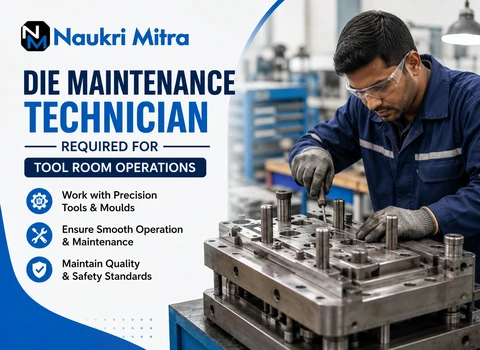
What this tool room job really involves
A
Die Maintenance Technician Required for Tool Room Operations is the person who keeps production dies in working condition so manufacturing can continue without avoidable stoppages. In simple terms, this job is about inspecting, repairing, fitting, adjusting, and maintaining dies used in press shops and tool rooms. It is a
Full-time role based in
Faridabad, Haryana, India, and it suits people who are comfortable with hands-on mechanical work, precision measurement, and problem-solving on the shop floor.
This is not just a machine-running job. A machine operator primarily operates production equipment, while a die maintenance technician spends more time inspecting tooling, identifying faults, and restoring accuracy. The work needs patience, steady hands, and a good understanding of how metal parts behave under pressure.
For freshers, ITI candidates, diploma holders, and experienced technical workers, this role can be a practical entry into manufacturing. It is especially useful for people who want a career in tool room operations, press tooling, and industrial maintenance.
Why factories depend on die maintenance
In many manufacturing units, dies are used repeatedly to cut, punch, bend, form, trim, or draw metal parts. These tools work under heavy load, so wear is normal. A punch may become blunt, a guide pin may loosen, a spring may fail, or the die may lose alignment. When that happens, the finished parts may show burrs, wrong dimensions, cracks, or uneven shapes.
Factories recruit maintenance technicians because even a small tooling issue can slow down the whole line. A damaged die can stop production, waste material, and affect delivery schedules. Good maintenance helps the plant remain productive and maintain stable quality.
Companies usually expect this kind of support because it helps them:
- reduce machine downtime
- improve part accuracy
- extend the life of expensive tooling
- support preventive maintenance
- avoid repeated production defects
- keep press operations safe and steady
In industries where large numbers of identical parts are made every day, a skilled tool room technician becomes a very important part of the team.
A normal shift in the tool room
The daily work of a technician varies depending on the die's condition and the production plan. Some days are calm and focused on inspection. Other days become busy when a press tool fails, and production needs to restart quickly.
A typical shift may include:
- checking dies before they go back to production
- opening die assemblies for cleaning and inspection
- replacing worn punches, bushes, springs, inserts, or guide pins
- checking alignment and fit before reassembly
- doing minor grinding, polishing, filing, or fitting work
- reading engineering drawings before repair
- measuring critical dimensions with precision instruments
- supporting die changeovers with the production team
- observing trial runs after maintenance
- noting down repair work and part replacement details
A practical example is easy to understand. If a stamped metal part comes out with rough edges or off-center holes, the technician may inspect the die to find whether the punch is worn, the guide system is loose, or the alignment has shifted. That kind of fault-finding is a big part of the job.
Dies, presses, and the equipment used to keep them running
A die is a special tool used in a press machine to shape metal with accuracy and speed. Industries use dies because they can produce thousands of identical parts with consistent size and finish. That is why press tooling is so common in Indian manufacturing.
Technicians may work with different types of dies, such as:
- blanking dies
- piercing dies
- progressive dies
- compound dies
- forming dies
- bending dies
- trimming dies
- draw dies
These tools are usually fitted in power presses or hydraulic presses. The press applies force, and the die performs the actual cutting or shaping action. If the die is not properly maintained, the press may still run, but output quality can drop quickly.
Common machines and measuring tools
Tool room work often involves both machining and inspection. Common equipment includes:
- surface grinders
- tool and cutter grinders
- milling machines
- lathe machines
- bench grinders
- drill machines
- EDM (Electrical Discharge Machining) machines
- hydraulic presses
- arbor presses
- polishing equipment
Precision measuring instruments are used every day, such as:
- vernier calipers
- micrometers
- height gauges
- dial indicators
- feeler gauges
- slip gauges
- bore gauges
- steel rules
- precision squares
Hand tools are also part of the routine:
- spanners
- Allen keys
- screwdrivers
- hammers
- punches
- files
- clamps
- torque wrenches
- bearing pullers
Engineering drawings are especially important because they show dimensions, tolerances, and assembly details. Without correctly reading drawings, it is difficult to repair a die with the accuracy that manufacturing requires.
Skills that matter on the shop floor
This job needs more than basic mechanical interest. A good technician understands how tooling works, how wear develops, and how to bring parts back to correct size and fit.
Important technical skills include:
- reading engineering drawings
- understanding die construction and press tooling
- using precision measuring instruments correctly
- doing basic machining operations
- fitting and assembling components
- identifying wear patterns and damage
- carrying out preventive maintenance
- handling EDM machines and grinding work
- checking alignment and tolerances
Practical workplace skills matter just as much:
- careful observation
- patience during precision work
- good hand-eye coordination
- logical troubleshooting
- teamwork with production staff
- time management
- accurate record keeping
- following standard operating procedures
Employers may prefer candidates with relevant machining or tool room training. Depending on the complexity of the work, an ITI in a machining-related trade, a Diploma in Mechanical or Tool and Die Engineering, or equivalent vocational training may be considered suitable. Practical experience with EDM machines, engineering drawings, and precision measuring instruments is often valued as much as formal education.
Freshers can start by learning basic measurement, cleaning, fitting, and safe handling of tooling. Experienced workers usually move faster because they already understand machine behavior and common die faults.
Where this work is usually found in India
This kind of maintenance support is needed wherever press tools and precision tooling are used regularly. In
Faridabad, Haryana, India, many manufacturing units depend on tool room teams to keep production moving, especially in metal-based industries.
Common workplaces include:
- automotive component plants
- sheet metal fabrication units
- electrical equipment factories
- consumer appliance manufacturing units
- precision engineering companies
- industrial equipment plants
- metal stamping units
- engineering workshops
- heavy manufacturing facilities
- industrial production plants
The role is most common in factories and workshops where repeated production runs are normal. It is less about office work and more about practical shop-floor support. In many Indian plants, the tool room is treated as a critical support area because one repaired die can restart an entire production line.
Working conditions, shifts, and physical demands
A tool room is usually cleaner and more organized than a busy production floor, but the work still demands alertness. Technicians move between the tool room and the press shop whenever a die needs inspection, repair, or installation.
The job often involves:
- standing for long periods
- lifting heavy die parts with proper equipment
- working at benches for precision fitting
- handling sharp metal edges
- staying focused during repetitive measurement work
- responding quickly when production stops
Because many factories run on tight schedules, shift work may be part of the routine. Some units operate day shifts, while others use rotating shifts. Overtime can also happen when a die must be repaired before the next production batch starts.
Physical fitness helps, but so does mental discipline. A technician must stay calm under pressure, especially when a breakdown affects output and everyone is waiting for the tool room to finish the repair.
Safety habits that protect people and tooling
Safety is a major part of die maintenance because the work involves heavy tools, sharp edges, moving machine parts, and precision equipment. One careless step can damage the die or injure the worker.
Common PPE used in this environment includes:
- safety shoes
- industrial gloves
- safety goggles
- face shields during grinding
- ear protection in noisy areas
- protective uniforms
- safety helmets where required
Good safety practice includes:
- following lockout and isolation procedures before maintenance
- using lifting devices for heavy dies
- keeping the work area clean and organized
- checking tools before use
- handling sharp edges carefully
- confirming die alignment before machine operation
- reporting damaged equipment immediately
- following factory safety rules without shortcuts
These habits protect both the technician and the tooling. In a tool room, safety and accuracy go together.
Common problems technicians face and how they handle them
Precision maintenance is rewarding, but it is not always easy. A technician may need to resolve a fault quickly while still ensuring the repair is accurate. That balance is what makes the job valuable.
Some common challenges are:
- finding the real cause of a defect
- repairing worn parts within tight tolerances
- handling multi-stage or progressive dies
- meeting urgent production deadlines
- preventing repeat failures
- keeping quality stable after repair
- working with heavy tooling safely
A practical way to succeed is to work step by step. Inspect first, measure carefully, compare with the drawing, repair only what is needed, and then test the die properly. Rushing usually creates more problems later.
Practical tips for doing well in this role
- learn to read drawings without guessing
- keep measuring instruments clean and calibrated
- observe how experienced technicians handle die faults
- never force parts during assembly
- note repeated wear patterns so the same issue does not return
- respect safety rules even during urgent breakdown work
- stay organized, because tool room work depends on small details
These habits help both freshers and experienced workers build confidence in tool room operations.
Salary, benefits, and long-term growth
For this
Die Maintenance Technician Required for Tool Room Operations role, the
monthly salary is ₹ 33000.
In India, industrial employers may also offer some additional benefits depending on company policy. These can include:
- overtime payment
- Provident Fund (PF)
- Employees' State Insurance (ESI)
- bonus or production incentive
- uniforms
- canteen facilities
- transport support
- paid leave
- training opportunities
These are only possible benefits, not guaranteed ones.
Over time, a technician can grow within the same field by handling more complex dies, supporting preventive maintenance planning, assisting in new die trials, or taking on senior tool room responsibilities. With steady experience, a person may move into roles such as senior technician, tool room in-charge, or maintenance lead inside the same manufacturing environment.
For people who like practical engineering work, this Full-time job in Faridabad, Haryana, India offers a solid path into manufacturing. It suits candidates who want hands-on technical work, steady learning, and a career built around precision, discipline, and real shop-floor experience.