
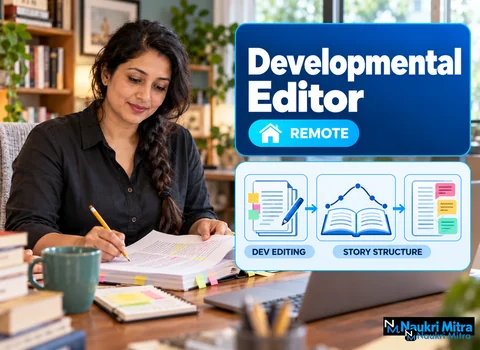
A copy editor fixes sentences. A developmental editor asks whether the chapters are in the right order, whether the narrator is telling the right story, and whether the middle of the book earns its length. This listing belongs to that second group of online developmental editor jobs: part-time, freelance, fully remote, open to editors in any country, and paid at $30 USD per hour, so it is developmental editor work from home in the full sense. You read whole manuscripts, fiction or nonfiction, and help authors see the book they are actually writing.
Every developmental edit starts with the full manuscript, read from page one to the last line, and the first pass should be done with as few notes as you can bear. The point is to experience the book as its eventual reader will. Where did you lean in? Where did you check how many pages were left?
Those reactions are evidence. A reader who drifts through the middle chapters has found a pacing problem before anyone has named it. Once you start annotating, you read like a mechanic instead of an audience, and you lose the one view of the book the author cannot get alone.
The second pass is slower and deliberate. Many editors build a chapter map: a line per chapter recording what happens, whose point of view carries it, and what changes by the end. For nonfiction, it tracks the argument: each chapter's claim and the evidence behind it.
The map is where structural problems become visible. Two chapters that do the same job. A subplot that vanishes for a hundred pages. A business book that explains a key idea in chapter nine but uses it in chapter four. None of this shows up at sentence level.
With the map in hand, you assess the four things this role names. In fiction, structure means the order and proportion of events; pacing means how time and tension are spent; character arcs ask whether people change, and whether that change is earned on the page; theme asks what the book keeps circling back to, and whether the ending honours it.
Nonfiction asks related but different questions. Structure becomes the logic of the argument or the shape of a memoir's chosen timeline. Pacing is about density, such as too many case studies in a row. Arcs still matter in memoir, where the narrator usually needs to change. Theme becomes promise: does the book deliver what its title and introduction told the reader to expect?
The editorial letter is the centre of the work and the document clients remember. It is a long letter to the author that explains what the manuscript does well, what is holding it back, and what to revise first. Prioritisation is the skill. An author handed thirty equal problems will freeze; an author told that the opening three chapters should become one, and that the antagonist needs a motive before the midpoint, can start work on Monday.
Good letters begin with what is working, because authors revise toward strengths. They describe problems through the reader's experience rather than the editor's taste, and they suggest fixes without rewriting the book. They are also honest: vague kindness wastes the author's money, and no editor should promise that a revision will win an agent, a publisher or a sale.
Alongside the letter, you leave comments in the manuscript itself, usually in Microsoft Word with Track Changes and comments switched on. Margin notes at this level are not corrections. They point to the moment a scene loses tension, flag where a character acts against what we know of them, or mark the paragraph where an argument quietly changes its claim.
Some authors work in Google Docs, so be comfortable with suggestion mode and comment threads there too. Keep comments tied to the letter: if the letter says the middle sags, the margins show exactly where. Leave sentence-level fixes alone; those paragraphs may not survive revision.
Once the author has had time to absorb the letter, this role includes a follow-up video or phone call. Authors arrive with questions, objections and sometimes a better idea than either of you had on paper. You listen, clarify, and help turn the letter into a revision plan: what comes first, what can wait, and what the author has reasonably decided to reject. A strong call ends with the writer knowing what the next draft is for.
A developmental editor works at the widest distance: the shape of the whole book, its order, its people and its argument. A line editor moves in to the paragraph and sentence, working on rhythm, voice, clarity and word choice while leaving the structure alone. A copy editor works closest of all, correcting grammar, spelling, consistency and house style, and checking that a character's eye colour does not change halfway through.
The order matters for budgets: polishing sentences before the structure is settled means paying twice.
A degree in English or literature, or an editing certificate, is common among developmental editors, though a strong track record with clients also works. Several years of fiction or nonfiction editing are expected here, along with a deep understanding of structure, pacing and character arcs and expert use of Word Track Changes. You will also need sample editorial letters to show. A developmental editor course or certification can sharpen your method, but on its own it rarely persuades an author; finished letters do.
Read any developmental editor job description closely and the core developmental editor skills are the same: reading stamina, holding a whole book in your head, genre awareness, and the tact to deliver hard news kindly.
Authors often ask for a sample before committing. For developmental work this might be a short critique of an opening chapter and synopsis, or a brief letter excerpt showing how you diagnose and prioritise. Decide in advance whether samples are paid.
Turnaround depends on manuscript length, genre and how much else is on your desk. Agree a delivery date in writing, leave room for the second read, and warn the client early if anything slips. On developmental editor salary, this listing is clear: $30 USD for every hour worked. Typically for part time developmental editor jobs, the hours rise and fall with the manuscripts that arrive, so log your real reading and writing time.
Freelance developmental editor jobs appear on general marketplaces such as Upwork and on publishing-focused ones such as Reedsy, which vets editors before listing them and so tends to expect an established record. Small presses, book coaches and writing communities also pass work along. Before joining any site, look up how it currently handles fees and AI-assisted work, since those policies move.
As for how to become a developmental editor from scratch, be realistic: authors rarely offer developmental editor jobs for freshers, because they are trusting you with years of work. Searches for developmental editor jobs no experience needed usually point toward beta reading, critique groups and copy editing first, which is a sensible route for building a portfolio of letters. Your developmental editor resume should list genres, word counts handled and what kind of feedback you gave, rather than a list of adjectives about yourself.
Developmental editing can be a sustainable freelance career, but it is lumpy. One full edit can fill weeks, and then the inbox goes quiet. Editors who last usually mix repeat authors, referrals, a marketplace profile and some line editing or teaching. Software and unpaid admin time are costs you carry yourself. Software can help with spelling and consistency, but it cannot tell an author why their second act feels hollow. That judgement is the job.