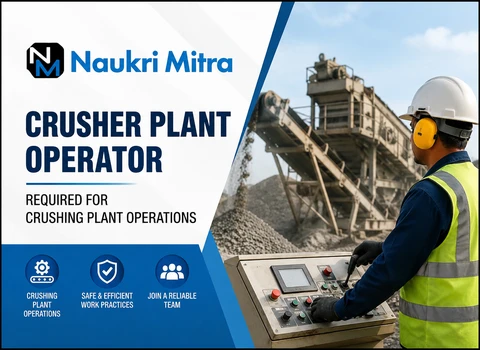
What Does a Crusher Plant Operator Actually Do?
Every road you've driven on, every concrete slab poured for a building, started somewhere as broken rock. Someone had to run the machine that turned boulders into gravel-sized material, and that's the job of a crusher plant operator. It's not glamorous work, but without it, construction sites and cement plants across India would grind to a halt. The operator controls the equipment that crushes large stones, rocks, or ore down to sizes that can actually be used — for roads, railway tracks, concrete mixing, and dozens of other construction needs.
The Reason Companies Need People in This Role
A crusher doesn't run itself. Feed too much material in too quickly and you risk jamming or damaging the machine. Feed it too slowly and production drops. Someone has to watch all of this constantly — checking the crusher gap, listening for strange noises, keeping an eye on how the output looks. That's why plants hire operators rather than leaving machines unattended. One wrong adjustment can cost a company hours of downtime, so the person at the controls carries real responsibility, even if the job title sounds simple.
How a Shift Usually Unfolds
Most operators start their shift by walking the plant floor first — checking belts, oiling points, and making sure nothing is stuck inside the crusher chamber. Once things look clear, the machines get started, and material begins flowing through. From there, it's a lot of watching and adjusting. Feed rate has to shift depending on whether the incoming stone is soft limestone or harder rock. A few of the regular tasks operators handle through the day:
- Starting up and shutting down jaw, cone, or impact crushers
- Adjusting the crusher setting to get the right output size
- Keeping watch on conveyor belts, screens, and hoppers
- Clearing jams caused by oversized rock or debris
- Noting down production numbers and gauge readings
- Handling minor greasing and quick maintenance checks between runs
Where People in This Trade Usually Work
You'll mostly find crusher operators at stone quarries, aggregate plants, and construction or mining sites. Madhya Pradesh has a decent concentration of crushing units thanks to its limestone belt, and this particular role is based in Satna — a city known for its cement industry and mineral-rich surroundings in Madhya Pradesh, India.
The Machines You'll Get Comfortable With
Give it a few weeks on the job and the equipment starts to feel familiar. Operators typically work with:
- Jaw crushers, used for the first stage of breaking down large rock
- Cone or impact crushers, which handle the finer secondary crushing
- Vibrating screens that sort material by size after crushing
- Conveyor systems moving stone from one stage to the next
- Hydraulic panels that let you fine-tune the crusher gap
None of these machines work in isolation. Knowing how belt speed affects the screen, or how a tighter crusher setting changes the load on the conveyor, is what really separates someone who's just pushing buttons from someone who understands the plant.
What Employers Tend to Look For
This isn't a desk job, and it suits people who don't mind getting their hands dirty around heavy equipment. A few things that matter on the shop floor:
- A working sense of how mechanical and hydraulic systems behave
- Comfort reading gauges and control panel indicators without hesitation
- The ability to think on your feet when a blockage or feed problem comes up
- An eye for consistency — spotting when output size starts drifting
- Basic discipline around housekeeping and routine upkeep
Freshers who've completed an ITI in Mechanical, Fitter, or a similar trade are usually seen as a good fit. Diploma holders in Mechanical Engineering also find this a workable entry point into plant operations. That said, plenty of employers value someone who's already spent time around crushing equipment or conveyor systems just as much as they value a formal certificate.
What the Body Goes Through on This Job
Expect to be on your feet a lot. There's walking between machines, occasional lifting, and long stretches of standing near running equipment. Dust and noise are part of daily life here, so stamina matters more than it might seem at first glance. Some plants run rotating or early-morning shifts depending on production targets, so flexibility around timing helps too.
Safety Isn't Optional in This Line of Work
Crushing equipment has moving parts, high noise levels, and constant dust — a combination that leaves little room for carelessness. Helmets, safety shoes, ear protection, dust masks, and gloves are the standard gear on most sites. One rule that's non-negotiable: never try clearing a jam while the machine is still running. Lockout steps should be followed before any maintenance begins, and staying alert around conveyor belts is something every experienced operator will tell you to take seriously.
Where New Operators Tend to Struggle
Getting the feed rate right for different stone types takes time — harder rock behaves very differently under the crusher than softer limestone, and it's not something you learn from a manual. The noise and dust wear people down over a full shift, especially early on. Recognizing early signs of trouble, like a slight change in vibration or an odd sound from the crusher, is a skill that builds gradually rather than something you pick up overnight.
Growing Within the Trade Over Time
Most people start out on smaller crushing units before moving up to bigger primary or secondary crushers. With a few years of experience, some operators move into shift-in-charge roles or take on plant supervisor responsibilities, coordinating between production and maintenance teams. The more crusher types and plant layouts someone has worked with, the more valuable they become to an employer.
Pay and What Comes With the Job
This is a full-time position based in Satna, Madhya Pradesh, India, with a monthly salary of ₹28,500. Some employers also offer extras on top of this — things like overtime pay, PF, ESI, bonuses, uniforms, transport, or canteen access — though these vary from one company to another and shouldn't be assumed as guaranteed.
Is This the Right Career Move?
If you're someone who's mechanically inclined, doesn't mind physical work, and wants a job with a clear path forward, crusher plant operation is worth considering. It's steady work tied to India's construction and cement sectors, and with patience, the skills built here can carry an operator into supervisory roles down the line.