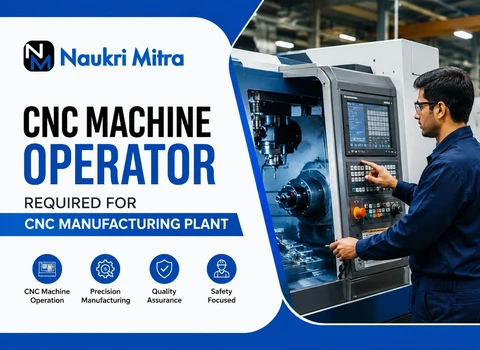
What Does a CNC Machine Operator Actually Do?
Walk into any machining workshop, and you'll notice the same thing: a machine running on its own, and someone standing close by, watching it like a hawk. That person is usually the CNC Machine Operator. CNC stands for Computer Numerical Control, which means the machine follows a prewritten program rather than a person's hand movements. But someone still has to load the material, set the tools, catch errors early, and check the output. That's the job.
Right now, there's an opening for a CNC Machine Operator at a CNC Manufacturing Plant based in Pune, Maharashtra, India. It's a Full-time position, and it's open to both freshers with the right training and operators with a few years on the shop floor.
Why Do Factories Bother Hiring Operators If the Machine Does the Work?
This is a fair question people ask when they first learn about CNC machining. The truth is, the machine only does what it's told. It won't notice a cracked tool bit, a slightly off measurement, or a batch of raw material that's not quite up to spec. An operator does. Plants keep operators around because precision manufacturing has zero tolerance for guesswork, and a trained set of eyes catches problems before they turn into rejected parts or, worse, damaged machinery.
A Rough Idea of How the Shift Goes
Most days start the same way — checking the machine, going through the job card, and confirming what the drawing actually wants. Then it's about loading the material, fixing the tooling, and letting the cycle run. In between, there's measuring, adjusting, sometimes waiting, sometimes rushing. Nobody's day looks exactly like the plan on paper. Machines jam. Tools chip. Supervisors change priorities mid-shift. Operators adapt.
What the Job Involves, Day to Day
- Setting up CNC lathes, milling machines, or EDM units depending on the part being made
- Loading and unloading workpieces without damaging the surface finish
- Keeping an ear and eye on the machine while it's cutting — sound and vibration tell you a lot
- Measuring finished pieces against the drawing tolerances
- Reading engineering drawings correctly, not just glancing at them
- Flagging tool wear or machine trouble before it becomes a bigger issue
- Filling in basic production logs and quality sheets
Where Operators Like This Actually Work
You'll find CNC operators in auto component plants, precision engineering units, tool rooms, mould and die shops, and general machining setups. Pune has grown into one of Maharashtra's stronger industrial hubs, and that's part of why this kind of technical role keeps coming up here — there's steady demand for people who can operate precision equipment without constant supervision.
The Machines and Instruments You'll Get Familiar With
Depending on which plant you land in, you might be running a CNC lathe, a CNC milling machine, or an EDM machine. EDM — Electrical Discharge Machining — is a bit different from regular cutting. It shapes hard metal using controlled electrical sparks rather than a physical blade, which is useful for intricate shapes that a standard tool can't reach. Alongside the machines, you'll be using vernier calipers, micrometers, height gauges, and dial indicators almost every day to double-check what you've made.
What Qualifies Someone for This Kind of Work
Employers may prefer candidates with relevant machining or tool room training. Depending on the complexity of the work, an ITI in a machining-related trade, a Diploma in Mechanical or Tool and Die Engineering, or equivalent vocational training may be considered suitable. Practical experience with EDM machines, engineering drawings, and precision measuring instruments is often valued as much as formal education — sometimes more, honestly, because a diploma doesn't teach you how a machine sounds right before a tool snaps.
Technical knowledge gets you in the door. What keeps you useful on the floor is patience with repetitive work, a habit of double-checking rather than assuming, comfort with the CNC control panel, and being someone the rest of the shift can rely on without needing to double-check your work.
The Physical Side of the Job
Nobody sits much in this role. You're on your feet for long stretches, occasionally lifting material or fixtures, and always staying alert near moving parts. Most manufacturing plants run in shifts, so be ready for rotational timing — this can include night shifts depending on how busy the production line is.
What the Shop Floor Actually Feels Like
It's noisy. There's coolant, metal shavings, the smell of machine oil, and machines running close together. None of that is unusual — it's just the environment. What matters is how seriously safety is taken. Operators are generally expected to wear safety glasses, gloves, safety shoes, and ear protection in louder sections. Machines are properly locked out before anyone touches them for maintenance, and a clean, uncluttered workstation isn't just for looks — it's one less thing that can go wrong.
Where New Operators Usually Struggle
Reading a complicated engineering drawing correctly takes time to get comfortable with — that's a common early hurdle. So is holding tight tolerances when the shift is moving fast, and there's pressure to keep output up. Tools break at inconvenient times. Machines go down without warning. None of this means someone isn't cut out for the job; it usually just means they haven't had enough hours on the floor yet. Senior operators tend to be a good source of shortcuts and warnings that the manual doesn't mention.
Growing Within This Line of Work
Operators who stay sharp and consistent don't stay entry-level forever. Over time, this can lead to senior operator roles, CNC programming, or shift supervision. Picking up programming basics or learning newer machine types along the way tends to open doors faster than just clocking years.
Pay and What Else Might Come With It
This Full-time role in Pune, Maharashtra, India pays ₹25,500 per month. Beyond the salary, some plants offer extras like overtime pay, PF, ESI, bonuses, uniforms, transport, or canteen facilities — though this really depends on the specific employer and shouldn't be assumed as guaranteed.
For someone willing to put in the hours and build real precision skills, this is a solid way into India's manufacturing sector — not glamorous, but steady, and with genuine room to move up if you stick with it.