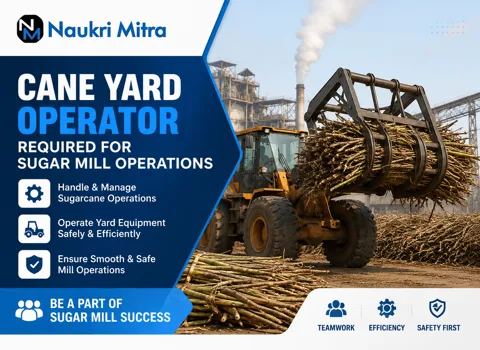
What Happens on a Sugar Mill's Cane Yard
Walk into any sugar mill during the crushing season, and the yard is usually where the action starts. Trucks and bullock carts line up, cane gets weighed, and someone has to make sure all that raw material actually moves toward the crushers without piling up or drying out. That's the job of a Cane Yard Operator. It's a Full-time position, based in Kolhapur, Maharashtra, and it sits right at the front end of the whole sugar-making process.
If you've never worked around a sugar mill before, think of the yard as the mill's intake system. Everything the factory produces starts here, and how well this stage is handled affects the rest of the operation.
Why This Job Exists in the First Place
Cut sugarcane doesn't wait well. Sucrose content starts dropping within hours of harvest, so mills can't afford to let vehicles sit around unattended or let cane pile up in the wrong spot. That's really the reason yard operators get hired — someone has to keep the queue moving, maintain consistent feed, and catch problems before they slow down the crushing line. It's not a background task; a poorly run yard can quietly eat into a mill's sugar recovery numbers.
A Rough Idea of the Daily Routine
No two days look exactly alike, but there's a general pattern. Vehicles arrive loaded with cane, and the operator directs them toward the weighbridge, then toward the correct unloading point once weight is recorded. From there, it's about running or supervising the unloading equipment, monitoring the carrier system that feeds cane to the cutters, and keeping an eye on how much stock is in the yard at any given time. Vehicle numbers, weights, and stock levels usually get logged as the shift progresses — not glamorous work, but it matters when supervisors need to track throughput later.
What the Job Actually Involves
- Running or assisting with hydraulic unloaders and tipplers
- Keeping cane carrier belts and feed systems moving without jams
- Working with weighbridge staff to make sure cane weight entries are correct
- Watching stockpile levels so the crushers never run short — or get overloaded
- Flagging equipment problems to maintenance before they become bigger issues
- Keeping the yard reasonably clean and organized, which sounds minor but affects safety a lot
The Equipment You'll Be Working Around
A cane yard isn't a single machine — it's several machines working together. Hydraulic unloaders tip cane off trucks, overhead cranes with grab buckets move bulk loads, and carrier conveyors pull everything toward the cutting knives that prep the cane before it hits the crusher. There's also the weighbridge, which sits just outside the actual yard but is tightly linked to everything the operator does. Knowing how one machine's output feeds the next one is genuinely useful here — a jam at the carrier stage backs up the entire unloading queue.
Where This Kind of Training Helps
You don't need an engineering degree, but some technical background goes a long way. Employers may prefer candidates with relevant machining or tool room training. Depending on how complex the yard equipment is at a given mill, an ITI in a machining-related trade, a Diploma in Mechanical or Tool and Die Engineering, or equivalent vocational training may be considered suitable. In practice, being able to read an engineering drawing or use precision measuring instruments often counts for just as much as the certificate itself — it shows you can actually troubleshoot rather than just operate.
Physical Side of the Work
This isn't a desk job. Expect to be on your feet for most of the shift, walking across the yard, and occasionally helping guide or lift cane bundles by hand. During peak crushing months, mills tend to run longer hours to keep up with harvest volumes, so shift work — including early mornings or nights — is part of the deal at busier times of year.
Dust, Noise, and Staying Alert
Yards get loud and dusty, especially with multiple vehicles moving at once. Staying safe here comes down to habits more than anything else — staying clear of conveyor lines while they're running, following crane signal procedures properly, and actually wearing the PPE you're given: safety shoes, gloves, a helmet, and a high-visibility vest. Most accidents in yards like this happen when someone gets a little too comfortable around moving equipment.
What Makes the Job Difficult at Times
Peak-season traffic is probably the biggest challenge — when vehicles are backed up and everyone wants to unload at once, decisions need to be made fast. Monsoon weather doesn't help either; wet yard surfaces slow down vehicle movement and can make footing tricky. Operators who do well here tend to stay calm under that pressure, communicate clearly with drivers, and adjust their pace as the workload shifts through the day.
Where This Can Lead
Operators who stick with it and show they can handle the pressure of peak season often move into supervisory roles — yard supervisor, shift in-charge, or handling more specialized equipment within the same mill. It's the kind of progression that comes from being reliable when things get busy, not from ticking boxes on paper.
Pay and What Else Might Come With It
The salary for this role is ₹31,200 per month. Beyond that, individual mills sometimes offer extras like overtime pay, PF, ESI, a seasonal bonus, uniforms, transport, or canteen access — but these vary from employer to employer, so it's worth confirming directly with whoever's hiring rather than assuming.
For someone looking to get into Maharashtra's sugar and agro-processing sector, this Kolhapur-based role is a fairly grounded starting point — plenty of hands-on exposure to mechanical systems, and a real shot at building toward something more senior over time.