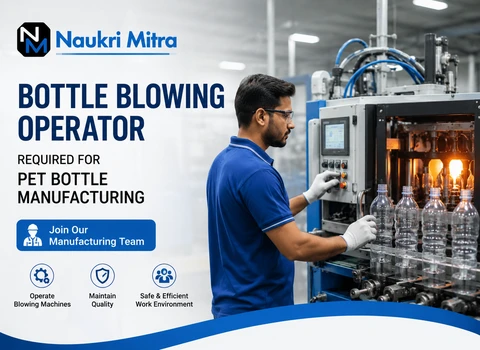
Life on the Floor: What It Means to Work as a Bottle Blowing Operator
PET bottles are everywhere, from drinking water to packaged beverages and household products, and every single one of them starts as a small plastic preform before it takes its final shape. The person who makes that transformation happen is the Bottle Blowing Operator Required for PET Bottle Manufacturing, a role currently open in Silvassa, Dadra and Nagar Haveli and Daman and Diu, India. This is a full-time position that suits people who enjoy working with machines, prefer hands-on production work, and want a stable career in India's growing plastic packaging industry.
Why Manufacturers Need Skilled Machine Operators
PET bottle manufacturing runs on precision. A blow molding machine heats a preform and stretches it under air pressure until it fills a mould in the exact shape required by the customer, whether that's a water bottle, an oil container, or a cosmetic jar. If the settings are wrong, bottles come out thin, deformed, or unevenly weighted, which wastes raw material and slows production. That is why plants prefer to hire a trained operator rather than leave the machine unattended, and why this role carries real responsibility from day one.
A Typical Day at the Blow Molding Station
The day usually begins with checking the machine, confirming air pressure and heating zone temperatures, and loading preforms into the feeding unit. Once production starts, the operator watches the bottles coming off the line, checking wall thickness, base strength, and neck finish. Any bottle that looks cloudy, thin, or unevenly stretched gets pulled aside for inspection. Machine parameters are adjusted via the control panel as needed, and minor stoppages, such as jammed preforms or mould misalignment, are handled on the spot.
Core Responsibilities on the Job
- Operating and monitoring PET stretch blow molding machines
- Loading preforms and unloading finished bottles
- Checking bottle quality against approved samples
- Adjusting heating and pressure settings within set limits
- Performing basic troubleshooting and reporting bigger faults to maintenance
- Keeping the work area clean and free of scrap plastic
Where This Kind of Work Happens
Plastic bottle manufacturing units, packaging plants, and beverage bottling facilities all run blow molding lines. In a region like Silvassa, which has a dense concentration of small and mid-sized manufacturing units, this kind of production work is common, and operators often move between similar plants as they gain experience.
Machines, Tools and Instruments You'll Work With
The main equipment includes single-stage or two-stage stretch blow molding machines, air compressors, mould sets, and preform heating ovens. Operators also use basic measuring tools, such as thickness gauges and weighing scales, to confirm that bottle specifications match the required standard.
Training and Skills Employers Look For
Freshers with an ITI certificate in a mechanical or plastic processing trade are usually preferred, though a Diploma in Plastic or Mechanical Engineering is also valued. Employers often place greater importance on practical machine-handling experience than on certificates alone, so anyone who has worked on similar production lines, even informally, has a real advantage.
Physical Work and Shift Patterns
This job involves standing for long stretches, lifting preform crates, and staying alert near hot machine parts. Most plants run rotational shifts, including night shifts, since blow molding lines typically operate continuously to meet production targets.
Staying Safe on the Production Floor
Heat from the ovens and pressurized air are the two biggest hazards on this job. Safety shoes, heat-resistant gloves, and ear protection are commonly provided, and operators are trained to never bypass machine guards or override pressure settings without authorization.
Challenges Operators Commonly Face
Repetitive motion, heat exposure, and the pressure of meeting hourly output targets are the most common challenges. Machine downtime can also be stressful when production schedules are tight, which is why quick, calm troubleshooting is a valued skill.
Growing Within the Trade
Operators who perform consistently often move into senior operator or shift-in-charge roles, and from there into machine setting or quality supervision, where their hands-on floor experience becomes a real asset.
Pay and Common Workplace Benefits
This full-time position in Silvassa offers a monthly salary of ₹30,000. Depending on the employer, workers may also receive benefits such as PF, ESI, overtime pay, uniforms, and canteen or transport facilities, though these vary from one company to another.