📚 Table of Contents
- The Big Picture: What’s Really Changing?
- How Workforce Transformation Hits Home
- Reskilling & Upskilling: Your Real Job Safety Net
- Remote Work Opportunities: A Silver Lining
- Local Entrepreneurship and the Gig Economy
- Robotics in Everyday Life
- The Hard Truth About Shifts in Labor Demand
- How Local Industries Innovate (and Create Jobs)
- Preparing the Next Generation for the Future of Local Jobs
- The Emotional Side: Stress, Fear, and Hope
- Real Stories of Transformation
- Wrapping It All Together: Community Development and the Future of Local Jobs
- Final Thought on the Future of Local Jobs
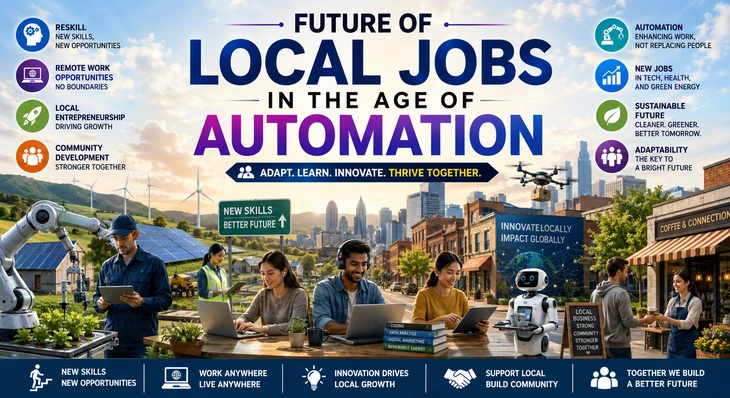
Future of Local Jobs in the Age of Automation
Automation isn’t just a buzzword in tech blogs anymore — it’s showing up in our daily lives. It’s shaping how we work, live, and even how our kids prepare for their futures. If you’ve ever worried about robots taking over jobs or wondered how your community will keep up, you’re not alone. Let’s break this down in plain talk — real examples, stories, and a mix of honest fears and practical hope.The Big Picture: What’s Really Changing?
Think back a decade. Ordering groceries online felt odd, and Zoom calls were rare. Fast forward — everything from banking to school lessons runs online now. That’s the digital economy at work. And it’s only getting bigger. Automation, AI, and innovative technologies aren’t just replacing people; they’re changing the kind of work people do. Picture this: instead of a factory worker tightening bolts all day, machines do the job. People supervise, solve tricky problems, or design improvements. That’s human-machine collaboration — the mix of machine speed and human creativity. But with every change comes economic disruption. Some jobs vanish, while others emerge, and many of us feel stuck in the middle. A coffee shop might use robots for cleaning, but it’ll still need baristas who make the human connection customers love. Personal note: When I toured a mid-size factory last year, the managers showed me new robotic arms. Yes, they replaced some repetitive tasks — but the same team also hired six new technicians to manage, program, and maintain those machines. It wasn’t about less work; it was about different work.How Workforce Transformation Hits Home
Workforce transformation isn’t abstract. It’s your neighbor losing a clerical job because software now does the filing. It’s the student learning coding instead of sticking with traditional office goals. Its parents are urging their kids toward flexible, future-proof paths. Whole towns are shifting. A small manufacturing city may no longer run on assembly lines — instead, it becomes a hub for renewable energy testing or cybersecurity services. New ones are passing old industries. But let’s be real: transformation takes time. It needs training, patience, and strong local support. Without that, many communities risk being left behind.Reskilling & Upskilling: Your Real Job Safety Net
Worried about job security? Honestly, your best shield isn’t luck — it’s reskilling and upskilling. Think of it like sports practice before a big match: you train harder, sharpen your skills, and get ready for the unexpected.- Reskilling: Learning something entirely new. Example: Maria, a single mom whose retail job vanished, took a digital marketing course. A year later, she’s running campaigns for small businesses. One door closed, another one cracked open — and she walked right through.
- Upskilling: Building on what you already know. Like a teacher adopting AI lesson tools instead of relying on chalk and blackboards.
- Coding and software development
- Digital marketing and e-commerce
- Renewable energy installation and maintenance
- Data analysis and visualization
- Healthcare and mental health support
Remote Work Opportunities: A Silver Lining
Remember lockdown days when “work from home” went mainstream? Well, remote work opportunities didn’t fade away. They’re here to stay — and that’s huge for small towns. Now, a graduate in a rural area can land a global role without leaving family behind. That money cycles back into local cafés, schools, and services. Communities stay strong, and people don’t need to uproot their lives. This trend is reshaping the future of local jobs in the age of automation — reaching even the smallest rural towns. Gallup found that 56% of U.S. workers now say remote work options are a priority when choosing a job. That’s not just a trend — it’s a shift in expectations shaping both cities and small towns.Local Entrepreneurship and the Gig Economy
Indeed, automation eliminates some jobs. But it also opens doors for local entrepreneurship. Take food delivery apps: their innovative matching systems created space for bakers, home kitchens, and delivery workers to thrive. And don’t ignore the growth of the gig economy. Uber drivers, freelance designers, online tutors — gigs can be lifelines. True, gig work often lacks employment security. But for many, it’s a bridge: a way to explore, survive, and test out new paths until a long-term role lands.Robotics in Everyday Life
Robots aren’t sci-fi anymore. From cleaning vacuums to hospital assistants, robotics in everyday life is real. One local hospital introduced robots to deliver medications across floors. Nurses didn’t get laid off — they shifted to patient care and emotional support. Less time walking halls, more time holding hands. That’s what changing career paths looks like.The Hard Truth About Shifts in Labor Demand
Let’s not sugarcoat it — shifts in labor demand are hitting some jobs hard. Picture truck drivers watching self-driving rigs roll past, or cashiers standing beside self-checkout machines. But here’s the upside. Roles on the rise include:- Cybersecurity experts
- Renewable energy technicians
- Data analysts
- Mental health counselors
How Local Industries Innovate (and Create Jobs)
Automation isn’t just for Silicon Valley giants. It’s reshaping local industries too. Picture a family-run farm installing AI irrigation to save water. Or a small textile shop using AI design tools to compete globally. These aren’t hypotheticals — similar cases are already happening across the U.S. According to a Brookings report, advanced industries now account for more than 8% of jobs in small towns, driven by technology adoption. When local businesses innovate, they don’t just stay afloat — they grow. And when they grow, they create jobs around them, such as IT support, digital marketing, and logistics.Preparing the Next Generation for the Future of Local Jobs
Parents often ask: “What should my kids study so they’re not jobless later?” It’s a fair worry. But the answer isn’t a single subject. It’s adaptability, problem-solving, and creativity — what we might call career adaptability. Notice how kids pick up apps faster than adults? That agility is gold. Schools mixing coding with storytelling, or science with design, are ahead of the curve. They’re not just teaching lessons — they’re prepping kids for jobs that don’t even exist yet. A Deloitte survey found that 90% of executives believe creativity and problem-solving will be among the most critical skills for future workers. That’s a clear sign schools need to nurture more than just academic knowledge.The Emotional Side: Stress, Fear, and Hope
Let’s be real. Automation talk sparks anxiety. People picture layoffs and dead ends. That knot in your stomach when you hear “robots replacing jobs”? Totally normal. But history shows a pattern: industrial revolutions create more jobs than they kill. The messy middle is the hardest. That’s why governments and companies must step up with retraining, safety nets, and a focus on economic resilience. And for us? Staying flexible, learning nonstop, and leaning on each other makes the ride less scary.Real Stories of Transformation
- Student Story: Rohan thought accounting was his only shot. Then he tried data visualization tools. Today, he freelances for startups, earning more than he expected.
- Parent Journey: Anita once feared online teaching would push her out. Now she runs interactive virtual classes, doubled her income, and still tucks her kids in at night.
- Community Shift: A bakery used AI inventory to cut waste. Sales jumped, and they hired two more delivery drivers instead of cutting back.
Wrapping It All Together: Community Development and the Future of Local Jobs
So what does the future of local jobs in the age of automation look like? It’s never black and white — more like a messy mix of gains and losses:- Yes, some jobs will disappear.
- Yes, stress and uncertainty will hit.
- However, new skills and industries will undoubtedly emerge.