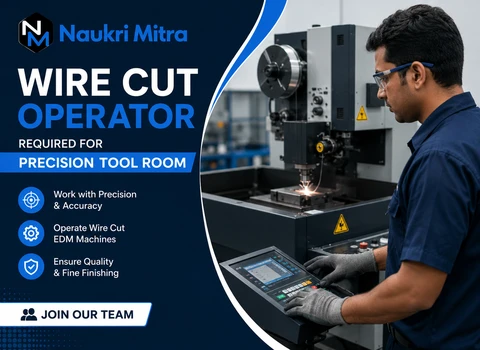
Working with Precision in a Tool Room
The
Wire Cut Operator role in a precision tool room is a practical, hands-on job for people who want to work in precision manufacturing. This
Full-time position in
Coimbatore, Tamil Nadu, India is suited to candidates who are comfortable around machines, drawings, measurements, and quality checks. In many factories and workshops, this kind of work supports the production of accurate metal parts that must fit and function without error.
A wire cut operator operates Wire EDM equipment, which uses electrical sparks to cut metal rather than a conventional cutting blade. That makes the job very useful in tool rooms, die shops, mold making units, and precision engineering plants. The work is not about speed alone. It is about control, accuracy, and steady attention.
For freshers, this role can be a strong entry point into technical manufacturing. For experienced workers, it offers an opportunity to apply machining knowledge in a more specialized environment. Many employers value practical skill, discipline, and the ability to read drawings just as much as classroom learning.
Why industries depend on wire cut machining
Wire cut machining is used when a part needs a clean shape, tight tolerance, and fine detail. In simple words, the machine removes metal by controlled electrical discharge. A thin wire moves through the workpiece path, and sparks do the cutting. Since the wire does not physically press against the metal as a drill or milling cutter does, the process is ideal for delicate and hardened components.
Companies recruit for this role because they need parts that are difficult to make by ordinary machining. A wire cut machine can handle hardened steel, complex profiles, narrow slots, and sharp internal corners with good repeatability. That is why this process is common in precision tool rooms and production units where quality matters more than rough cutting.
This type of work is widely used in:
- Die and mold manufacturing
- Automotive component production
- Aerospace-related machining
- Industrial machinery plants
- Precision engineering workshops
- CNC and tool room facilities
In Indian manufacturing, especially in industrial cities like Coimbatore, such work supports many small and medium engineering units that depend on accurate tooling for daily production.
What the day usually looks like on the shop floor
A wire cut operator’s day often begins with checking the job order, drawing, and machine condition. Before cutting starts, the operator must understand the part shape, the required size, and the tolerance limits. Even a small mistake in setup can affect the final component, so the early steps matter a lot.
Typical daily work may include:
- Studying engineering drawings and job instructions
- Checking the material and confirming the workpiece size
- Fixing the component properly on the machine table
- Loading or selecting the correct machining program
- Setting cutting parameters based on material and thickness
- Watching the wire path during machining
- Checking dielectric fluid and machine condition
- Measuring the finished part after cutting
- Cleaning the machine and work area
- Reporting any issue to the supervisor or senior technician
The work is steady and detail-oriented. In many cases, the operator must wait while the machine completes a cut, then inspect the part carefully before moving to the next stage. This is normal in precision machining, where accuracy is more important than rushing.
Tools, machines, and measuring instruments used in the job
A person in this role works with both machine controls and inspection tools. The machine itself does the cutting, but the operator must know how to prepare, monitor, and verify the job.
Common equipment includes:
- Wire EDM machines
- CNC wire cut machines
- Automatic wire threading systems
- Dielectric fluid systems
- Workholding fixtures
- Magnetic chucks
- Precision clamps
Measuring and inspection tools often used in the tool room are:
- Vernier calipers
- Micrometers
- Height gauges
- Dial indicators
- Slip gauges
- Bore gauges
- Surface plates
- Edge finders
- Digital measuring instruments
The operator may also work with:
- Engineering drawings
- CAD profiles
- CNC programs
- Tool offsets
- Inspection sheets
- Process notes
Knowing how to use these tools correctly is a big part of the job. A machine may cut the part, but measuring instruments confirm whether it is actually correct.
Skills that help a wire cut operator perform well
This profession needs a mix of technical knowledge and practical shop-floor habits. A person does not need to be an expert on day one, but they should be willing to learn and work carefully.
Useful skills include:
- Reading engineering drawings
- Understanding dimensions and tolerances
- Basic knowledge of Wire EDM working
- Machine setup and alignment
- Handling precision measuring instruments
- Checking surface finish and part accuracy
- Following work instructions properly
- Spotting errors early
- Communicating clearly with supervisors and inspectors
- Keeping the machine area clean and organized
Practical thinking is very important. For example, if the wire keeps breaking, the operator should not just restart the machine repeatedly. They should check the setup, material condition, cutting parameters, and wire path. Small observations like this save time and prevent damage to the job.
Employers may prefer candidates with relevant machining or tool room training. Depending on the complexity of the work, an ITI in a machining-related trade, a Diploma in Mechanical or Tool and Die Engineering, or equivalent vocational training may be considered suitable. Practical experience with EDM machines, engineering drawings, and precision measuring instruments is often valued as much as formal education.
Education and training that can help candidates enter this field
This job is open to people who have technical interest and a willingness to learn. Many freshers start after completing an ITI course, while others come from diploma backgrounds. A formal degree is not always necessary for entry-level work if the candidate has strong practical understanding.
Helpful training areas include:
- Machining-related ITI trades
- Mechanical engineering basics
- Tool and die concepts
- CNC fundamentals
- Workshop practice
- Measurement and inspection methods
- Drawing reading and interpretation
A candidate who has spent time in a workshop or tool room during training usually adjusts faster. Even simple experience with machine setup, measuring tools, or EDM basics can make a difference during selection and on-the-job learning.
Physical work, shifts, and the shop-floor environment
This is a technical job, but it also has physical demands. The operator may stand for long periods, move around the machine area, and handle metal components carefully. Good eyesight, steady hands, and concentration are useful because the work involves close inspection and fine adjustments.
Common physical requirements include:
- Standing for long hours
- Lifting parts within safe limits
- Good hand-eye coordination
- Careful handling of sharp or heavy workpieces
- Focus during detailed measurement work
- Ability to stay alert during long machine cycles
Shift work may be part of the routine in many manufacturing units. Depending on production needs, the job may involve day, evening, rotating, or night shifts. Since the role is
Full-time, regular attendance and reliability are important.
The working environment is usually cleaner than heavy fabrication areas, but it still has machine noise, coolant systems, and continuous production activity. Precision tool rooms often keep the area organized because dust, dirt, and poor housekeeping can affect machining quality.
Safety habits that should never be ignored
Wire EDM machines are precise, but they still need careful handling. Safety is not optional in a tool room. A small mistake can damage the job, the machine, or the operator’s hand.
Good safety practices include:
- Following standard operating procedures
- Checking the machine before starting work
- Wearing proper personal protective equipment (PPE)
- Keeping hands away from moving parts
- Avoiding loose clothing near the machine
- Using safe lifting methods
- Cleaning spills quickly
- Reporting faults without delay
- Never bypassing machine safety systems
- Switching off power during maintenance when required
Common PPE may include:
- Safety shoes
- Safety glasses
- Protective gloves where suitable
- Industrial uniform
- Hearing protection if needed
A clean workstation also supports safety. In precision machining, a tidy area is not just about appearance. It helps prevent slips, mistakes, and contamination of the workpiece.
Problems operators often face and how they handle them
Every machine job has its challenges, and wire-cut machining is no different. The work may look smooth from the outside, but the operator must keep resolving minor issues throughout the shift.
Common challenges include:
- Wire breakage during cutting
- Incorrect alignment of the workpiece
- Difficulty in holding tight tolerances
- Working with hardened material
- Slow cutting on complex shapes
- Surface finish issues
- Machine parameter adjustments
- Delays caused by setup errors
A good operator learns to stay calm and check the basics first. Is the job clamped properly? Is the wire tension correct? Is the program right? Is the material suitable for the selected settings? These simple checks often solve the problem faster than guessing.
This is one reason companies value people who are patient and observant. In precision manufacturing, careful work usually gives better results than hurried work.
Salary, benefits, and career growth in this profession
For this position, the monthly salary is
₹ 28500.
In India, pay for wire-cut and precision machining roles can vary depending on experience, machine knowledge, industry type, and level of responsibility. A fresher may begin with basic machine handling, while an experienced operator may take on more complex jobs, better tolerances, and advanced setups.
Common employee benefits in manufacturing units may include:
- Overtime pay
- Provident Fund (PF)
- Employees’ State Insurance (ESI)
- Bonus
- Uniforms
- Transport support
- Canteen facility
- Paid leave
These benefits depend on the employer and are not guaranteed everywhere.
Career growth in this field usually comes from skill and consistency. A person who learns machine setup, drawing reading, inspection, and troubleshooting can move into more advanced tool room work over time. With experience, a wire cut operator may handle difficult jobs, support junior staff, or work on more specialized precision components.
For anyone interested in manufacturing, this role offers a solid path into technical work. It is practical, respected, and useful across many industries. In a place like Coimbatore, Tamil Nadu, India, where engineering and precision manufacturing are active, this kind of skill can remain valuable for a long time.