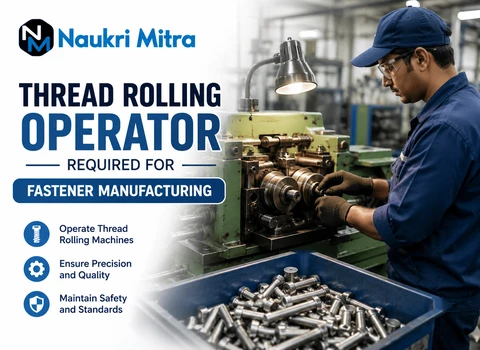
Understanding the Role of a Thread Rolling Operator in Fastener Manufacturing
A Thread Rolling Operator works in fastener manufacturing units where bolts, screws, and threaded components are produced in large volumes. This professional handles thread rolling machines that form external threads on metal blanks by pressing them between hardened dies rather than cutting the metal away. This method is widely preferred in the fastener industry because it produces stronger threads with better fatigue resistance compared to traditional thread cutting.
Why Fastener Companies Need Skilled Machine Operators
Fasteners are used in automobiles, machinery, construction, and countless industrial products, which means production lines run continuously to meet demand. Companies recruit dedicated operators to keep thread rolling machines running efficiently, maintain consistent thread quality, and reduce material wastage. A well-trained operator directly affects product quality, production speed, and the manufacturing unit's reputation.
A Typical Day on the Production Floor
The daily routine usually begins with checking the machine setup, inspecting dies for wear, and confirming that raw material blanks match the required specification. Throughout the shift, the operator loads components, monitors the rolling process, checks thread dimensions at regular intervals, and records production output. Any deviation in thread pitch or diameter must be corrected immediately to avoid rejected batches.
Core Responsibilities on the Job
- Setting up and operating thread rolling machines as per job specifications
- Selecting and fitting correct dies based on thread size and pitch
- Monitoring machine speed, pressure, and lubrication levels
- Performing first-piece inspection before starting bulk production
- Checking finished components using thread gauges and micrometers
- Reporting machine faults or die damage to the maintenance team
- Maintaining production and rejection records
Industries and Workplaces Where This Skill Is Needed
This profession is common in fastener manufacturing plants, auto component units, and hardware production workshops. Such workplaces are usually organized around cold-forming or hot-forming machine sections, quality inspection areas, and packing lines. Operators generally work close to heading machines, threading sections, and heat-treatment areas, since fastener production often involves multiple interconnected processes.
Machines, Tools, and Measuring Instruments Used
Apart from the thread rolling machine itself, operators regularly use plug gauges, ring gauges, micrometers, and vernier calipers to verify thread accuracy. Basic hand tools are needed for die changing and adjustment. Employers may prefer candidates with relevant machining or tool room training, and depending on the complexity of the work, an ITI in a machining-related trade, a Diploma in Mechanical or Tool and Die Engineering, or equivalent vocational training may be considered suitable. Practical experience with EDM machines, engineering drawings, and precision measuring instruments is often valued as much as formal education.
Skills That Matter Beyond Machine Handling
Technical understanding of thread specifications, tolerance limits, and material behavior is important, but practical workplace skills are equally important. Patience during repetitive tasks, alertness to changes in the machine's sounds or vibrations, and the discipline to follow standard operating procedures help operators avoid costly errors.
Physical Demands and Working Conditions
This is a full-time factory floor role that involves standing for long hours, handling metal components, and working near moving machinery. Shift-based working is common in fastener units to maintain continuous production, so operators should be prepared for rotational shifts when required.
Safety Practices and Protective Equipment
Working near rolling dies and moving parts demands strict safety awareness. Operators are generally expected to wear safety shoes, hand gloves, and safety goggles, and follow machine guarding rules strictly. Good housekeeping around the machine area also reduces slip-and-fall risks from coolant or oil spillage.
Challenges Faced and How to Handle Them Well
Common challenges include die wear affecting thread quality, material inconsistency, and maintaining accuracy during long production runs. Regularly checking gauges, keeping the machine clean, and reporting unusual noise early can prevent larger breakdowns and rejected batches.
Growing Within the Fastener Manufacturing Trade
With experience, an operator can progress toward handling multiple machines, taking up quality inspection responsibilities, or moving into a senior machine operator or shift-in-charge position within the same production environment.
Expected Salary and Common Benefits
This Thread Rolling Operator position in Ludhiana, Punjab, India offers a monthly salary of ₹27,500 on a full-time basis. Depending on the employer, benefits may possibly include overtime pay, PF, ESI, bonus, uniforms, or transport and canteen facilities, though these vary by company policy.