
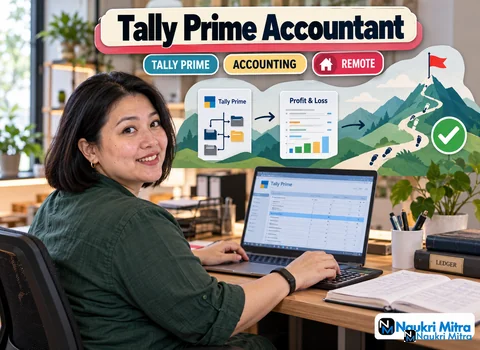
It is the last working day of the month. The bank account in Tally shows eleven lines still waiting for a match, two of them small charges nobody has explained yet. Four purchase bills came in on email this week and have not been entered. One supplier's ledger does not agree with the statement he sent. None of this is a crisis. Sorting it out calmly is the heart of remote tally prime accountant jobs like this one. The post is full-time, worked from home, open to people anywhere in the world, and carries $450 per month in USD. You will keep the books of small businesses in Tally Prime, from daily vouchers to the monthly reports owners actually read.
People often ask what a Tally Prime accountant does all day. The short answer is that you keep the company's money story accurate and up to date. You record sales and purchase invoices with the right GST details, post payments and receipts, and keep party ledgers clean so outstanding balances are correct. You raise e-invoices and e-way bills from inside Tally where the business needs them. You match the bank book against the statement. At month end you put together the data that goes into GST and TDS returns, and you produce the profit and loss, stock summary and outstanding reports.
That is the whole tally prime accountant job description, really: steady, detailed work on a rhythm you learn quickly.
Every office has its habits, but an accounting month keeps a fairly constant shape.
The first few days belong to the previous month. You finish any pending bank matching, post late bills, and check that every sales invoice for the month has its GST details right. This is when you pull together the figures for GST returns and confirm that the sales register in Tally agrees with what has been uploaded or reported.
Once sales are settled, attention moves to purchases and deductions. You prepare the information needed for TDS filing, check that tax has been deducted on the right payments, and compare input credit in your books with what suppliers have reported. Gaps go on a follow-up list.
This is the best week to tidy up. Merge duplicate ledgers, fix wrong groupings, review stock items with odd units, and chase old receivables.
Now you push to get everything in. Ask for missing bills, clear suspense entries, and reconcile the bank up to the latest statement. On the last day you run the P&L, stock summary and outstanding reports, check them for anything that looks wrong, and the cycle starts again.
Much of the job sits on Tally Prime's GST features. You should be comfortable setting up tax ledgers with the correct classification, creating party ledgers with GSTIN and state details, and recording invoices so the tax splits correctly. Tally Prime can generate e-invoices and e-way bills directly from a voucher when the company is set up for it, and you should know how to cancel or correct one. Reconciliation is the other half. You match the bank book line by line, and you match party ledgers against supplier and customer statements so outstanding figures can be trusted.
These are the tally prime accountant skills a reviewer notices within your first week.
Expect us to ask for a B.Com or M.Com and somewhere from one to three years as an accountant in Tally Prime. TallyEdu certification is preferred. You will also need a laptop and a secure, stable internet connection, because client data should never travel over shared or public networks.
A word on the course and certificate question. A good tally prime accountant course gives you structure, and a tally prime accountant certification such as the TallyEdu programme shows an employer you have covered GST, inventory and reporting in a planned way. It does not replace real entries, though.
For full-time work, the tally prime accountant salary on offer is $450 a month in USD. Think of that tally prime accountant salary per month as a fixed amount: it does not shift up or down with where you live. Because this is one of the tally prime accountant jobs remote worldwide, you can apply wherever you live, as long as you can work with Indian GST and TDS records.
Clients for this kind of work are often traders, distributors, small manufacturers and service firms that rely on Tally and prefer to keep accounts support outside the office.
People reasonably wonder how a remote accountant reaches a company's Tally data safely. The usual methods are a secure remote desktop connection to the office machine, Tally's own remote access features, or a cloud-hosted Tally server where each user has a separate login and permission level. Whichever is used, the rules are simple. Use only your own credentials, keep your laptop updated and password-locked, avoid public Wi-Fi, and never copy company data to personal drives or email it around. Good tally prime accountant work from home jobs explain this setup on day one.
Some candidates compare this with Zoho Books roles. Both tools handle GST invoicing and reconciliation. Tally Prime is desktop-first and very common among Indian traders and manufacturers, with strong inventory and offline working. Zoho Books is cloud-based and tends to suit service businesses that want online access and app integrations. The principles are the same, so skills transfer.
As for growth, the usual path is from accountant to senior accountant, where you review others' entries, own the monthly close and handle auditors' questions. After that come accounts manager or finance lead roles.
This particular listing asks for some experience, but freshers often ask how to get started anyway. Practise on a dummy company in Tally Prime: create ledgers, enter a month of sales and purchases, reconcile a sample bank statement and print the reports. Take a structured course, try for the TallyEdu certificate, and look for internships or assistant roles with a local accountant. Entry level remote tally prime accountant jobs do exist, some with no experience needed, though they usually pay less and involve more supervision.
When preparing a tally prime accountant resume, list the Tally features you have used, the kinds of businesses you have worked for, and the reports you produced. For tally prime accountant interview questions, expect practical tasks: recording a GST invoice, explaining a reconciliation difference, or setting up a ledger in front of the interviewer.
If you are looking at remote tally prime accountant jobs hiring now, take a little care. Paying to apply, to train or to receive a laptop is never part of a genuine hiring process. Be wary of anyone who wants your bank login, offers pay far above the market for very little work, or refuses to tell you who the client business is before you start. Ask how you will access the data and who you report to. Vague answers are your cue to walk away.
If the month-end picture in the first paragraph sounds like something you can sort out patiently, we would like to see your application.