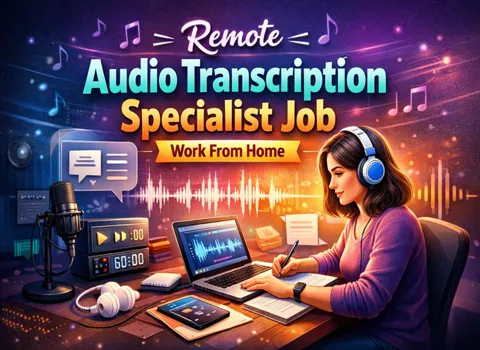
Remote Audio Transcription Specialist Work From Home Opportunity
Behind every clear report, searchable archive, or accessible piece of content is someone who took raw audio and turned it into something meaningful. This role sits at the center of that transformation. As a Remote Audio Transcription Specialist, your work quietly powers decision-making, preserves important conversations, and helps organizations operate with clarity and precision.
With an annual salary of $58,000, this opportunity blends flexibility with purpose, offering a chance to contribute to real outcomes while working from the comfort of home.
Role Overview
This position focuses on converting spoken audio into accurate, well-structured written content. The work goes beyond typing words—it involves listening carefully, understanding context, and delivering transcripts that are clear, reliable, and easy to use.
From business meetings and interviews to podcasts and research recordings, each audio file contains information that must be captured without distortion. The value of this role lies in turning those recordings into dependable documentation that teams can reference, analyze, and share.
What This Role Contributes
Accurate transcription supports better communication across teams, especially in remote environments where conversations happen across time zones and platforms. By producing high-quality transcripts, this role ensures that no detail is lost and that information remains accessible long after the conversation ends.
Clear documentation improves workflow efficiency, reduces misunderstandings, and allows teams to revisit key insights without replaying hours of audio. It also plays a vital role in accessibility, making content usable for individuals who rely on written formats.
Day-to-Day Work
Each day begins with reviewing the assigned audio files and understanding their context. Some recordings may involve technical discussions, while others might capture interviews or customer interactions.
The process typically includes:
- Listening attentively to audio recordings using transcription software
- Converting speech into clean, structured text with proper formatting
- Identifying speakers and maintaining consistency throughout transcripts
- Editing for clarity while preserving the original meaning
- Meeting deadlines while maintaining high accuracy standards
The work requires focus and attention to detail, especially when dealing with accents, background noise, or fast-paced conversations. Every transcript delivered contributes to a larger system of organized, searchable information.
Skills That Help You Succeed
Strong listening skills are essential, along with the ability to quickly process and interpret spoken language. Attention to detail ensures that transcripts remain accurate and professional.
A successful transcription specialist often demonstrates:
- Excellent command of grammar, punctuation, and formatting
- High typing speed with strong accuracy
- Familiarity with audio transcription tools and speech recognition software
- Ability to manage time effectively in a remote work environment
- Patience and concentration during long or complex recordings
Adaptability also plays a key role, as different projects may require different transcription styles or formatting standards.
How Work Happens in This Remote Role
This is a fully remote job, designed for individuals who value flexibility and independence. Work is typically organized through digital platforms where audio files, deadlines, and instructions are shared.
Communication with team members happens through messaging tools, project management systems, or occasional virtual meetings. Despite working independently, there is a strong sense of collaboration, with feedback loops helping maintain quality and consistency.
Time management becomes a personal responsibility, allowing you to structure your day to support both productivity and work-life balance.
Tools or Methods Used in the Work
The role relies on a combination of technology and human skill. Commonly used tools include transcription software, audio playback systems with variable-speed controls, and text-editing platforms.
Speech-to-text technology may help speed up the process, but human review remains essential to ensure accuracy and context. Noise-cancellation techniques, foot pedals for playback control, and keyboard shortcuts are often used to improve efficiency.
Familiarity with file formats, audio quality adjustments, and formatting guidelines helps streamline the workflow and maintain consistent output.
A Realistic Scenario or Short Workplace Story
Imagine receiving a recording of a virtual strategy meeting involving multiple speakers from different regions. The conversation moves quickly, with overlapping dialogue and varying accents.
At first listen, the audio feels challenging. But by slowing down playback, identifying speaker patterns, and carefully reviewing unclear sections, the transcript begins to take shape. Key decisions, action points, and insights emerge clearly in written form.
Once delivered, the transcript becomes a reference document for the entire team. Members who missed the meeting can quickly catch up, while others use it to confirm responsibilities and timelines. What started as a complex audio file turns into a structured resource that keeps the project moving forward.
Who Thrives in This Role
This role suits individuals who enjoy focused, independent work and take pride in accuracy. It appeals to those who appreciate structure, consistency, and the satisfaction of producing polished results.
People who succeed here often:
- Prefer working in a quiet, distraction-free environment
- Enjoy language, writing, and attention to detail
- Feel motivated by meeting deadlines and maintaining quality
- Adapt easily to different types of content and subject matter
It’s also a strong fit for professionals seeking remote transcription jobs that offer stability, flexibility, and meaningful contributions.
Closing Message
Every organization depends on clear communication, and this role plays a key part in making that possible. As a Remote Audio Transcription Specialist, your work ensures that conversations don’t fade into memory but instead become reliable, accessible records.
If you’re someone who values precision, enjoys working independently, and wants to contribute to a process that supports teams and decision-making, this opportunity offers both purpose and flexibility. It’s a role where your attention to detail creates lasting impact—one transcript at a time.