What This Job Actually Involves, Beyond the Title
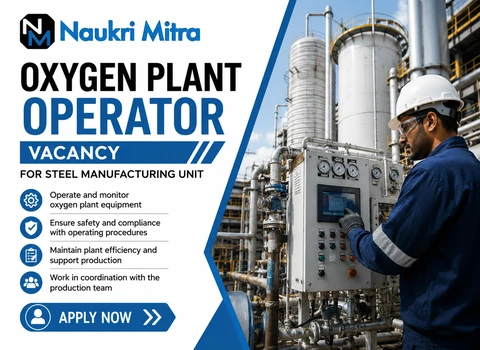
Steel isn't made without a steady supply of oxygen to the furnace. Somebody has to make sure that feed never stops, never drops in purity, and never runs at the wrong pressure. That's the job behind an Oxygen Plant Operator Vacancy for Steel Manufacturing Unit — not glamorous, but the kind of work a whole production line quietly depends on.
Why This Role Exists as Its Own Position
A furnace operator has enough to watch without also babysitting the gas supply. So steel units keep a separate plant operator whose only job is the oxygen system — checking purity, tracking flow, catching a pressure dip before it turns into a shutdown. Get this wrong, and the melting shop feels it within minutes.
How a Shift Usually Goes
Operators start by walking the plant and checking what the last shift left behind — gauge readings, compressor status, tank levels. Numbers get logged. Then it's mostly watching: pressure, temperature, purity, at set intervals through the shift. When something drifts, a valve gets adjusted or a compressor setting gets tweaked before it becomes a problem for anyone downstream.
Day-to-Day Duties
- Running the air separation unit that produces oxygen, and often nitrogen and argon alongside it
- Logging pressure, temperature, and purity readings on schedule
- Catching alarms early and fixing what can be fixed on the spot
- Matching oxygen output to whatever the melting shop is asking for
- Doing basic preventive checks and flagging anything bigger to maintenance
- Writing clear handover notes so the next shift isn't guessing
Where You'll Find This Kind of Work
This role sits within integrated steel plants, sponge iron units, and industrial gas facilities that support heavy manufacturing. This particular vacancy is full-time and based in Vijayanagar, Karnataka, India — a region with a strong presence of steel manufacturing.
The Equipment You'll Be Working With
At the center of it all is the air separation unit, which cools and compresses ordinary air until oxygen and nitrogen split apart at extremely low temperatures. Around that sits the rest of the job: compressors, cryogenic storage tanks, pressure regulators, flow meters, control panels. Many plants have moved to digital monitoring now, so reading a screen matters almost as much as reading a physical gauge did a decade ago.
Skills That Actually Make a Difference
Knowing how gas separation works helps, but so does being able to read a piping diagram at a glance and spot a fault in a compressor before it fails outright. Comfort with pressure regulation and interlock safety systems counts too. Companies tend to look for an ITI in Mechanical, Electrical or Instrumentation, or a Diploma in Mechanical or Chemical Engineering. In practice, someone who's already spent time around gauges, valves and control panels often gets picked over someone with only the paperwork — hands-on time is hard to fake.
What the Job Demands Physically
You're on your feet for most of the shift, moving between equipment, occasionally working at height or in tighter plant spaces. Add in compressor noise, heat near certain equipment, and exposure to industrial gases, and it becomes clear why fitness and staying alert matter here. Shifts, including nights, are common depending on how the plant runs.
Safety Isn't Optional Around Oxygen
Oxygen feeds fire, and cryogenic liquid can burn skin through cold rather than heat — both facts that shape how this job is done. PPE is standard: helmet, safety shoes, gloves, eye protection. Oil and grease anywhere near oxygen lines is a hard no. Leak checks happen regularly; valves are opened and closed in the correct order; and anything that smells or reads wrong gets reported immediately, not investigated alone.
What Trips People Up on the Job
Demand from the melting shop can shift suddenly, equipment ages and starts behaving unpredictably, and cryogenic systems respond to seasonal temperature swings in ways that take experience to anticipate. Operators who've been at it a while tend to lean on their checklists, stay level-headed when an alarm goes off, and loop in a supervisor or maintenance rather than trying to fix something major on their own.
Where This Can Lead
Most people start as a trainee or junior operator and take on more independent shift responsibility as they get comfortable with the equipment. From there, it can move toward senior operator charge, shift-in-charge, or a more specialized track in plant maintenance and utilities — all still within industrial gas and steel plant operations.
Pay and What Usually Comes With It
This position, based in Vijayanagar, Karnataka, India, pays ₹38,500 a month on a full-time basis. Depending on the employer, that may include overtime pay, PF and ESI, an annual bonus, uniforms, or transport and canteen facilities — none of it guaranteed and worth confirming directly with the employer before joining.