
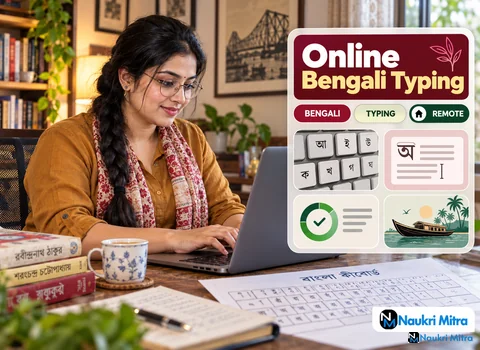
Be honest with me: when you send a message in Bangla on your phone, do you type "kemon acho" and watch it turn into কেমন আছো? Most of us learned Bengali typing that way, the phonetic Avro way, without ever thinking of it as a skill. Now ask yourself a second question. Could you do the same thing on a computer, for hours, from a blurry scanned page, without a single wrong conjunct? If the answer is "probably, with a bit of practice", then online bengali typing jobs like this one are worth a close look. Hours are part-time, there is no office, any country works, and the weekly pay is $80 USD. You take scanned Bengali pages, retype them into clean Word files, and send them back with a short page count report. I have typed Bangla for years, so let me walk you through it.
The scanned page goes on one side of your screen, MS Word on the other. Then you type. That is the heart of it, but the details matter. The scans vary: a page from an old Bengali novel, a school question paper, a land document, a set of poems. Your job is to turn each image into editable Unicode Bengali text that looks like the original.
"Looks like the original" means more than the words. If the page has a heading, your file has a heading. If it has a table of names and dates, you rebuild that table in Word. Bold stays bold. Paragraph breaks stay where they were. At the end of the week you upload the finished files and note how many pages you completed. That is the whole bengali typing job description in plain terms.
Because you already think in sounds. With Avro Keyboard in phonetic mode you type Bengali using English letters as they sound, and the software converts them. "bangla" becomes বাংলা. "ami" becomes আমি. You do not need to memorise where each Bengali letter sits on a fixed layout, which is a big relief for beginners.
A few habits I wish someone had told me early:
Avro is free to install on a Windows computer, and it works directly inside MS Word. That one tool covers almost everything this role needs.
This is where Bengali typists earn their keep. Juktakkhor, the joined conjunct letters, are everywhere in printed Bangla, and a scanned page will throw dozens at you. In Avro you usually just type the consonants back to back. "kSh" gives ক্ষ. "gg" gives জ্ঞ, and "nt" gives ন্ত. "shr" gives শ্র.
The trouble starts when the font in the scan draws a conjunct in an old-fashioned way and you do not recognise it. Keep a small paper list next to your desk of the conjuncts that confuse you, with the Avro keys that produce them. And always zoom into the scan when a cluster looks odd. Guessing a conjunct is the most common mistake I see from new typists.
Most of the time the hasanta (the little ্ mark that kills the vowel) hides inside a conjunct and you never see it. But sometimes the original page shows it on its own, at the end of a word or in a borrowed English term. If you let Avro join the letters, your copy no longer matches the source.
In Avro phonetic, typing two commas after a consonant, like "k,,", gives you a standalone হসন্ত form instead of a joined letter. For khanda ta (ৎ), as in উৎসব, Avro uses "t``". A reviewer comparing your file with the scan will spot them straight away.
Bangla spelling has a few traps that a phonetic keyboard will not catch for you, because the letters sound alike. Watch these pairs closely:
The rule I follow: copy the spelling on the page, even if you would personally spell it another way. Older books use older spellings. Your job is to reproduce, not to correct. Do not forget the danda (।) at the end of sentences either.
A standard English computer keyboard is fine. You do not need a special Bengali keyboard, because Avro handles the conversion. Beyond that, you need a computer (a laptop or desktop, not just a phone), MS Word, and a stable internet connection to download scans and upload files. Many typists simply split one screen in half.
People often ask about words per minute. No fixed number appears in the listing, only a call for fast, accurate Bengali typing, and in my experience accuracy is what decides whether your work gets accepted. Speed builds naturally after a few weeks of steady practice.
A typing speed certificate is listed as helpful "if available", not compulsory. Without one, you can still apply. A short bengali typing course can help you learn Avro shortcuts faster, and some online speed tests let you download a result, which works as informal proof of your bengali typing skills. A formal bengali typing certification is a bonus, not a gate.
What matters more is a clean sample. Type one scanned page you find yourself, format it properly in Word, and keep it ready. That sample often says more than any certificate.
Yes, and this is one of the friendlier roles for that. Basic schooling of 10th or 12th pass is enough, and beginners with good accuracy are welcome. These are real bengali typing jobs for freshers, with no prior work history required.
Here is how I would start if I were new:
Bengali typing work from home suits students, parents and anyone who wants part-time desk work. Since nobody needs you in an office, Kolkata, Dhaka or anywhere with a good connection will do.
They sound similar, but they are not the same. Data entry usually means filling short fields in forms or spreadsheets: a name here, a phone number there, a date in a column. Typing work like this is about long running text. You reproduce full paragraphs, keep the layout of the original page, and care about every conjunct and vowel sign.
If you enjoy reading Bangla and like the feeling of a finished, tidy page, typing will suit you better. Part time bengali typing jobs reward patience with long text, and so do the freelance bengali typing jobs you may find elsewhere.
I have seen friends get burned here. Genuine work pays you. It does not ask you to pay. Be very careful if an offer does any of the following:
To find real work, look for listings that clearly state the pay, the period and the tasks, as this one does: $80 USD per week, part-time, remote. Ask questions before you start. A real client will happily answer them.