
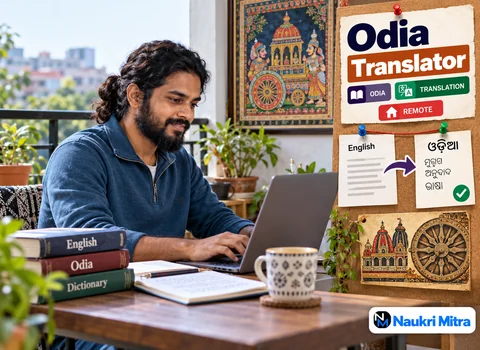
A loading screen in a shopping app says "Hang tight, we're almost there." Four friendly words in English. In Odia there is no ready phrase that carries the same mix of casual reassurance and slang, so the translator has to choose. Keep the image of holding on, which may read as literal, or say plainly that the page will be ready soon? And which "you" do you use, since Odia asks you to pick a level of respect that English never marks? Small decisions like these fill every working day in online odia translator jobs, and this listing is for someone who enjoys making them well. Hours are part-time, the desk can sit in any country because everything happens online, and the rate is $12 per hour, paid in USD.
The short answer to what an Odia translator does working from home: you take English source text and rewrite it as natural, correct Odia that a reader in Odisha would not suspect was translated. The source arrives as documents, website pages and app strings. Think user guides, health leaflets, product pages, help articles, and the short buttons and error messages inside software.
Alongside the translating itself, you work inside the project's translation memory and glossaries, adapt examples and units so they make sense to an Odia reader, proofread your own output for spelling and consistency, and deliver the files exactly as the project instructions describe. A beautiful sentence saved in the wrong format still causes a problem.
This part-time position suits a teacher, a student with strong languages, or a retired writer who wants focused hours at home. Because it is open worldwide, you can be in Bhubaneswar or London, as long as you have a reliable computer. People searching for odia translator work from home often expect only document work. Here the mix is wider, and app strings need their own kind of attention.
English sentence order is subject, verb, object. Odia usually puts the verb at the end, and it attaches meaning through suffixes where English uses separate small words. Follow English order line by line and the result feels foreign. Read the whole sentence, decide what it means, then build the Odia from that meaning.
Register is the other big choice. Odia has more than one level of "you", from intimate to respectful. A banking app and a children's game should not address the reader the same way, and the guidelines often say which level the client prefers.
Then there are idioms. "Piece of cake", "on the same page", "touch base": none of these should be carried across word for word. Sometimes Odia has its own idiom with similar weight; often a plain phrase serves the reader better.
Odia script has its own rounded letter shapes, many with a curved top stroke, and a large set of conjunct consonants. All of it must be typed as proper Unicode, not in a legacy font that only looks right on one machine.
Some spelling points come up again and again. Odia keeps a retroflex L separate from the ordinary L, and swapping the two changes a word. Odia also has two related letters, one said like "ja" and one like "ya", and writers sometimes mix them up. Conjuncts typed out of order can render wrongly, so check the display. Even the name of the language trips people up: the older English spelling "Oriya" still appears in some source files, while "Odia" is the current official form, so follow the client's glossary on that.
Most of the work happens inside a CAT (computer-assisted translation) tool. Smartcat and memoQ are two common examples, and experience with at least one CAT tool is required for this role. These tools split the source into segments, show translation memory matches, flag glossary terms and check for missing numbers or tags.
You will also need an Odia Unicode keyboard that you can type on comfortably and accurately. Phonetic input or a fixed layout are both fine, as long as the result is correct Unicode.
Localising goes a step beyond translating. If an English example mentions a Thanksgiving dinner, a baseball game or a temperature in Fahrenheit, an Odia reader may need something closer to home, or at least a unit they use every day. The responsibility here is to adapt examples and units so the meaning lands, while staying inside what the client allows. Some clients want formats changed, others want them left alone; the instructions decide.
App strings add their own puzzle. A button has limited space, and Odia text often runs longer than the English. You may need a shorter word, a different construction, or a note to the developer. Strings also contain placeholders, such as a slot where a user's name or a number will appear, and those must stay untouched while the Odia grammar still works around them.
The qualifications in the listing are clear. You should be a native Odia speaker with strong English reading skills, able to type in Odia Unicode, and experienced with a CAT tool such as Smartcat or memoQ. A degree is optional. You will be asked to share a sample translation, and you need a reliable computer.
The odia translator skills that matter most are patience with a stubborn sentence and the habit of checking the glossary before inventing a term. A good odia translator resume shows this through examples. Name the kinds of text you have translated, the CAT tools you have used, and a short before-and-after sample if you can.
An odia translator course or odia translator certification can help, but neither is a condition here.
Your sample is read for accuracy, then fluency, then mechanics: spelling, Unicode, consistent terms, intact numbers and placeholders. Many projects also set a short odia translation test inside a CAT tool, to see whether you handle segments and tags without breaking anything.
If you are preparing, think through the sort of odia translator interview questions a reviewer might ask. How would you handle an English idiom? Which level of "you" would you pick for a government notice versus a game? What do you do when the glossary and the source seem to disagree?
This listing pays $12 per hour in USD for part-time work. When people search for odia translator salary per hour, they find a wide spread, and some projects elsewhere pay by the word instead of by the hour. This one is hourly, so careful work is not penalised by a per-word count. Hours depend on the projects available, and no fixed amount of work or income is promised.
People sometimes compare translation with transcription. An Odia transcriptionist listens to audio and types what is said; a translator moves meaning from English into Odia. Which pays more depends on the project rather than the title.
Many people look for part time odia translator jobs on freelance sites such as ProZ or Upwork, and companies like Lionbridge and RWS are well known in the language industry. This listing is separate and is judged on your sample.
For freshers, the honest view is that CAT-tool experience is needed for this role, but no minimum number of months is set. A small volunteer project in Smartcat or memoQ counts. To get your first Odia translation project online, build a short portfolio of varied samples, learn one CAT tool properly, and apply with a clear note about the text types you handle best.
As for AI: machine translation tools produce Odia drafts quickly, and some projects ask translators to correct those drafts. They still miss register, idiom, local context and the spelling details covered above. That judgment, the kind the opening example needs, is still human work.