
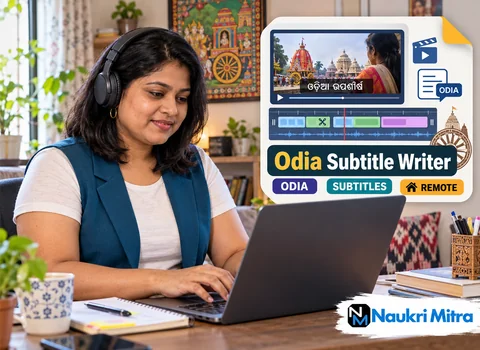
Close-up on the mother at the door of a Cuttack house. She looks at her son's muddy shoes, sighs, and says a long, warm, slightly sarcastic Odia sentence about boys who never grow up. Then the camera cuts away. You get a moment, and two short lines, to carry all of it. That squeeze, where a full sentence of feeling has to fit through a keyhole of screen time, is the daily work behind these online odia subtitle writer jobs. You can take it on part-time from any country, entirely online, at $10 per hour in USD. You translate and time subtitles for films and shows, working in tools such as Subtitle Edit or Aegisub, and freshers are welcome once they pass the subtitle test.
If someone asks what an Odia subtitle writer does, the short answer is that you decide what the viewer reads, and exactly when. The longer answer has four parts. You listen to the dialogue, either in Odia or in English, depending on the project. You write or adapt the text so it carries the meaning in fewer words than were spoken. You set an in cue and an out cue for each subtitle so it appears with the speech and leaves before it overstays. Then you check your file against the style guide and fix whatever the quality checker flags before the final delivery.
Files may be transcription (Odia audio to Odia text), translation (English to Odia or the reverse) or adaptation of a rough draft that needs cutting and retiming. The odia subtitle writer job description covers all three, and the brief tells you which one you have.
Good translation with bad timing is still a bad subtitle. Timing and translating Odia subtitles for films and shows means watching the waveform as closely as you listen. A late subtitle feels like a bad dub. You will learn to snap cues to the start of a voice, keep a small gap between consecutive subtitles, and respect scene cuts unless the line really needs to cross one.
Fast exchanges are where most people slip. Two characters arguing on a Bhubaneswar bus overlap, and you decide whether to merge them into a two-speaker subtitle or split them.
Viewers read slower than actors talk. Every project sets a reading-speed limit, and your text has to fit inside it. That is the reason a subtitle is rarely a word-for-word translation. You drop filler, fold two clauses into one, and pick the shorter of two equal words. In Odia, that often means choosing a natural spoken form over a heavy Sanskrit-derived one, as long as the tone of the scene allows it. A priest keeps the formal word; a college boy should not.
The craft is cutting without losing the joke, the threat or the tenderness. If the mother at the door is being sarcastic, the subtitle must still sound sarcastic, even with half the words gone.
Where you break a two-line subtitle changes how it reads. The general rule is to break at a natural pause and keep grammatical units together. Odia gives you a few specific traps. Case endings and postpositions sit on the noun, so a word like ଘରକୁ stays whole and never gets split. Do not strand a verb on one line and its helping verb on the next. Keep a name and its honorific together. And never let a conjunct letter (a juktakhyara) break apart because of a stray space or a bad copy-paste, which happens more than you would expect.
Punctuation is its own small decision. Some guides want the danda (।) to close a sentence and others want a plain full stop. Follow the guide for that project, and stay consistent through the whole file.
All work is typed in Odia Unicode, not in older legacy fonts that only look right on one computer. Many writers use the InScript layout or a phonetic input tool, and fonts such as Noto Sans Oriya or Kalinga will render the text on most systems. Check that matras render in place and that the dotted letters (the nukta forms of da and dha) show up correctly rather than as a letter with a loose dot beside it.
Odia Unicode typing is also part of the subtitle test for remote subtitlers. Expect a short clip to transcribe or translate and time, plus a few spelling checks. Common slips the test watches for include mixing up ଣ and ନ, choosing between ଶ, ଷ and ସ, and confusing ଯ with ୟ. Careful spelling matters more than speed here.
You need comfort in at least one subtitling program. For Odia subtitling, skill in Subtitle Edit or Aegisub comes down to a handful of habits: loading the video and waveform, setting cues with shortcuts, watching the reading-speed indicator, and exporting in the format the project asks for, often SRT. Both tools are free to practise in.
Many streaming projects follow a published standard such as the Netflix Timed Text Style Guide, or a client guide for Odia built along similar lines. These documents spell out character limits per line, how to show songs and on-screen text, and what counts as an error. Read it before your first cue. The checker will.
People often ask how an Odia subtitle writer differs from an Odia translator. It comes down to the frame. A translator working on a document can take as many words as the meaning needs. A subtitler has a clock and a character count. You still need full command of Odia and English, but you also need to think in screen time, shot changes and how fast an eye can read. Some good translators find the switch hard at first.
Your kit is simple: a laptop, a decent pair of headphones and a steady internet connection. Dialogue under a song is impossible to catch on laptop speakers.
If you are wondering how to start odia subtitling work without experience, this post is open to you. Freshers can join after passing the subtitle test, so these are genuine odia subtitle writer jobs for freshers. A practical route looks like this: install Subtitle Edit or Aegisub, take a short Odia clip you have permission to use, and subtitle it from scratch. Watch it back the next day and you will spot late cues and clumsy breaks.
An odia subtitle writer course or certification can help you learn the rules faster, but it is not required for this role. What counts is how your test file reads on screen. If you are building an odia subtitle writer resume, list the languages you work in, the tools you know, and any practice projects, with a short sample if you have one.
The odia subtitle writer salary for this post is $10 per hour, paid in USD. Some people in the field ask about pay per minute or hour; here, it is hourly. As odia subtitle writer work from home, these part time odia subtitle writer jobs can sit next to studies or another job, and hours depend on the files available. These freelance odia subtitle writer jobs do not promise a fixed volume of work.
As for demand, Odia films, TV serials, web shows and documentaries reach viewers who want to watch them with subtitles, and OTT platforms keep adding regional titles. Localization vendors such as Iyuno or ZOO Digital are examples of companies that handle subtitling work in the wider industry. This post is not a listing from any of those companies. It is an opening for a careful subtitler who can make a sarcastic mother sound sarcastic in two short lines.