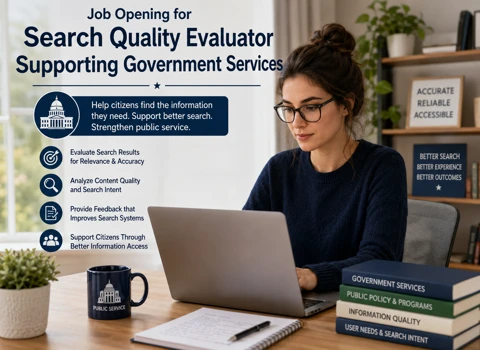
Understanding the Role of a Search Quality Evaluator Supporting Government Services
A
Search Quality Evaluator Supporting Government Services helps improve the way people access and discover information online. Government agencies publish a vast amount of digital content, including forms, service guides, policy updates, benefit information, and public resources. The purpose of this role is to ensure that search engines and internal search platforms return accurate, relevant, and helpful results when users search for government information.
This position blends research abilities, analytical thinking, attention to detail, and an understanding of how people search online.
Working remotely, evaluators review search results, analyze content quality, and provide feedback that supports improvements to search algorithms and information retrieval systems.
With a pay rate of
$40 per hour, this remote opportunity appeals to professionals who enjoy research, data analysis, content evaluation, and digital information management.
Why Government Organizations Depend on Search Quality Evaluation
Government websites are often the first place citizens turn for information on taxes, healthcare programs, licenses and permits, employment assistance, public safety updates, or social services.
When search functions fail to deliver relevant results, users can become frustrated or struggle to locate critical information. A
Search Quality Evaluator Supporting Government Services helps address these issues by reviewing search performance and identifying opportunities to improve the quality of results.
Organizations hire professionals in this role to:
- Improve the accuracy of search results
- Help citizens locate government resources more efficiently
- Support digital modernization projects
- Measure content relevance and usefulness
- Improve user experiences across government websites
- Assist with refining search ranking systems and algorithms
Their evaluations help make public information easier to access and understand.
How Search Quality Evaluation Works in Practice
Many job seekers ask what a Search Quality Evaluator Supporting Government Services actually does on a day-to-day basis.
The role is not focused on building search engines or writing code. Instead, evaluators examine how well search systems perform from a user's perspective. They review search queries, analyze the results displayed, and determine whether those results satisfy the likely needs of the person searching.
For instance, if a user searches for "renew driver's license online," the evaluator checks whether the search results lead directly to the appropriate government service rather than unrelated pages or outdated information.
The work relies heavily on human judgment, content evaluation, and relevance assessment rather than software development.
A Typical Day in a Remote Evaluation Environment
Most assignments are completed through specialized online platforms that provide evaluation tasks and guidelines.
Daily responsibilities may include:
- Reviewing assigned search queries
- Comparing search results against quality standards
- Evaluating content accuracy and relevance
- Assigning ratings based on usefulness
- Identifying outdated, misleading, or low-quality content
- Recording observations and feedback
- Performing quality assurance checks
- Meeting productivity and accuracy goals
Because government information can change frequently, evaluators must stay informed about updates to policies, regulations, and public services.
Evaluating Search Intent and User Needs
Understanding search intent is one of the most important aspects of this profession.
Every search query reflects a goal or need. A Search Quality Evaluator Supporting Government Services must determine what the user is trying to accomplish and whether the search results successfully meet that objective.
Common categories of search intent include:
Informational Searches
These searches are made by users looking for explanations, guidance, or educational content.
Examples include:
- How to apply for unemployment benefits
- What documents are required for a passport application
Transactional Searches
These searches indicate that the user wants to complete a task or service.
Examples include:
- Renew vehicle registration
- Submit tax forms online
Navigational Searches
These searches are intended to locate a specific website, portal, or webpage.
Examples include:
- Social Security Administration login
- State government employment portal
Recognizing the difference between these search types helps evaluators make accurate relevance decisions.
Digital Tools Commonly Used in the Profession
Although this role does not require advanced programming skills, professionals regularly use a variety of digital tools and online systems.
Commonly used tools include:
- Search evaluation platforms
- Internet browsers
- Content management systems
- Government service portals
- Data annotation tools
- Productivity software
- Spreadsheet applications
- Reporting and documentation systems
Comfort with technology is important because evaluators often work across multiple platforms throughout the day.
Skills That Make Candidates Effective in This Position
Successful
Search Quality Evaluators Supporting Government Services typically possess a combination of analytical and communication skills.
Research and Investigation Skills
Evaluators must be able to locate reliable information quickly and verify whether content is relevant to a search query.
Critical Thinking
Search results are not always straightforward. Professionals need strong judgment to determine whether information truly satisfies user intent.
Attention to Detail
Minor wording differences can affect search relevance. Careful review helps ensure accurate evaluations.
Written Communication
Clear notes and feedback allow organizations to understand evaluation outcomes and improve search performance.
Time Management
Since many positions are remote, professionals must organize their workload and complete assignments efficiently.
Information Literacy
The ability to identify trustworthy government sources and distinguish them from unreliable content is essential.
Educational Background and Professional Preparation
There is no single educational route into this field, but many employers prefer candidates with strong analytical and research backgrounds.
Relevant areas of study include:
- Communications
- English
- Journalism
- Information Science
- Public Administration
- Political Science
- Library Science
- Data Analysis
- Social Sciences
A bachelor's degree is often preferred, although some employers place greater emphasis on practical experience, research abilities, and evaluation skills.
Individuals with strong reading comprehension and analytical thinking skills can often transition successfully into this profession.
Certifications and Learning Opportunities That Add Value
Formal certifications are not always required for a Search Quality Evaluator Supporting Government Services position, but additional training can strengthen a candidate's profile.
Useful learning areas include:
- Information management
- Digital content evaluation
- Data analysis
- User experience research
- Search engine fundamentals
- Government records management
- Quality assurance practices
Ongoing professional development is beneficial because search technologies and digital government services continue to evolve.
Challenges Professionals Commonly Encounter
Like many analytical careers, search quality evaluation comes with its own set of challenges.
One common challenge is maintaining consistency while reviewing large numbers of search results. Evaluators must apply guidelines accurately across every assignment.
Another difficulty involves interpreting vague or incomplete search queries. Users do not always provide detailed searches, so evaluators often need to determine the most likely intent behind a query.
Other challenges may include:
- Adapting to updated evaluation guidelines
- Understanding complex government terminology
- Staying current with policy changes
- Balancing efficiency with accuracy
- Working independently in a remote setting
Professionals who enjoy problem-solving and analytical work often find these challenges rewarding.
Industries and Organizations That Employ Search Quality Evaluators
While this role focuses on government services, similar positions can be found in several industries.
Potential employers include:
- Federal government agencies
- State government departments
- Local government offices
- Public sector contractors
- Search technology companies
- Digital transformation organizations
- Information management firms
- Research institutions
- Public sector consulting companies
As governments continue expanding digital services, the need for professionals who can evaluate information quality remains important.
Who Thrives in This Career Path?
This profession is often a strong fit for individuals who enjoy independent work, research, and analytical thinking.
People tend to perform well in this role when they:
- Enjoy investigating information
- Prefer structured tasks and processes
- Have strong reading comprehension skills
- Pay close attention to details
- Can follow detailed guidelines
- Value consistency and accuracy
- Work effectively without constant supervision
- Have an interest in public service information
Those who enjoy finding the most relevant answer to a question often find this work especially satisfying.
Remote Work Expectations and Professional Flexibility
Many
Search Quality Evaluator Supporting Government Services positions are fully remote, allowing professionals to work from home while supporting government-related projects.
Remote workers generally need:
- Reliable internet access
- A quiet and organized workspace
- Strong self-discipline
- Effective time management habits
- Good virtual communication skills
Because most responsibilities are completed online, the role offers flexibility while still requiring accountability, productivity, and adherence to quality standards.
Remote opportunities also allow employers to recruit qualified professionals from a wider geographic area.
Advancement Opportunities Within the Field
Experience gained as a Search Quality Evaluator Supporting Government Services can open doors to a variety of related careers.
Potential career progression opportunities include:
- Quality Assurance Specialist
- Content Quality Analyst
- Data Quality Analyst
- User Experience Researcher
- Information Management Specialist
- Digital Content Strategist
- Search Relevance Analyst
- Government Technology Consultant
- Knowledge Management Professional
As professionals build expertise in search systems, information retrieval, and content evaluation, they may qualify for more advanced analytical or leadership positions.
What Job Seekers Should Know Before Pursuing This Profession
A
Search Quality Evaluator Supporting Government Services helps bridge the gap between technology and user needs. By evaluating search results and content relevance, these professionals help ensure that citizens can access accurate, reliable, and useful government information.
The role is well-suited for individuals who enjoy research, critical thinking, digital information analysis, and remote work. While success requires patience, consistency, and attention to detail, the work can have a meaningful impact on how people access important public services.
For job seekers interested in a remote analytical career that supports information quality and public service accessibility, this profession offers valuable experience and long-term career development opportunities.