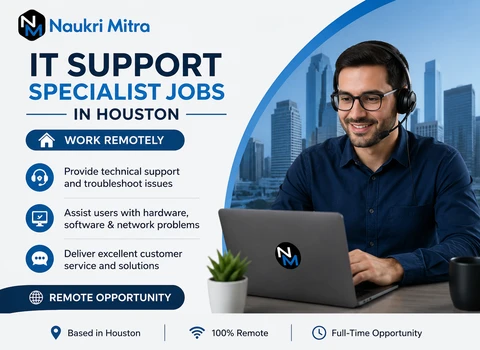
IT Support Specialist Careers in Houston
Position Snapshot
In most Houston workplaces, technology is not something people think about—until it stops working. When that happens, everything slows down at once. Emails stall, shared drives disappear, applications freeze mid-task, and frustration spreads quickly across teams.
That’s where an IT support specialist quietly steps in. Not with noise or attention, but with steady problem-solving that brings systems back to life. One minute, someone can’t log in. Next, a department is locked out of shared files. Your job is to make sure those moments stay brief.
The yearly salary for this role is around $80,000, reflecting the level of responsibility involved in maintaining day-to-day digital operations across an organization.
Your Role in the Workflow
This role sits right in the middle of business operations, even if it doesn’t always look that way from the outside. When systems work, people move faster, make fewer errors, and stay focused on the actual work rather than technical distractions.
Your contribution shows up in those small recoveries—resetting access just in time for a meeting, restoring network connectivity before a deadline slips, or helping a team get back into a system they rely on every hour.
Through help desk support, network troubleshooting, and hands-on system assistance, you remove the friction that slows people down. Over time, you become the reason workflows feel uninterrupted.
What Your Day Often Feels Like
There is no perfectly predictable routine here. Some mornings are quiet. Others start with a wave of tickets already waiting.
You might begin by helping users with login issues, then shift into diagnosing a software conflict affecting multiple machines. A few minutes later, you could be working through a network support issue that suddenly affects an entire floor.
Some problems are quick—password resets, printer errors, and access requests. Others require digging deeper into system logs or coordinating with infrastructure teams to figure out what’s really going on.
A ticketing system helps keep everything organized, but real work depends on judgment: what needs attention first, what can be resolved quickly, and what needs escalation. Remote support tools often let you step directly into a user’s system, saving time and avoiding unnecessary delays.
Skills That Actually Matter Day to Day
Technical knowledge is important, but it only works when paired with clear thinking. A strong understanding of system administration basics, operating systems, and troubleshooting methods gives you a solid starting point.
But the real difference often comes from communication. Most users don’t want technical details—they want their issue fixed and an explanation they can actually understand. That ability to translate complexity into clarity is a big part of the job.
Experience with IT support specialist tools, hardware, and software, as well as remote diagnostics, helps you move faster and avoid guesswork. Just as important is patience. Some issues resolve quickly. Others take a few attempts before the pattern becomes clear.
How Work Actually Flows
This is a collaborative environment, even when you’re working independently on a ticket. You’re connected to system administrators, other IT staff, and employees across departments who depend on stable systems.
Communication happens constantly through internal tools, support platforms, and direct conversations. Sometimes you solve issues alone. Other times, you work closely with others to track down a deeper system problem.
There’s a natural back-and-forth rhythm here. Planned maintenance might be running in the background, while unexpected issues arrive without warning. You learn to shift between both without losing focus.
Tools You Use Without Overthinking Them
The tools in this role become part of your daily thinking. A ticketing system organizes incoming requests so nothing slips through. Remote support tools let you connect directly to user machines and resolve issues in real time.
Network monitoring systems help you see when something is starting to slow down or behave unusually. Diagnostic tools and system logs provide the details you need to understand what’s actually happening behind the scenes.
Alongside these, basic productivity software supports documentation, communication, and tracking. Together, they create a workflow that feels structured even when the problems themselves are unpredictable.
A Real Situation You Might Face
Picture a regular afternoon in a Houston office. People are working, meetings are running, and then suddenly, shared drives become inaccessible. At first, it looks like a small glitch, but quickly it starts affecting multiple teams.
You start by checking authentication services and reviewing network logs. Within a short time, you identify a temporary synchronization issue affecting access permissions.
While a backend fix is coordinated with the technical team, you guide users through a temporary workaround using remote support tools. Work doesn’t stop completely, but it keeps moving while the underlying issue is resolved.
After a short period, systems stabilize. Most people return to their tasks without even fully realizing how close the disruption came to bringing everything to a halt.
The Kind of Person Who Does Well Here
This role suits people who prefer solving real problems over theoretical ones. If you naturally look for patterns when something breaks or enjoy figuring out why something stopped working, this environment will feel familiar.
Calm thinking under pressure is important. So is curiosity. No two issues are exactly the same, and each one teaches you something useful for the next.
Prior experience in help desk support, network support, or technical troubleshooting helps you get comfortable faster, but mindset plays an even bigger role. People who enjoy helping others stay productive tend to do especially well here.
A Final Perspective
An IT Support Specialist role in Houston is built around keeping digital operations running smoothly, even when systems don’t cooperate. With a salary of around $80,000 per year, it offers both stability and steady professional growth in IT infrastructure and system-focused careers.
For someone who enjoys practical problem-solving, real-time challenges, and making work easier for others without being in the spotlight, this role offers a clear sense of purpose in everyday operations.