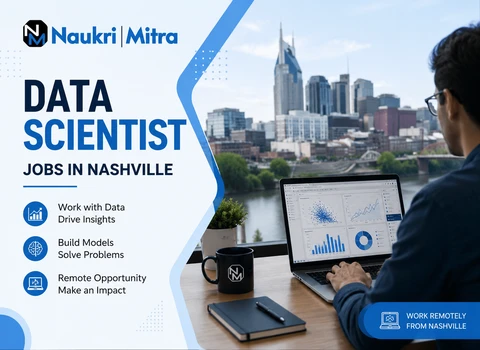
Data Scientist Opportunities in Nashville | Machine Learning & Analytics Careers
Nashville has been changing in subtle but important ways. Alongside its well-known creative and healthcare identity, there’s a growing layer of companies that run on data. Decisions are no longer driven by instinct alone—there’s a steady reliance on people who can read patterns, question them, and translate them into something useful. This Data Scientist role, offering around $130,000 per year, sits right in that shift where information quietly shapes business direction.
Position Snapshot
This is less about following a fixed routine and more about stepping into problems that don’t come with instructions. Some days begin with unclear questions—why did usage drop, why did costs spike, or why did a model behave differently after a release?
The work moves between exploration and structure. You look at raw data, clean it until it makes sense, and slowly build something that helps others see what’s really happening underneath the surface.
Contribution to the Bigger Picture
The effect of this role is usually felt downstream. A pattern found in customer behavior can shift how a product is designed. A forecasting model might quietly prevent overstaffing or improve planning accuracy across teams.
It’s not always dramatic changes. Sometimes, a small correction in a model or a clearer insight into user behavior leads to smoother operations, better timing, or fewer mistakes in decision-making. Over time, those small improvements add up in a real way.
A Closer Look at Daily Tasks
Workdays rarely look identical. The morning might start with pulling data from cloud systems or internal databases. It’s often messy at first, with missing values, inconsistent formats, or scattered logs that need structure.
Python and SQL become part of the rhythm. Not in a flashy way—just practical tools used to join datasets, reshape tables, and build something usable from raw inputs.
Later in the day, attention shifts toward testing ideas. Maybe a model needs tuning. Maybe a hypothesis needs validation through an A/B test. Or maybe a dashboard needs refining, so non-technical teams can actually understand what the numbers are saying without asking for translation.
Conversations with engineers or product teams often break up the technical work. These are usually short, direct discussions about what the data is showing and what it might mean for a real decision.
Capabilities That Help You Excel
The strongest foundation for this role is comfort with data itself—working through it without getting stuck when it’s messy or incomplete. Experience with Python and SQL is essential because most of the work starts there.
Machine learning concepts such as regression, classification, and clustering come into play when patterns need to be predicted rather than merely described. A working understanding of statistics helps when results need to be tested instead of assumed.
Just as important is clarity of thought. Being able to step back, question whether a result actually makes sense, and explain it in simple language is what makes the work useful to others.
How You’ll Collaborate and Work
This role sits in constant connection with other teams. Data scientists don’t operate in isolation—they work closely with product managers, engineers, and business stakeholders who rely on insights to make decisions.
The flow of work often moves back and forth. A question comes in from the business side; analysis begins; findings are tested; and results are shared in a way that can be acted on. Sometimes the data confirms expectations. Other times, it completely changes the direction of thinking.
There’s also room for independent digging—following patterns that weren’t explicitly asked for but turn out to be important once uncovered.
Software and Processes Used
Most of the technical work revolves around Python libraries like pandas, NumPy, and scikit-learn. SQL is widely used to extract and organize structured data from databases.
Cloud platforms handle storage and processing, especially when datasets become large or distributed. Machine learning frameworks support model building and experimentation.
Visualization tools play a key role, too. They turn complex outputs into something readable so teams outside data science can actually use the insights in their daily decisions.
A Short Workplace Story
A digital platform in Nashville notices something unusual. Engagement is dropping, but there’s no obvious technical issue.
A data scientist starts by pulling behavioral data across multiple user segments. After cleaning and organizing it, a pattern emerges—users lose interest at a specific step in the experience.
A simple model built in Python confirms that small changes in that step could improve retention. An A/B test is run to validate the idea.
A few weeks later, the results are clear. Engagement improves, drop-off reduces, and the insight is handed over to the product team for full implementation. It’s not a dramatic breakthrough moment—it’s a quiet correction that makes the system work better.
Who Will Enjoy This Work
This role suits people who don’t need all the answers upfront. Those who are comfortable working through uncertainty and building clarity step by step tend to do well here.
It also fits individuals who enjoy seeing their work used in real decisions. If the idea of your analysis directly influencing how a product behaves or how a service is delivered feels satisfying, this environment aligns well with that.
Strong collaboration skills help, but so does the ability to work independently for long stretches without losing direction.
Your Next Move
Nashville’s data-driven ecosystem continues to expand, and roles like this are becoming central to how companies operate. Machine learning, predictive modeling, and structured experimentation are no longer optional—they’re part of everyday decision-making.
For someone experienced in Python, SQL, data modeling, and analytical thinking, this role offers steady exposure to real business problems where the output is actively used. It’s practical, evolving work with a visible impact over time.