What Honing Actually Does in a Machine Shop
Walk into any precision component factory, and you'll usually find one machine tucked away from the noisy CNC section, working quietly on cylindrical parts that need to be almost perfect on the inside. That's the honing machine. Its job is narrow but critical: correct the bore of a metal part so it's round, smooth, and exactly the size the drawing calls for. Engine cylinders, hydraulic tubes, gear housings — these all pass through honing at some stage because drilling or boring alone just doesn't get the finish tight enough.
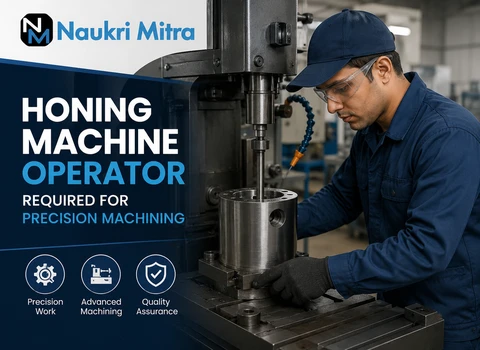
The person running this machine is the honing machine operator. In Pune, Maharashtra, there's a full-time opening for this role with a monthly salary of ₹28,500. Before we get into that, though, it helps to understand what the job is really like day to day.
Why This Step Can't Be Skipped
Here's the thing about a bore that's slightly out of round or a fraction too wide — it might look fine to the eye but fail completely under pressure. A hydraulic cylinder with an oversized bore leaks. An engine liner with an uneven surface wears out early. So manufacturers add honing as a finishing step specifically to catch the small deviations left by other machining processes.
The abrasive stones inside a honing head move up, down, and around inside the bore at the same time. That combined motion is what creates the crosshatch pattern you sometimes see on the inside of a cylinder wall. It's not decorative — that pattern actually helps oil retention and reduces wear once the part is in use.
How the Shift Actually Unfolds
No two days are identical, but there's a rhythm to it. Machines get checked first — coolant levels, stone condition, air pressure if it's a pneumatic setup. Then comes the part that separates an average operator from a good one: setting the stones and running a few trial pieces before full production starts.
Once the setup is confirmed against the drawing, production runs continue with periodic checks. An operator isn't just feeding parts in and out all shift; measuring, adjusting, and troubleshooting take up a large chunk of the time too. Some of what fills the hours:
- Reading drawings for tolerance, finish grade, and bore diameter
- Adjusting stone pressure and stroke length based on material and finish requirements
- Loading and unloading components without damaging the bore surface
- Checking parts with bore gauges, micrometers, and dial indicators
- Flagging or separating out parts that don't meet spec
- Logging production counts and basic quality data
Pune's Manufacturing Base and Why It Matters Here
Pune has grown into one of India's stronger hubs for automotive and precision component manufacturing, and that's exactly the kind of environment where honing operators are in steady demand. Component suppliers feeding two-wheeler and four-wheeler assembly lines, tool rooms, and precision engineering units are the typical employers for this trade in the region.
This particular position is full-time and based in Pune, Maharashtra, India — details worth keeping in mind if you're comparing it with other openings, since shift structure and location can vary quite a bit between factories even within the same city.
The Toolkit You'll Actually Touch
A honing machine doesn't work in isolation. Operators end up handling a fair spread of supporting equipment too:
- Vertical or horizontal honing machines, depending on the shop
- Bore gauges and telescopic gauges for internal measurement
- Micrometers and vernier calipers
- Dial indicators to check run-out
- Surface roughness testers
- Basic hand tools for stone changes and minor adjustments
It's also worth knowing that many tool rooms handle EDM (Electrical Discharge Machining) work alongside honing. So exposure to EDM processes, along with comfort reading engineering drawings and using precision instruments, tends to make a candidate more employable — even if it's not the core part of the job.
What Actually Makes Someone Good at This
Technical knowledge gets you in the door, but this trade rewards patience more than almost any other machining role. You're working in fractions of a millimeter, and rushing a setup usually shows up as rejected parts later.
A few things tend to separate operators who do well from those who struggle:
- Comfort reading engineering drawings, including tolerance and surface finish symbols
- A steady, methodical approach — this isn't a job for someone who likes to move fast and fix later
- Basic understanding of metal behavior and how cutting fluids affect finish
- The instinct to ask "why" when a part comes out slightly off, instead of just re-running it
Honestly, a lot of this comes from time on the floor rather than a classroom. Someone who's spent six months actually handling gauges and adjusting stones will often outperform someone with stronger theoretical knowledge but no hands-on time.
Where the Qualification Requirement Sits
Employers hiring for honing work generally look favorably at candidates with an ITI in a machining-related trade — Fitter, Turner, or Machinist backgrounds are common. A Diploma in Mechanical Engineering or Tool and Die Engineering also fits well here, particularly for someone hoping to move into a supervisory role down the line.
That said, formal education isn't the only route in. Equivalent vocational training, combined with genuine practical exposure to EDM machines, engineering drawings, and precision measuring instruments, is often valued just as much — sometimes more — than a certificate alone.
On Your Feet, Around Machines, Most of the Shift
This is physical work in the sense that you'll be standing for long stretches and repeating fine hand movements throughout the day. It's not heavy labour, but it does demand a certain level of stamina and comfort in an industrial setting — coolant smell, machine noise, and metal shavings are just part of the territory.
Shift work is common in this line of work. Depending on how the factory schedules production, that can include rotational shifts and occasional night shifts, so it's worth asking about shift patterns specifically when exploring a role like this.
Safety Isn't Optional Around Rotating Tooling
Honing machines involve moving parts and cutting fluid, both of which carry real risk if safety practices are ignored. Most workplaces expect operators to follow a fairly standard set of precautions:
- Safety glasses, to protect against splashes and flying particles
- Safety shoes, since dropped components are a genuine hazard
- Gloves for handling — removed during actual machine operation, per standard safety protocol
- Hair tied back and no loose clothing near moving components
- Proper lockout procedure before any maintenance work begins
None of this is complicated, but skipping it even once is usually how accidents happen. Good operators treat these habits as automatic, not optional.
What Trips Up Most Beginners
If there's one thing that frustrates new operators early on, it's consistency. Getting one part right is easy. Getting the fiftieth part in a shift to match the first one exactly — while stones wear, coolant temperature shifts, and material batches vary slightly — that takes real practice. Coolant management and tool wear tracking are the two areas that usually cause the most grief in the first few months.
The good news is that this evens out with time. Most operators develop a feel for the machine that's hard to teach directly — you just get there through repetition.
Where This Can Lead
This isn't a dead-end role. Operators who show consistency and a genuine interest in the work often move from junior positions into handling more complex components, and from there into senior operator or quality inspector roles. Some go further into shift supervisor positions, and a few with strong technical grounding move into broader tool room work that combines honing with other precision finishing processes.
None of that happens automatically, though. It tends to follow people who keep learning new setups rather than sticking to what they already know.
What the Job Pays and What Else Might Come With It
This role, based in Pune, Maharashtra, India, is a full-time position paying ₹28,500 per month. That figure reflects the precision and responsibility required to maintain tight tolerances on parts that often end up in engines or hydraulic systems, where failure isn't an option.
Beyond the base pay, full-time roles in this sector sometimes include additional benefits — overtime pay, Provident Fund (PF) contributions, ESI coverage, occasional bonuses, uniforms, or access to transport and canteen facilities. These vary by employer, so it's worth confirming directly rather than assuming they're included.