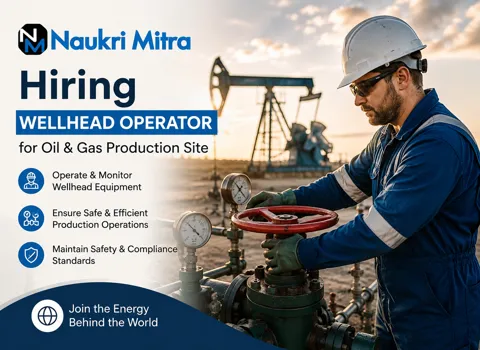
What a Wellhead Operator Actually Does in the Oilfield
Barmer district in Rajasthan has some of the busiest onshore oil fields in India, and that's exactly where this opening sits. It's a Full-time position at ₹40,500 per month, based in Barmer, Rajasthan, India. If you're looking into this line of work for the first time, here's the short version: a wellhead operator sits at the point where crude oil, gas, and water first reach the surface, and their job is to keep that flow safe, steady, and properly recorded.
The wellhead itself is basically the control point of a producing well. Pressure gauges, valves, chokes — all of it sits right there above ground, and someone has to watch it every shift. That someone is the wellhead operator.
Why This Job Exists on Every Production Site
No well runs itself for long. Pressure drifts, a valve starts leaking, a gauge reads wrong — small things, but if nobody catches them early, production drops or worse, safety becomes a problem. That's why companies keep operators posted at wellheads round the clock instead of checking in only occasionally.
A Regular Shift, Start to Finish
Rounds usually start the shift — walking to each assigned well, reading pressure and temperature, checking valves are sitting where they should be. Anything odd goes into the log, on paper or on a tablet, depending on the site, and is flagged to the supervisor right away. Between rounds there's cleaning, small maintenance jobs, and a fair bit of radio chatter with the production team about what's coming next.
Day-to-Day Tasks on the Job
- Reading wellhead pressure, temperature, and flow rate off gauges and sensors
- Adjusting chokes and valves to keep production within set limits
- Checking the Christmas tree assembly for corrosion or seepage
- Keeping shift logs accurate — this gets checked often
- Calling in unusual readings before they turn into bigger issues
- Helping the servicing crew during workover jobs
- Getting permits signed off and following lockout-tagout steps before touching anything under maintenance
Where This Work Happens
Mostly it's onshore fields — well pads out on their own, gathering stations, sometimes a bigger processing terminal where several wellheads feed into one system. In Rajasthan's oil belt, many of these locations are spread out along service roads, so getting to your assigned well can take up a chunk of the shift. Gas processing units, where the separated gas is treated before it moves on, also employ operators, though the equipment there looks a little different.
The Equipment You'll Be Working With
Knowing your way around wellhead hardware isn't optional here. Pressure gauges, flow meters, master valves, the Christmas tree — that's the stack of valves and fittings sitting on top of the well controlling everything that comes up. Hand tools come out for small adjustments. Gas detectors clip onto the belt. A radio stays within reach at all times, because coordination matters more than people expect until they're actually on site.
Understanding which valve does what, and in what order to operate them, takes a while to click. Most operators say it's the kind of thing you only really learn by doing it wrong once under supervision and getting corrected.
What Employers Look For
An ITI in a fitter, mechanical, or instrumentation trade puts a candidate in a good position, though diploma holders and those with prior field exposure receive equal consideration. What tends to matter just as much as the certificate is whether someone has actually stood near a live wellhead before — operated a valve, read a real gauge under pressure, dealt with an alarm going off. That kind of hands-on time counts for a lot.
Beyond the technical side, supervisors want people who won't cut corners on safety steps even when nobody's watching, who can read a gauge and trust the number instead of guessing, and who communicate clearly over the radio when something's wrong. A lot of the shift happens without direct supervision, so being dependable matters more here than in many other roles.
Physical Side of the Job and Shift Timing
Expect to be on your feet, walking between wells, occasionally lifting or carrying tools. Sites run continuously, so shifts rotate through day and night. Barmer gets extremely hot for a good part of the year, and there's no getting around working outdoors through it — stamina and heat tolerance genuinely matter for this role, more than most job postings mention upfront.
Safety Isn't a Checkbox Here
PPE is worn full-time on-site — helmet, fire-resistant coveralls, goggles, gloves, steel-toed boots. Gas checks happen before entering certain zones, permits get signed before maintenance starts, and everyone on shift is expected to know the shutdown procedure cold, not just in theory. Hydrocarbons don't forgive shortcuts, and pressurized equipment even less so. Rushing through a step to save five minutes is the kind of habit that gets corrected fast on a real site.
What Makes This Job Hard, Honestly
New operators usually struggle with two things early on: the isolation of remote well locations with little around, and the pressure to make a quick call when something goes wrong. A gauge spikes, and there's no time to phone a friend — you act on what you know. It takes months, sometimes longer, before valve layouts stop feeling unfamiliar and readings start making instant sense instead of requiring a second look.
Where the Role Can Lead
Most people start as a trainee or junior operator and move up to senior operator once they've handled a range of well types and situations. From there, a shift-in-charge or production supervisor role is a realistic next step, overseeing several wells or an entire pad instead of just one assignment. Some operators shift sideways into well servicing or workover crews; others move toward production engineering support — both paths build on the same core wellhead experience.
Pay and What Might Come With It
The role pays ₹40,500 per month, full-time, in Barmer, Rajasthan. As with a lot of field jobs in Indian oil and gas, there could be extras — overtime for additional shifts, PF and ESI coverage, uniforms, transport to and from the site, maybe a canteen. None of this is guaranteed by default, though, so it's worth asking the employer directly what's actually included before making assumptions.
If You're Just Starting Out
Freshers and ITI candidates get thrown into real operations fairly quickly in this line of work — there's not much sitting around in a classroom once you're on site. Spend the first months really learning the valve system and pressure behavior rather than rushing to look competent. For anyone already coming from a mechanical or instrumentation background, much of that knowledge carries over directly, making this an easier entry point into oil and gas than people often assume.