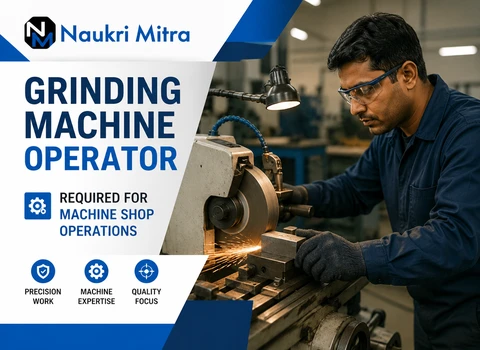
What Grinding Work Actually Involves
Metal parts rarely come off a lathe or mill ready for use. Most still need a final pass to bring them to the exact size and finish a drawing calls for, and that's where grinding comes in. A Grinding Machine Operator Required for Machine Shop Operations spends the day removing tiny amounts of material with an abrasive wheel until a part sits within a few microns of its target dimension. It's slow, careful work, and it's currently open as a Full-time position in Rajkot, Gujarat, India.
Where This Role Fits in a Machine Shop
Grinding usually happens near the end of a part's journey through the shop. By the time a component reaches the grinder, someone has already spent hours turning or milling it, so there's real cost riding on getting this step right. A rushed or careless pass can scrap a part that took half a day to make. That's part of why shops don't hand this station to just anyone — they want someone who checks twice, works methodically, and doesn't get impatient with slow, repetitive cuts.
A Look at the Daily Routine
An operator's shift typically starts with the job card: what part, what tolerance, what finish. From there, it's set up — mounting the workpiece, picking or dressing a wheel suited to the material, and taking the first cuts lightly rather than aggressively. Between passes, most of the time goes into measuring, comparing against the drawing, and adjusting. Toward the end of the shift, there's usually cleanup, a wheel check, and a note of anything rejected or reworked.
- Reviewing drawings and job cards before setup
- Mounting components on cylindrical, surface, or tool room grinders
- Dressing or replacing wheels as needed
- Measuring between passes with precision instruments
- Logging output, rework, and rejections
- Shutting down and cleaning the machine at shift end
Industries That Hire for This Kind of Work
Automotive component makers, tool and die shops, agricultural equipment manufacturers, and general engineering workshops all need grinding capacity at some point in their processes. Rajkot has a fairly deep engineering and machine-tool base, so demand for this skill tends to remain steady rather than seasonal. The work itself happens indoors, on a shop floor shared with lathes, mills, and inspection benches — not outdoors or in a warehouse setting.
Machines and Instruments on the Floor
Depending on the shop, an operator might run a cylindrical grinder, a surface grinder, a centerless grinder, or a tool and cutter grinder. Measuring tools sit right alongside the machine — micrometers, vernier calipers, dial gauges, sometimes a height gauge or surface comparator. Quite a few tool rooms also keep an EDM setup nearby for die work, and operators who can read engineering drawings and handle EDM alongside grinding tend to be in a stronger position than those who can only do one.
Skills That Separate a Good Operator from an Average One
Feed rate, wheel speed, and coolant flow interact, and getting any one of them wrong results in a burnt surface or a finish that doesn't pass inspection. Reading a drawing is one thing; turning it into a machine setup that actually produces the right part is a different skill, and it's usually built through trial and error alongside someone more experienced.
- Working knowledge of tolerances and surface finish requirements
- Choosing the right wheel grit and bond for the material
- Confidence with micrometers and other measuring instruments
- Spotting dimensional drift before it becomes a batch of scrap
- Patience to stop and recheck rather than push through
None of this happens in isolation, either. Keeping the wheel storage area dry, wiping down the machine bed, and flagging a bad batch of raw material to a supervisor early — these small habits are usually what separates someone reliable from someone who's constantly cleaning up avoidable mistakes.
What Employers Look for on Paper
There isn't one fixed qualification here. Some shops are fine with an ITI in a machining trade; others, especially for toolroom precision work, prefer a Diploma in Mechanical or Tool and Die Engineering or equivalent vocational training. In practice, hands-on time with grinding machines, some exposure to EDM, and comfort reading engineering drawings often carry as much weight as the certificate itself.
Physical Side of the Job and Shift Timing
This is standing work, done at close range, with repetitive movement and metal parts that can be heavy or sharp-edged. Decent eyesight matters, since a lot of the day is spent reading fine measurement scales. Many machine shops operate rotating shifts to keep production running, so operators should expect occasional night shifts depending on how the employer schedules production.
Safety Around Wheels, Sparks, and Coolant
A grinding wheel spinning at high speed isn't forgiving of shortcuts. Damaged wheels can fracture, and fine metal dust builds up quickly if it isn't managed. Most shops expect safety goggles or a face shield, gloves suited to machine work, safety shoes, and ear protection where noise levels run high. Wheel guards stay on, always — removing one for convenience is how accidents happen. Coolant systems also need regular checks, both to stop the workpiece from overheating and to avoid skin irritation from prolonged contact.
The trickier part of the job is usually thermal drift — a part measures fine right after grinding but shrinks slightly as it cools, throwing off the reading. Operators who make a habit of checking the first and last piece in a batch, rather than trusting the middle to stay consistent, tend to catch this before it costs them a rework.
Where the Role Can Lead
Most people start with surface grinding and move toward cylindrical or toolroom grinding as they get comfortable. From there, some move into senior operator or shift-in-charge roles; others shift toward quality inspection, where their sense of tolerances becomes even more useful. Tool and die grinding, in particular, tends to earn more respect on the floor because of how much precision it demands. Picking up basic CNC grinding controls along the way can also open doors to newer machines as shops upgrade.
Pay for This Position
The role in Rajkot, Gujarat pays ₹25,500 a month on a Full-time basis. Some employers add overtime pay, PF and ESI contributions, an annual bonus, or facilities like uniforms, transport, or a canteen — none of these are guaranteed, and they vary by employer, so it's worth confirming during the hiring conversation rather than assuming.
A Few Honest Tips Before You Apply
If you're new to this trade, get comfortable with a micrometer before you ever touch a grinding machine — misreading one is probably the most common beginner mistake. If you already have some machining experience, spend time understanding how different materials behave under the wheel; mild steel, hardened steel, and cast iron don't grind the same way. For anyone based near Rajkot looking at manufacturing work, this is a reasonably steady way into precision engineering, with a real path toward tool room or quality-focused work down the line.