What Happens to Paper After It Leaves the Main Production Line
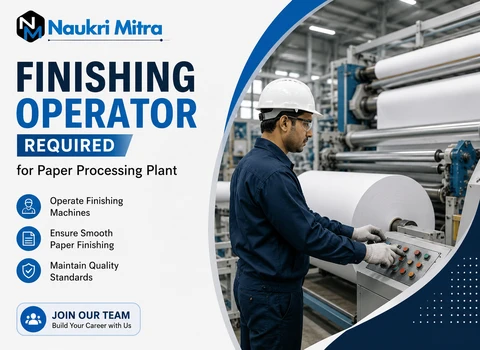
A reel of paper coming off a paper machine isn't ready for anyone to use yet. It still needs to be cut to size, checked for defects, and stacked correctly before it can be made into notebooks, cartons, or printing sheets. That last stretch of work has a name in the industry — finishing — and the worker who runs it is the Finishing Operator. Right now there's an opening for a Finishing Operator Required for a Paper Processing Plant in Muzaffarnagar, Uttar Pradesh, a full-time position in a region where paper units run shift after shift to keep up with demand.
The Reason Plants Keep This Position Filled
Raw paper output is messy by nature. Edges come out uneven, sheet sizes drift from what a customer ordered, and if stacking isn't done to count and weigh, dispatch gets delayed. A plant without a finishing operator ends up shipping inconsistent material — and that costs money fast, either through rework or an angry customer on the phone. So this job exists because someone has to stand between "raw output" and "product ready to leave the gate."
A Rough Idea of How the Shift Goes
Most operators start by walking the finishing line — checking blades, guides, and sensors before anything gets fed through. Once the line is running, reels or sheets move into the finishing machine, and the operator keeps an eye on cut accuracy while pulling finished stacks off for packing. Thickness and surface checks occur throughout, not just at the start, and there's usually a production log to complete by the end of the shift.
What the Work Actually Involves
- Running cutting, trimming, and sheeting machines
- Measuring paper dimensions with scales and gauges
- Sorting output by size, grade, or thickness
- Catching defects — tears, moisture marks, uneven edges — before they move further down the line
- Keeping pace with the packing team so material doesn't pile up
- Flagging machine issues to maintenance before they become bigger problems
Equipment You'll Be Working With
The finishing section usually has reel cutters, sheet cutters, guillotine trimmers, and stacking units. Beyond that, operators use hand tools for measurement — vernier calipers, thickness gauges, weighing scales — to confirm the output actually matches what was ordered. None of this is complicated once you've handled it for a few weeks, but blade alignment and speed settings do need to be understood properly, or wastage adds up quickly.
Who Tends to Get Hired for This
Both freshers and experienced hands are considered, though anyone with prior machine-operation exposure has an edge. Employers often lean toward candidates with some machining or tool room background — an ITI in a machining trade, a Diploma in Mechanical or Tool and Die Engineering, or similar vocational training tends to help. That said, hands-on experience with EDM machines, reading engineering drawings, and using precision measuring instruments can matter just as much as a certificate, since it shows the person can actually follow specifications rather than eyeball things.
Beyond the technical side, the workers who do well here tend to be the ones who don't lose focus during repetitive stretches. Attention to detail, physical stamina for standing shifts, and being able to coordinate with the rest of the line are what separate a smooth shift from a messy one.
What the Work Environment Is Like
This is a full-time role, based in Muzaffarnagar, Uttar Pradesh, and it involves a lot of standing near active machinery — not a desk job by any stretch. Paper plants generally operate on rotational shifts to maintain continuous production, so operators should expect to work varying hours rather than a fixed nine-to-five. Expect some noise from the machines and paper dust in the air; it's a normal part of the setting, not a sign something's wrong.
Staying Safe Around the Machines
Blades and rollers don't forgive carelessness. PPE — gloves, dust masks, safety shoes — is standard here, and machines shouldn't be touched or adjusted while running, full stop. Loose clothing and jewelry near moving parts is asking for trouble. Lock-out procedures during maintenance exist for a reason, and reporting anything that looks unsafe right away, rather than waiting, is what keeps a shift accident-free.
Where New Operators Usually Struggle
Cutting accuracy at high speed takes time to get right — it's rarely intuitive on day one. Paper jams show up when least expected, blades dull faster than people assume, and humidity can throw off paper quality without much warning. The operators who improve fastest are the ones who learn to spot these issues before they turn into a defect, not after.
Where This Role Can Lead
It's a solid starting point in manufacturing. Operators who stick with it and build a track record can move toward senior operator roles, shift-in-charge positions, or quality control work within the same plant over time. What usually decides who moves up isn't seniority alone — it's whether someone consistently knows the machine well and can be relied on when things go wrong.
What the Job Pays
The salary for this Finishing Operator position is ₹29,800 per month. On top of that, manufacturing roles in India often come with additional benefits — overtime pay, PF, ESI, bonuses, uniforms, transport, or canteen facilities — though these vary by company and shouldn't be assumed to be guaranteed.
Deciding If This Fits You
If hands-on machine work suits you, and a structured, shift-based routine doesn't put you off, this is a fairly realistic entry into paper manufacturing. It works for freshers looking to get a foot in the door, and equally for experienced workers in or around Muzaffarnagar, Uttar Pradesh who want a steady role without relocating far from home.