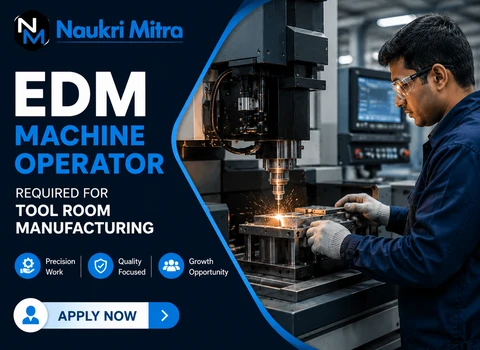
Build a Career as an EDM Machine Operator in Tool Room Manufacturing
An
EDM Machine Operator Required for a Tool Room Manufacturing role is a practical, skill-based job for people who enjoy precision work and steady machine handling. In this
Full-time position based in
Chennai, Tamil Nadu, India, the operator works with equipment that shapes metal with extreme accuracy. This is not the kind of job where you simply press a button and walk away. It needs focus, patience, and a good understanding of how precision machining works.
EDM stands for Electrical Discharge Machining. It is used when a part needs fine detail, sharp corners, or a smooth finish that is difficult to achieve with normal cutting tools. Many freshers, ITI candidates, diploma holders, and experienced technical workers look at this field because it offers hands-on work in a tool room environment and builds strong machining knowledge over time.
Why precision industries depend on this role
Toolroom manufacturing forms the backbone of modern production. When a company makes molds, dies, fixtures, or special machine parts, the accuracy of each component matters. A small error can affect the quality of the final product, delay production, or create costly rework.
That is why industries recruit skilled machine operators who can handle EDM work carefully and consistently. This profession is useful in many sectors, such as:
- Injection mold manufacturing
- Press tool and die making
- Automotive component production
- Aerospace tooling
- Electrical equipment manufacturing
- Industrial machinery workshops
- Precision fabrication units
- Heavy engineering plants
EDM is especially valuable when the job involves hardened steel, deep cavities, narrow slots, or shapes that are hard to machine with a milling cutter. In many Indian manufacturing units, including those in Chennai, Tamil Nadu, India, tool room teams depend on EDM to keep production moving smoothly.
Understanding how EDM technology works
Electrical Discharge Machining removes metal using controlled electrical discharges rather than a rotating cutting tool. The workpiece and the electrode are kept very close together, and a dielectric fluid surrounds the area. When the machine sends electrical pulses, tiny sparks jump across the gap, removing microscopic bits of metal.
A simple way to understand it is this: the machine does not “cut” in the usual sense. It erodes the metal little by little until the required shape is formed.
The process usually follows these steps:
- The workpiece is clamped firmly in position.
- An electrode or wire is aligned with the job.
- The machine creates controlled electrical discharges.
- Each spark melts and vaporizes a tiny portion of metal.
- The dielectric fluid cools the area and clears away debris.
- The cycle continues until the required dimension or profile is reached.
There are two common types of EDM work. Wire EDM uses a thin wire as the cutting element, while sinker EDM uses a shaped electrode to create cavities or detailed forms. Both are widely used in tool room manufacturing because they can produce accurate results on hard materials without heavy mechanical force.
A typical working day in the tool room
A typical shift in this job usually involves setup, monitoring, inspection, and cleaning. The operator has to stay alert because EDM jobs often run for long periods and need regular checking.
A typical day may include:
- Reading the job card and engineering drawing
- Checking the material and confirming the machining requirement
- Preparing the machine and setting the workpiece
- Aligning the electrode or wire properly
- Entering machining parameters into the control panel
- Watching spark conditions and machine performance
- Measuring the part during or after machining
- Replacing worn electrodes when needed
- Cleaning the machine bed and surrounding area
- Recording job details and inspection results
- Informing the supervisor if any fault appears
In many tool rooms, the operator also helps with small adjustments, trial runs, and final inspection. The work may look repetitive from the outside, but each job can be different because the shape, material, and tolerances vary from one component to another.
Where these professionals commonly work
People in this field are usually employed in places where precision metal parts are made or repaired. The work is mostly indoors, in a workshop or production unit, where cleanliness and order matter a great deal.
Common workplaces include:
- Tool rooms
- Mold manufacturing units
- Die shops
- Precision engineering workshops
- Automotive supplier factories
- Industrial machine manufacturing plants
- Electrical component factories
- Heavy engineering workshops
- Precision fabrication facilities
In Chennai, Tamil Nadu, India, manufacturing activity is strong in several engineering sectors, so skilled EDM operators can find work in environments that value accuracy and steady production. Depending on the unit, the job may involve day, rotational, evening, or night shifts to support continuous manufacturing.
Equipment, tools, and measuring instruments used every day
This job is closely tied to machine handling and inspection. A good operator should know how to use both the EDM machine and the measuring tools used to verify quality.
Common machines and equipment include:
- Wire EDM machines
- Sinker EDM machines
- CNC EDM systems
- Die-sinking machines
- Electrode preparation tools
- Coolant and dielectric filtration systems
Measuring and inspection tools often used in the tool room:
- Vernier calipers
- Micrometers
- Height gauges
- Dial indicators
- Bore gauges
- Slip gauges
- Surface plates
- Digital measuring instruments
Other useful workshop items include:
- Clamps and fixtures
- Magnetic chucks
- Tool holders
- Hand tools for setup and adjustment
- Air blow guns for cleaning chips and debris
A wire EDM machine uses a thin wire to cut through material with high accuracy. A sinker EDM machine uses a shaped electrode, often made from copper or graphite, to create cavities or detailed forms. Knowing the difference helps the operator choose the right setup and avoid mistakes.
Technical knowledge that helps build confidence
A strong EDM machine operator is not only someone who can run a machine. The person also needs to understand drawings, tolerances, and the logic behind the machining process.
Important technical skills include:
- Reading engineering drawings correctly
- Understanding dimensions and tolerances
- Setting up and aligning the machine
- Handling electrodes carefully
- Adjusting EDM parameters
- Checking surface finish requirements
- Using precision measuring instruments
- Identifying materials
- Understanding basic CNC controls
- Following tool room procedures
Employers may prefer candidates with relevant machining or tool room training. Depending on the complexity of the work, an
ITI in a machining-related trade, a
Diploma in Mechanical Engineering,
Tool and Die Engineering, or equivalent vocational training may be considered suitable. Practical experience with EDM machines, engineering drawings, and precision measuring instruments is often valued as much as formal education.
For freshers, the biggest advantage is a willingness to learn. For experienced workers, the advantage is the ability to handle jobs with less supervision and better accuracy.
Useful workplace habits include:
- Careful observation
- Patience during long machining cycles
- Clear communication with supervisors and teammates
- Good record keeping
- Time management
- Problem-solving when a job does not run as expected
- Consistent quality checking
Physical demands and workplace safety
This is a technical shop-floor role, so the work is active even though it is not as physically heavy as some other manufacturing jobs. Operators may stand for long periods, move smaller components, and inspect parts repeatedly during the shift.
The role may involve:
- Standing for extended hours
- Handling tooling parts safely
- Moving workpieces with proper lifting methods
- Concentrating for long machining cycles
- Repeating inspection and setup tasks
Because EDM work uses electrical systems, fluids, and industrial machinery, safety cannot be ignored.
Common PPE used in the workplace includes:
- Safety shoes
- Safety glasses
- Protective gloves when needed
- Cotton uniforms
- Hearing protection in noisy areas
Safe work habits usually include:
- Following machine operating instructions
- Keeping guards and covers in place
- Avoiding contact with live electrical parts
- Keeping the floor and machine area clean
- Handling dielectric fluid properly
- Using approved lifting tools for heavy jobs
- Reporting faults or unusual machine behavior quickly
A careful operator protects both the machine and the finished component. In precision manufacturing, safety and quality go together.
Challenges that come with precision manufacturing
EDM work can be satisfying, but it also brings pressure. The tolerances are often tight, and the material may be expensive. One wrong setup can waste time and affect production.
Common challenges include:
- Maintaining exact dimensions
- Managing electrode wear
- Working with hardened materials
- Handling long machining cycles
- Meeting delivery deadlines
- Avoiding surface defects
- Troubleshooting machine issues
- Keeping quality steady across repeated jobs
A practical example is a mold cavity that needs a sharp internal corner. A normal cutting tool may not reach it properly, but EDM can. The challenge is making sure the cavity is accurate, clean, and within tolerance. That is where skill and patience matter.
Practical habits that lead to long-term success
Good operators build strong habits early. These habits save time, reduce rework, and improve confidence on the shop floor.
Helpful habits include:
- Checking the drawing before starting the job
- Confirming the setup twice before machining
- Keeping the machine and work area clean
- Recording settings for repeat jobs
- Watching for electrode wear and spark changes
- Learning from senior tool room staff
- Improving knowledge of metals and alloys
- Practicing measurement skills regularly
Small details make a big difference in this profession. A clean setup, proper alignment, and careful measurement can prevent a lot of trouble later.
Growth opportunities within tool room manufacturing
With experience, an EDM operator can take on more responsibility inside the same field. Growth usually depends on accuracy, speed, reliability, and the ability to handle more complex jobs.
Possible career progression may include:
- Senior machine operator
- Senior EDM technician
- Tool room technician
- Tool room specialist
- CNC EDM programmer
- Tool room supervisor
- Production supervisor
- Tool room production coordinator
As skills improve, the operator may work on more difficult molds, dies, and precision components. People who understand both machine operation and inspection often become valuable members of the production team.
Salary, employment conditions, and common workplace benefits
For
the EDM Machine Operator (Tool Room Manufacturing) position in
Chennai, Tamil Nadu, India, the
monthly salary is ₹ 28500.
Since this is a
Full-time role, the work arrangement may include regular or rotational shifts, depending on the unit’s production schedule. In many manufacturing workplaces, employees may also receive benefits such as:
- Overtime pay where applicable
- Provident Fund (PF)
- Employees’ State Insurance (ESI)
- Performance or production bonus
- Paid leave as per company policy
- Uniforms
- Safety gear
- Transport support where available
- Canteen facilities in some units
These are only possible benefits and depend on the employer’s policy. They are not guaranteed in every workplace.
For job seekers who want a practical, technical career, EDM machine operation offers a solid path into precision manufacturing. It suits people who are careful, disciplined, and willing to learn from the machine, the drawing, and the job itself. Over time, this kind of work can build strong shop-floor experience and open the door to deeper expertise in tool room manufacturing.