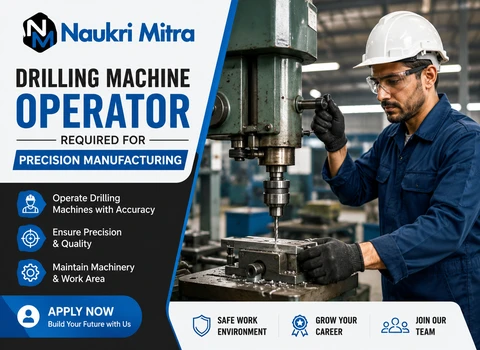
What Does a Drilling Machine Operator Actually Do?
Ask someone outside the manufacturing world what a Drilling Machine Operator does, and they'll probably picture someone drilling holes all day. That's not wrong, exactly, but it misses the point. The real job is precision — making sure every hole, every depth, every alignment matches what's on the drawing, batch after batch. This particular opening is based in Rajkot, Gujarat, India, and it's a full-time role suited to someone who's either fresh out of an ITI course or already has a few years of shop-floor experience.
The Reason Factories Keep Hiring for This Position
Here's the thing about precision manufacturing — a machine can only do what it's told, and a lot rides on whoever's setting it up. One misjudged feed rate or a slightly off-center clamp, and an entire part is scrap. That's why factories don't just want someone who can switch a machine on. They want someone who reads a drawing correctly the first time and catches problems before they turn into wasted material.
A Shift, Start to Finish
Most days start the same way: pick up the job card, look over the drawing, and set up the workpiece before touching the machine. Then comes the actual drilling — adjusting speed and feed based on whatever material is in front of you, running the first piece, checking it, and only then moving into full production.
- Reading job cards and technical drawings before starting
- Clamping and aligning the workpiece so it doesn't shift mid-cut
- Choosing the right drill bit for the material
- Checking finished pieces against tolerance limits
- Flagging tool wear or machine issues to a supervisor rather than pushing through
Beyond Running the Machine
Operating the equipment is only part of it. There's also basic upkeep — clearing swarf, checking coolant levels, keeping the station tidy — plus separating rejected parts so they don't accidentally end up in a finished batch. None of this is glamorous work, but skipping it is usually how quality problems start.
Where This Kind of Work Happens
You'll typically find drilling operators in precision engineering units, tool rooms, and component manufacturing plants. Gujarat's manufacturing base, particularly around Rajkot, has a fair number of engineering workshops that need this exact skill set — small enough to know every machine on the floor, but busy enough to run full shifts.
The Machines and Instruments You'll Work With
Radial and bench drilling machines form the core of the job, and depending on the shop, you might also work with EDM (Electrical Discharge Machining) equipment for harder materials that need extra precision. On the measuring side, expect to use vernier calipers, micrometers, and dial gauges regularly — these aren't optional extras; they're how you prove a part is within spec before it moves forward.
What Employers Actually Look For
Formal education matters, but it's not the only thing employers weigh. An ITI qualification in a machining trade is often enough to get started, and a Diploma in Mechanical or Tool and Die Engineering can help for more complex work. What tends to matter just as much, though, is hands-on exposure — having actually run an EDM machine, having read real drawings under pressure, having used measuring instruments enough times that it's second nature.
Skills that come up again and again:
- Interpreting engineering drawings without needing help
- Setting speed and feed correctly for different materials
- Handling measuring instruments confidently
- Understanding tolerances and fits, not just memorizing numbers
- Staying calm when a part doesn't come out right and figuring out why
What the Job Asks of You Physically
This isn't a desk job. Expect to stand for most of the shift, handle metal parts, and work close to moving machinery — plus some noise and coolant exposure along the way. Since it's full-time, shift rotations are possible depending on how the plant schedules production.
Staying Safe on the Floor
Safety here isn't a once-a-year training session — it's a daily habit. Machine guards stay in place, loose clothing stays away from rotating parts, and lockout procedures get followed during maintenance- no shortcuts. PPE typically includes safety glasses, gloves suited for machine work, safety shoes, and ear protection where it's loud enough to need it.
Where New Operators Usually Struggle
Consistency across a long production run is harder than it sounds, especially once you hit a harder material that chews through tools faster than expected. Add in the occasional machine breakdown or a batch of inconsistent raw material, and you start to understand why experience counts for so much in this line of work.
What Helps You Get Good at This
Operators who do well tend to get serious about drawing interpretation early on, keep their measuring tools properly calibrated, and never skip checking the first piece of a batch — even when they're in a hurry. Spotting early tool wear before it ruins a part is a habit worth building fast; it saves both material and time.
Where Experience Can Take You
Put in enough time and the work changes. Experienced operators often move on to more demanding precision jobs, take on quality-checking duties, or step into a senior operator role, guiding newer staff. The path forward usually comes from breadth — handling different machines and materials — combined with a track record of consistent accuracy.
Pay and What Might Come With It
This role, based in Rajkot, Gujarat, India, pays ₹26,000 a month on a full-time basis. Depending on the employer, additional benefits such as overtime pay, PF, ESI, bonuses, uniforms, transport, or canteen facilities may also be part of the package — though these vary from one company to another and shouldn't be assumed to be guaranteed.