The Person Behind the Backup Power
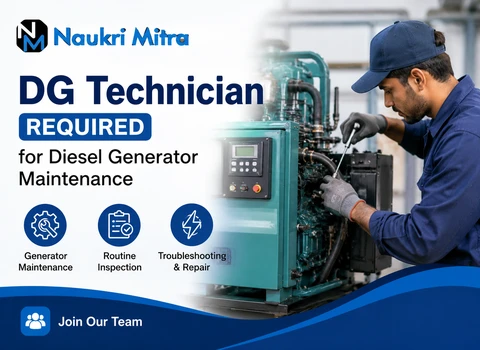
Power cuts don't stop production lines, hospital equipment, or server rooms from needing electricity. Something has to take over the moment the grid drops, and that something is usually a diesel generator sitting quietly in a back room or shed. Someone has to keep it ready. That someone is the DG Technician Required for Diesel Generator Maintenance, a position currently open in Chennai, Tamil Nadu, India. If you're an ITI graduate wondering what this job looks like day-to-day, or someone with a few years on the tools already, here's an honest look at it.
Why Companies Bother Hiring for This At All
A diesel generator left unattended doesn't stay reliable for long. Batteries die quietly. Fuel filters clog without warning. Oil breaks down and stops protecting the engine the way it should. None of this shows up until the power actually fails and the machine won't start — which is exactly the moment nobody wants a surprise. So companies bring in a technician whose job is to catch these issues before they become 2 a.m. emergencies.
What the Day Actually Looks Like
Most mornings start with a walk-around: check the oil, check the coolant, listen for anything that sounds off, confirm the battery still holds charge. Some days that's it, and the rest of the shift goes into scheduled servicing or load testing. Other days, a fault call comes in and the whole plan changes. You're now tracing a wiring fault or figuring out why the alternator output dropped, and the servicing waits.
The Work Itself
- Servicing DG sets — oil changes, filter replacements, coolant top-ups
- Tracking down engine, alternator, or control panel faults
- Watching fuel levels, battery health, and voltage output
- Keeping logbooks updated with running hours and service records
- Working alongside electrical staff during changeover or power transfer
Factories, Sites, and Buildings Where This Job Exists
You'll find this kind of work needed in manufacturing plants, commercial complexes, data centers, hospitals, and construction sites. Chennai has no shortage of these — factories that can't afford downtime and IT campuses that run round the clock both depend on dependable backup power, which keeps demand for skilled technicians fairly steady in the city.
What's In the Toolbox
Spanners and torque wrenches for the mechanical side. Multimeters and megger testers for checking insulation and electrical faults. A battery hydrometer to check charge condition. Newer DG sets also come with diagnostic ports, so reading fault codes off a small screen is becoming as normal as checking oil with a dipstick.
Skills That Actually Matter
Knowing diesel engines and alternators inside out helps, but it's not the whole story. The technicians who do well are the ones who can trace a fault logically instead of guessing — reading a wiring diagram under pressure, understanding what the control panel is telling them, staying steady when a generator won't start, and everyone's watching. That kind of judgment isn't taught in a classroom. It comes from time spent actually doing the work.
Getting In the Door: Education and Training
An ITI certificate in Electrician, Mechanical, or Diesel Mechanic trades is what most employers look for first. A Diploma in Mechanical or Electrical Engineering also works, and tends to matter more for larger DG installations. Beyond the paper qualification, hands-on exposure to engine overhaul, alternator repairs, and safe electrical handling counts for a lot — sometimes more than the certificate itself.
On Your Feet, and Sometimes at Odd Hours
This is a full-time role, and it's physical — standing for extended periods, bending into tight engine compartments, and working in spaces that aren't always comfortable. Generators don't fail on a schedule, so shift work is common, especially in facilities running production continuously.
Safety Isn't Optional
You're working near fuel, batteries, and panels that carry real voltage, so the basics matter: gloves, insulated tools, safety shoes, and ear protection near a running engine. Lockout-tagout before touching anything electrical isn't a formality — it's the difference between a routine repair and a serious accident.
The Parts Nobody Warns You About
Breakdown calls at inconvenient hours. Engine rooms that are loud and hot. Faults that only show up intermittently and refuse to repeat themselves while you're watching. None of this goes away with experience, but a methodical approach — checking one thing at a time instead of jumping around — makes it a lot less frustrating.
Where This Can Lead
Technicians who stick with it tend to move toward handling bigger capacity DG sets, supervising a small maintenance team, or specializing in automation and control panels. Reliable, consistent servicing work is usually what opens the door to a site-in-charge or senior maintenance role down the line.
What the Job Pays
This full-time position, based in Chennai, Tamil Nadu, India, comes with a monthly salary of ₹32,000. Beyond that, some employers offer overtime pay, PF, ESI, uniforms, transport, or canteen access — though this depends entirely on the company, and none of it should be assumed before joining.