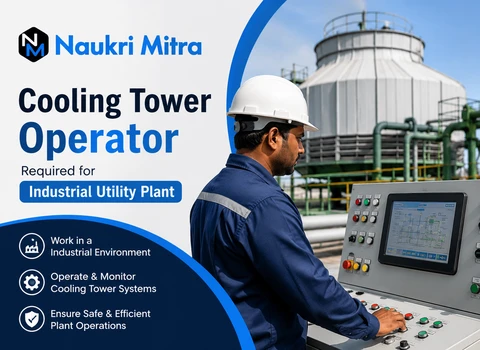
What Does a Cooling Tower Operator Actually Do?
Walk into any large industrial plant, and you'll notice something running hot somewhere — compressors, boilers, process reactors. Someone has to make sure that heat doesn't build up and cause damage. That's the job of a Cooling Tower Operator working at an Industrial Utility Plant in Jamnagar, Gujarat. It's not glamorous work, but it's the kind of role a plant genuinely cannot function without.
Why This Position Exists in the First Place
You might assume cooling systems run themselves once installed. They don't. Pumps wear out, water chemistry drifts, fans stop spinning the way they should. A plant in Jamnagar recruiting for this full-time position needs someone who notices a strange vibration or an unusual temperature reading before it becomes a shutdown. Automation helps, but it doesn't replace a trained set of eyes and ears on the ground.
A Shift on the Floor
No two shifts look identical, but there's a rhythm to it. Water levels get checked. Fan motors get listened to. Pressure gauges get read and logged. Some days it's routine — write the numbers, sign the register, move on. Other days a valve sticks or a nozzle clogs and the whole schedule shifts.
Things an operator typically handles during a shift:
- Reading inlet and outlet water temperatures at set intervals
- Listening for grinding or knocking sounds in fan motors and gearboxes
- Dosing water treatment chemicals as per instructions from the shift supervisor
- Checking fill media and drift eliminators for scale or algae buildup
- Recording everything in shift logs, whether paper-based or digital
When Something Goes Wrong
Troubleshooting is where the job gets interesting. A blocked spray nozzle, a leaking pipe joint, a bearing that's starting to fail — these aren't always obvious at first glance. Experienced operators develop a feel for what "normal" sounds and looks like, which makes it easier to catch problems early. Bigger repairs usually get handed off to maintenance technicians, but the operator is the one who flags the issue in the first place.
Where Jobs Like This Exist
Chemical manufacturing units, petrochemical complexes, power plants, textile dyeing houses, food processing facilities — anywhere there's heavy machinery generating heat, there's usually a cooling tower nearby. Gujarat's industrial belt, including areas around Jamnagar, has a steady demand for people who can keep these systems running, given the number of process industries operating in the region.
Equipment You'll Get Familiar With
Induced-draft and forced-draft cooling towers, circulation pumps, motorized fans, flow meters — these become part of daily life. So do the smaller instruments: pH testing kits, conductivity meters, and the usual hand tools like spanners, grease guns, and a multimeter for quick electrical checks.
What Makes Someone Good at This Job
Technical knowledge matters — understanding how water circulates through a system, basic electrical troubleshooting, familiarity with rotating equipment. But honestly, a lot of it comes down to attentiveness. Someone who checks a gauge and actually notices when a number looks off, rather than glancing past it out of habit, tends to do well here. Staying calm when something breaks down at 2 a.m. helps too.
Qualifications Employers Look For
An ITI certificate in Fitter, Electrician, or a similar mechanical trade tends to open doors for this kind of role. A Diploma in Mechanical Engineering is a plus, particularly for candidates hoping to move into supervisory positions down the line. That said, employers often care just as much about whether a candidate has actually handled industrial pumps and motors before, not just studied them on paper.
Physical Side of the Work
Cooling towers sit in open or semi-covered areas, so expect exposure to sun, rain, and occasional water spray from the tower itself. There's climbing involved — platforms, ladders, walkways around the tower structure. Reasonable fitness helps, since the job isn't a desk job by any stretch.
Staying Safe on Site
PPE isn't optional here. Safety shoes, a helmet, gloves, and ear protection are standard near high-noise fan areas. Lockout-tagout procedures matter greatly during maintenance work, and wet surfaces around the tower base pose a real slip hazard that operators quickly learn to respect.
What Tends to Go Wrong on the Job
Scaling, algae growth, corrosion — these show up again and again regardless of how well a system is maintained. Weather swings can affect tower performance too. Odd-hour alarms are part of the deal, and operators need to be ready to make a judgment call without waiting for a supervisor to walk them through it.
Moving Up From Here
Operators who stick with this line of work often move into senior operator roles or shift-in-charge positions within the same plant. Utility supervisor roles are another realistic next step for someone who builds solid knowledge of water treatment and preventive maintenance over a few years.
Pay and What Else Might Come With It
This is a full-time position based in Jamnagar, Gujarat, India, offering a monthly salary of ₹32,000. Some employers add extras like overtime pay, PF, ESI coverage, uniforms, or canteen and transport facilities — but these differ by plant, so it's worth confirming directly rather than assuming.
A Few Things Worth Knowing Early On
Spend the first few weeks watching how experienced operators handle small problems before they become big ones. Ask questions when a reading looks off, rather than guessing. Keep your own notes, even if the plant already has a logging system — it helps build the instinct for what's normal and what isn't, and that instinct is really what separates a good operator from an average one.