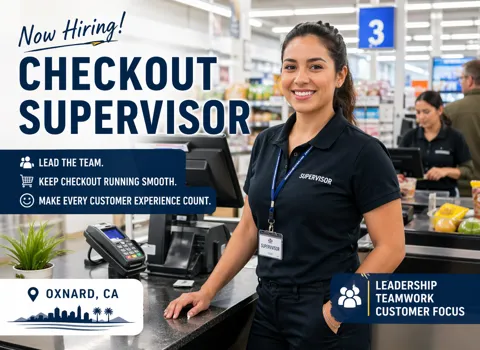
Check Out Supervisor Role in Oxnard Retail Operations
A Quick Look at the Role
So here’s the thing—if you’ve ever stood near a checkout lane on a busy day in Oxnard, you already know that’s where the whole store either feels smooth… or starts to feel a little chaotic.
That’s basically where this role sits.
As a checkout supervisor, you’re not stuck behind a desk or doing anything overly complicated. You’re right there on the floor, watching how the front end moves, stepping in when needed, and keeping things from getting stuck. Cashiers are doing their part, customers are coming in waves, and you’re the one making sure it all doesn’t fall out of rhythm.
Some shifts are calm enough that you almost forget how busy it can get. Others? You’ll be moving nonstop. That’s just retail. The pay is around $48,000 a year, which lines up with the responsibility you carry every day at the front of the store.
Why This Role Matters (More Than People Think)
Customers don’t really care about the job title. They just remember how long they waited or how smoothly things went.
If checkout is slow, that’s what sticks with them. If it’s smooth, they barely think about it. And that’s kind of the goal here.
You’re the person making sure those small frustrations don’t happen—or at least don’t last long. A frozen register, a pricing issue, a long line building too fast… these are normal things. What matters is how quickly they get handled.
There’s also the accuracy side of it. Cash handling, POS systems, transaction checks—none of it is flashy, but it keeps the store from running into problems later. A small mistake at checkout can turn into a bigger headache if nobody catches it early.
What a Shift Actually Feels Like
Most days start simple enough. You walk in, check the cash registers, make sure everything is working, and maybe have a quick word with the team so everyone knows what’s going on.
Then the store wakes up.
Customers start coming in, and the pace slowly builds. You’ll move around a lot—helping a cashier with a quick price check, fixing something in the POS system, or just stepping in when a line starts getting longer than it should.
It’s not about standing still and watching. It’s more like constantly adjusting.
And honestly, you can feel the shift when it gets busy. Phones ringing, scanners beeping, people lining up—it all stacks up fast. That’s when experience kicks in. You don’t overthink it. You just open another register, shift someone over, or jump in yourself for a few minutes to clear things out.
Later in the day, things slow down again. That’s when you breathe a little, wrap up cash handling, check balances, and make sure everything matches before closing things out.
What You Should Be Comfortable With
You don’t need to come in knowing everything, but you shouldn’t be brand new to retail either.
If you’ve worked with POS systems before, that helps a lot. Same with cash register operations, customer service, or just being around retail store management environments where things move quickly.
But honestly, the bigger thing is how you handle pressure.
Because at some point, something will go off track. A register will freeze, a customer will be upset, or the line will just suddenly get out of hand. You don’t need to panic—you just need to handle it calmly and move on.
Communication matters too, but not in a formal way. It’s just about being clear with your team so nobody has to guess what to do next.
How Things Run on the Floor
There’s no perfect script for a checkout area.
Some parts of the day feel predictable. Others change in minutes.
You’re always kind of scanning the room—how many people are waiting, which register is slowing down, whether someone needs help. It becomes second nature after a while.
Queue management is a big part of it, even if nobody calls it that during the shift. You’re just trying to make sure people aren’t standing around longer than they should.
And the truth is, a lot of what you do is a series of small decisions stacked together. Nothing dramatic. Just constantly adjusting so things don’t pile up.
The Tools You’ll Be Working With
Most of your day runs through POS systems. That’s where transactions happen, payments are processed, receipts are printed—everything flows through there.
You’ll also constantly use barcode scanners and cash registers. Card payments, mobile payments, all of that is standard now, so it becomes routine pretty quickly.
Behind the scenes, retail management software tracks sales and supports reporting. You won’t be buried in it, but you’ll rely on it to make sure everything lines up at the end of the day.
Cash handling is still a big part of the job, so accuracy matters. Not in a stressful way, but in a “don’t let small mistakes build up” kind of way.
A Real Moment from a Busy Day
Picture a Saturday afternoon in Oxnard. The store is full. Lines are already forming.
One register suddenly starts lagging right in the middle of it.
You don’t really have time to think too long—you just act. Move a cashier to another lane, restart the system, and keep things moving. At the same time, you’re talking to customers in line, just letting them know things are being handled so nobody gets frustrated.
It’s not dramatic. It’s just quick thinking and staying calm while things are happening fast around you.
After a few minutes, everything settles back down. Lines move again. People relax. The team gets back into rhythm.
That’s pretty much the job in real life—catching little problems before they turn into bigger ones.
Who Usually Fits This Role
This isn’t a sit-still kind of job.
It fits someone who doesn’t mind moving around, paying attention, and jumping in when something needs fixing.
If you’re the kind of person who notices when something feels off before anyone says it out loud, you’ll probably do well here.
You also can’t get easily thrown off by busy environments. Some days are calm, some days are not. That’s just how retail works.
Reliability matters more than anything else. Showing up, staying aware, and keeping things steady—that’s really the core of it.
Wrapping It Up
At the end of the day, this role isn’t about being in one place doing the same thing over and over.
It’s about keeping the front of the store running smoothly while everything around you keeps shifting.
If you’re okay working in a fast-moving retail environment, handling real-time problems, and being right in the middle of customer flow, this kind of role fits naturally.
It’s steady work, real responsibility, and no two shifts feel exactly the same—which, honestly, is what keeps it from getting boring.