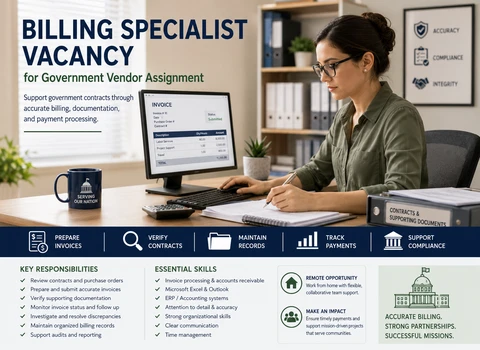
Understanding the Billing Specialist Vacancy for Government Vendor Assignment
A
Billing Specialist Vacancy for Government Vendor Assignment focuses on handling invoices, payment records, and financial documentation for companies that provide products or services to government agencies. At first glance, the role may seem limited to creating invoices, but the responsibilities are much broader. Billing specialists verify contract terms, review supporting paperwork, track payments, and help ensure that billing activities meet government requirements.
Government contracts often involve strict rules and detailed documentation. Something as small as an incorrect purchase order number or missing attachment can delay payment. For that reason, employers seek professionals who are detail-oriented, dependable, and comfortable working with financial records.
In a remote setting, billing specialists complete these tasks from home while staying connected with accounting departments, project teams, procurement personnel, and contract managers through digital tools.
Why Government Vendor Billing Requires Specialized Knowledge
Government billing follows a different process than billing for private customers. Public agencies typically require additional approvals, specific invoice formats, and detailed supporting records.
Professionals working in a
Billing Specialist Vacancy for Government Vendor Assignment may be responsible for areas such as:
- Contract-based invoicing
- Purchase order validation
- Billing for grant-funded programs
- Federal, state, or local government payment procedures
- Cost allocation tracking
- Documentation retention
- Audit support
Because public funds are involved, agencies often review billing records carefully. Accurate documentation and adherence to procedures help prevent delays and reduce the risk of compliance issues.
How the Position Contributes to Business Operations
Billing has a direct impact on an organization's financial health. When invoices are submitted correctly and on time, businesses are more likely to receive prompt payment for completed work.
Professionals in this role often:
- Generate and submit invoices
- Review contract requirements before billing
- Monitor unpaid balances
- Investigate billing discrepancies
- Coordinate with finance teams
- Maintain organized records
Their efforts help keep revenue flowing while ensuring government clients receive accurate billing information that aligns with contract terms.
What a Typical Workday Looks Like
Most billing specialists follow a structured workflow, although priorities can shift depending on project deadlines and payment schedules.
Daily responsibilities may include:
- Reviewing completed work for billing eligibility
- Preparing invoices based on contract requirements
- Confirming purchase order information
- Checking supporting documentation
- Monitoring invoice approval progress
- Responding to billing-related questions
- Following up on outstanding payments
- Updating accounting and billing systems
Remote employees generally spend much of their day working within accounting software, spreadsheets, document repositories, and communication platforms.
Example of a Common Billing Situation
Imagine a technology contractor has completed a support project for a state agency. Before sending an invoice, the billing specialist may need to confirm:
- Approved labor hours
- Contract pricing terms
- Purchase order details
- Project completion documentation
- Required backup records
Only after these items are verified can the invoice be submitted in accordance with the agency's guidelines.
Technical Skills That Support Success
Strong performance in this profession depends on both financial knowledge and careful attention to detail. Small mistakes can create payment delays or require invoices to be corrected and resubmitted.
Valuable skills include:
- Invoice preparation and processing
- Accounts receivable management
- Accurate data entry
- Financial record maintenance
- Contract review
- Account reconciliation
- Reporting and documentation
- Payment tracking
- File management
The ability to stay organized while handling multiple contracts is especially useful in environments with several government clients.
The Importance of Analytical Thinking
Billing specialists often compare information from contracts, invoices, timesheets, and payment records. When numbers do not align, they must identify the source of the discrepancy.
For instance, if billed labor hours exceed approved hours, the specialist may need to work with project managers or accounting staff to resolve the issue before the invoice can move forward.
Software and Systems Commonly Used in the Profession
Technology is central to modern billing operations. Employers frequently look for candidates who can quickly learn financial systems and work comfortably with digital tools.
Commonly used software includes:
- Microsoft Excel
- Microsoft Outlook
- Enterprise Resource Planning (ERP) systems
- Accounting software
- Accounts receivable platforms
- Contract management applications
- Customer relationship management systems
- Electronic invoicing tools
- Document management software
Depending on the organization, professionals may use platforms such as QuickBooks, SAP, Oracle, NetSuite, or similar accounting solutions.
Spreadsheet proficiency is often important because billing specialists regularly review data, verify calculations, and prepare reports.
Educational Background and Professional Credentials
There is no single route into this field, but many employers prefer candidates with education related to accounting, finance, or business administration.
Common qualifications include:
- High school diploma combined with relevant experience
- Associate's degree in accounting or business
- Bachelor's degree in accounting, finance, economics, or a related discipline
Professional certifications can also strengthen a candidate's profile.
Examples include:
- Certified Bookkeeper credentials
- Accounts receivable certifications
- Accounting coursework and training
- Government contract management programs
- Industry-specific billing certifications
Practical experience with invoicing, collections, or contract billing is often highly valued by employers.
Navigating Compliance and Documentation Requirements
One of the most important aspects of government contract billing is maintaining accurate records. Every invoice may require supporting documentation demonstrating compliance with contract requirements.
Tasks can include:
- Maintaining invoice records
- Tracking contract amendments
- Verifying approved billing rates
- Reviewing funding restrictions
- Organizing supporting documents
- Preparing files for audits
Well-maintained records help organizations respond efficiently to questions from clients, auditors, or regulatory bodies.
Why Audits Matter
Government-funded projects are often subject to reviews and audits. During these evaluations, organizations may need to provide documentation supporting invoices and payment requests.
Billing specialists play a key role by ensuring that records are complete, organized, and readily available upon request.
Remote Work Expectations in This Career
Remote opportunities have become increasingly common because most billing functions can be performed electronically.
A remote
Billing Specialist Vacancy for Government Vendor Assignment may involve:
- Attending virtual meetings
- Processing invoices through online systems
- Managing digital records
- Sharing documents securely
- Communicating through email and collaboration tools
- Accessing accounting platforms remotely
Although the work takes place outside a traditional office, expectations regarding confidentiality, accuracy, and productivity remain high.
Traits of Successful Remote Billing Specialists
Professionals who excel in remote environments often demonstrate:
- Self-motivation
- Strong organizational skills
- Clear communication
- Reliability
- Attention to detail
- Independent problem-solving
The ability to manage workloads without constant supervision is particularly valuable.
Challenges Professionals Commonly Encounter
Billing specialists regularly face situations that require careful review and persistence.
Common challenges include:
- Missing supporting documents
- Delayed invoice approvals
- Contract interpretation questions
- Payment disputes
- Data entry mistakes
- Changing billing requirements
- Tight reporting schedules
Addressing these issues often involves coordinating with multiple departments while maintaining accuracy and professionalism.
Managing Multiple Deadlines
Government contracts frequently operate on fixed billing cycles. Missing a submission deadline can postpone payment, making time management an essential skill for success.
Industries That Frequently Hire Billing Specialists
Government contract billing skills are useful across a wide range of industries.
Organizations that commonly recruit for a
Billing Specialist Vacancy for Government Vendor Assignment include:
- Information technology companies
- Engineering firms
- Healthcare organizations
- Defense contractors
- Construction companies
- Consulting firms
- Educational service providers
- Infrastructure contractors
- Professional services organizations
Any business that works with government agencies may require billing specialists to manage invoicing and payment activities.
Who Is Well-Suited for This Career Path?
This profession often appeals to individuals who enjoy structured processes and detail-focused work. Accuracy and consistency are important parts of the job.
Successful professionals typically possess:
- Strong numerical abilities
- Attention to detail
- Organizational skills
- Professional communication
- Problem-solving capabilities
- Integrity and discretion
- Process-focused thinking
People who enjoy reviewing records, identifying inconsistencies, and maintaining organized documentation often find this work rewarding.
Building Long-Term Career Opportunities
A
Billing Specialist Vacancy for Government Vendor Assignment can provide a foundation for advancement within accounting, finance, and contract administration.
Potential career paths include:
- Senior Billing Specialist
- Accounts Receivable Analyst
- Revenue Operations Specialist
- Contract Administrator
- Financial Analyst
- Accounting Coordinator
- Billing Manager
- Government Contracts Specialist
- Finance Manager
As experience grows, professionals may move into leadership positions, compliance-focused roles, or specialized government contracting functions.
Continuing Professional Development
Career advancement often comes from expanding technical knowledge and industry expertise.
Areas that can support growth include:
- Government contracting regulations
- Financial reporting practices
- Advanced Excel techniques
- ERP systems
- Audit preparation
- Project accounting
- Revenue management
Ongoing learning helps professionals stay current with changing regulations and evolving financial technologies.
What Job Seekers Should Know Before Pursuing This Profession
A
Billing Specialist Vacancy for Government Vendor Assignment combines financial administration, contract awareness, and strong organizational skills. The role supports accurate invoicing, proper documentation, and timely payment processing for organizations that serve government clients.
Individuals considering this career should be comfortable working with detailed financial information, following established procedures, and maintaining accurate records. Success often depends on consistency, attention to detail, and the ability to communicate effectively with different stakeholders.
For those interested in accounting support, finance operations, or government contracting, this profession offers practical experience and transferable skills that can open doors to a variety of future career opportunities.