
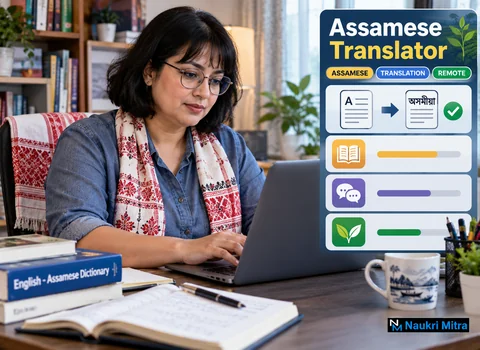
It is a little after nine. You open a fresh project in Smartcat, and the file is a long list of app strings: button labels, error messages, a cheerful welcome screen that someone in a marketing team clearly enjoyed writing. Your tea is already going cold on the desk. This listing is for online Assamese translator jobs of exactly this kind: part-time, fully remote, open to applicants anywhere in the world, and paid at $12 per hour (USD). Below is how a typical day runs, followed by the practical details about tools, tests, pay and getting started.
App strings look easy until you meet them. "Save" might be a verb on a button or a noun in a settings menu, and the file rarely tells you which. So you read the context notes, check the screenshots if the client supplied any, and only then type. A short label such as "Got it!" needs an Assamese phrase that sounds like a friendly app, not a government circular.
Most weeks involve a mix of material. The brief for this role covers English documents, website pages and app strings, so one day you might work through a product help page and the next a set of notification texts. Put simply, this Assamese translator work from home role is about turning English into natural Assamese that a reader in Guwahati, Jorhat or Dibrugarh would accept without noticing it was ever English.
Once a batch is drafted, you stop translating and start checking. Clients usually attach a glossary, a list of approved terms for their product names, features and recurring phrases. If the glossary says a word stays in English, it stays in English, even if you would personally choose an Assamese equivalent.
Translation memory is the other half of this habit. Your CAT tool remembers segments you or earlier translators have already handled, and it offers them back as matches. A good translator does not accept those matches blindly. You read each one, confirm it still fits, and fix any that were wrong to begin with. Consistency across a project is one of the things reviewers notice first.
This is also the stage for the awkward bits: an idiom about baseball, a holiday Assamese readers do not celebrate, a joke that only works in English. Adapting these is part of the Assamese translator job description here. Sometimes you find a local equivalent; sometimes you simplify and leave a note for the project manager explaining why.
Later you return to the draft as if someone else wrote it. You look for spelling slips, inconsistent spellings of the same word, wrong conjuncts, missing punctuation and numbers that did not survive the trip from English. Assamese has its own characters, such as ৰ and ৱ, and a tired eye can let a Bengali form slip through.
Your tool's QA check helps too. It flags untranslated segments, tag mismatches and terms that ignore the glossary. Clear every warning or explain why it can stay.
The final step is delivery. You confirm the file status, export or submit it in the format requested, and send a short message listing any queries or decisions the reviewer should know about. Delivering on the agreed timeline matters more than almost anything else in freelance work, because a late file holds up a whole release. If you can see a deadline slipping, say so early.
Experience with Smartcat or memoQ is required for this role. Smartcat runs in a browser, while memoQ is mainly used as a desktop program. Both handle translation memory, termbases and QA checks.
Typing matters just as much. You need fast, accurate Assamese Unicode typing, not old font-based tricks that produce text other computers cannot read. Options include the built-in Assamese keyboard layouts on Windows and Android, phonetic input tools and the InScript layout. Pick one, practise until your speed feels natural, and test that your output displays correctly in the CAT tool. A reliable computer and a steady internet connection complete the setup.
Every candidate must clear a translation test before taking on project files. Expect a short English passage, sometimes with a few app strings, to translate into Assamese, often inside the same CAT tool you will use on projects. Reviewers check accuracy, natural phrasing, correct spelling, punctuation and whether you followed the instructions and glossary.
To prepare, translate a few real web pages and help articles for practice, then proofread them a day later. If you are asked Assamese translator interview questions afterwards, they usually cover your tools, your process for checking work and how you handle terms you do not know.
For this listing, a degree or translation certificate is a plus, not a requirement. What is essential is native Assamese, strong English comprehension, the CAT tool skills above and a passing test. Freshers can apply if they pass the test, but note that hands-on Smartcat or memoQ experience is still required. So if you have been searching for Assamese translator jobs for freshers or Assamese translator jobs no experience, learn one of those tools properly before you apply.
Anyone asking how to become Assamese translator with stronger credentials can look at an Assamese translator course from a university or language institute can sharpen technique, and an Assamese translator certification can strengthen a profile. Neither replaces practice. On your Assamese translator resume, list the CAT tools you use, the subject areas you know well and any sample work you can share.
This role pays $12 per hour, USD, on a part-time basis. Hours depend on project volume, so weekly totals can vary.
Elsewhere in the industry, much translation is priced per word instead, and some clients pay per project. Hourly pay is easier to plan around and does not penalise careful research. When you compare an Assamese translator salary across offers, look at the pay basis, the type of text and how much review is included, not just the headline number. For this listing, the Assamese translator salary per hour is the figure stated above and nothing more.
Getting the first project online is the hardest step. Freelancers commonly look on translator marketplaces and directories such as Proz, on general freelance platforms such as Upwork, and on the vendor pages of large language service companies such as Lionbridge and RWS. Treat these only as examples of where people search; always confirm any opening through the company's official careers or vendor page, and remember that real clients do not charge you for applying.
A small portfolio of two or three short translated samples, a clear profile listing your language pair and tools, and quick, polite replies all help. Freelance Assamese translator jobs can lead to repeat work once a project manager trusts your files. Part time Assamese translator jobs like this one are also a sensible way to build that track record alongside study or another job.
People often confuse the two. A transcriptionist listens to audio and types what is said, usually in the same language. A translator moves meaning from one language to another and adapts it for readers. Translation generally asks for more specialised skill and tool knowledge, and it is often priced higher for that reason, but rates depend on the client, the subject and how the work is paid.
Machine translation for Assamese has got better, and some projects now include machine output for a human to edit. It still struggles with tone, idiom, regional usage and the small judgement calls that make an app feel local. Clients who care about quality keep a human reviewer involved. The useful response is to get comfortable editing machine drafts while keeping your own Assamese sharp, because the core Assamese translator skills of judgement and consistency remain what clients pay for.