
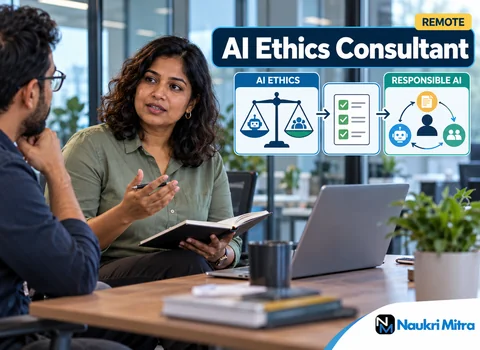
A hiring product can rank a thousand applicants overnight while one feature quietly scores their faces for "enthusiasm". Someone has to ask whether that feature should exist. Among the remote AI ethics consultant jobs open to applicants anywhere in the world, this one is a full-time post with a salary of $100,000 per year (USD), done entirely from home. It suits people with a few years in responsible AI, technology law, applied ethics or risk consulting who can explain a hard trade-off to an engineer and a lawyer in one meeting.
The client builds and buys AI systems faster than its internal review can keep up with. Product teams want answers on fairness, privacy and accountability before launch, not a policy PDF after the model is live.
You will run assessments that follow NIST's AI Risk Management Framework and the UNESCO Recommendation on the Ethics of Artificial Intelligence. The output is a review, mitigations with owners, and a recommendation someone senior has to sign.
The core AI ethics consultant skills here are judgement and writing. A bachelor's degree is the baseline, with about three years of relevant work at minimum.
The AI ethics consultant salary per year for this full-time post is $100,000 (USD). For readers in India, it works out near ₹95 lakh with the dollar at roughly ₹95, an approximate conversion that changes daily.
A normal week mixes two or three stakeholder interviews, one workshop of about 90 minutes, and long stretches of writing. Because these are AI ethics consultant jobs remote worldwide, some calls will land early or late in your day. Like most AI ethics consultant work from home jobs, it needs a quiet room and a second monitor for reading a model card beside your draft.
A sample file: a hiring platform wants to add "engagement scoring" to recorded video interviews, reading facial expressions and voice tone. The workshop starts with who is affected, not with the model.
A useful rubric line from the review template: "List at least one group that bears the harm but never touches the product." Here, that group is every rejected applicant.
Each harm is then tied to a framework so the review is traceable. Under the NIST functions:
Against UNESCO, the feature runs into proportionality and do no harm, fairness and non-discrimination, transparency and explainability, and human oversight and determination. One comment from a reviewer on an earlier draft is worth keeping in mind: "You have described the risk. Now tell them what to do on Monday."
The recommendation is short: do not deploy emotion scoring in hiring. The EU AI Act has banned emotion recognition in workplace settings since February 2025, and the ban is widely read to cover recruitment, so EU candidates add a legal problem to the ethical one. Keep the transcript features, which infer no emotion, and add a candidate notice and human review of every rejection the tool influences.
The sign-off sheet lists each mitigation, an owner, a due date and the residual risk rating. A full review of this size usually takes two to three weeks from first interview to signature.
Most people who search "how to become AI ethics consultant" come from philosophy, law or policy. Philosophers need to add technical literacy, lawyers need to learn how models fail, and risk staff need sharper written reasoning.
A good AI ethics consultant course will cover the frameworks and give you a case to assess, not just slides. The AI ethics consultant certification clients recognise most is the IAPP AIGP. It helps, but two or three sample reviews often carry more weight.
Be realistic about entry level remote AI ethics consultant jobs: very few exist. Listings that pop up under "AI ethics consultant jobs no experience" are mostly research assistant or data annotation work. Junior privacy or compliance roles are the usual stepping stone.
A strong AI ethics consultant resume names systems and outcomes: "Led impact assessment of a credit-scoring model; two features removed before launch." Put framework names in context, not in a keyword list.
Typical AI ethics consultant interview questions include:
An ethics consultant asks whether a system should be built and for whom it might fail; a governance specialist builds the policies, inventories and controls that keep a whole programme compliant. Governance roles often follow a few years of ethics review.
Demand is growing as regulation arrives, but it tracks budgets, so no one can promise a steady stream of openings.
Something is wrong if a recruiter wants a registration or "certification kit" fee, needs your UPI PIN or the OTP your bank texts you, keeps all contact on Telegram or WhatsApp, or makes an offer without any interview or written exercise. No payment is ever taken from candidates here, and applying costs nothing.
Send your CV and one sample review of no more than four pages. Expect a screening call, a written case exercise and a panel interview, with no promise of an offer at the end.