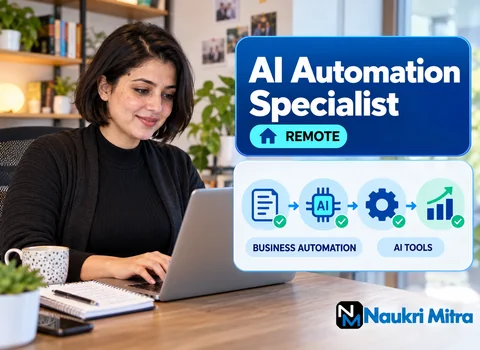
"I just want new form leads to show up in my CRM with a summary." Picture that as the entire brief from a florist (the florist is hypothetical) who runs wedding bookings off a contact form. It sums up what online AI automation specialist jobs look like day to day. This listing is a part-time, remote role open worldwide at USD 30 per hour. If you want AI automation specialist work from home, this is what it looks like in practice: take requests like hers, build working automations, and leave something her staff can keep running. Here is one gig, from first call to handover.
Advertisement
The scoping call, where one sentence becomes a spec
A client sentence like that hides a dozen decisions. On the call, you ask boring questions. Which form tool? Which CRM, and on which plan, since some plans lock the API? Who reads the summary, and what do they do next with it? What should happen when someone submits the form twice, or types gibberish in the phone field?
You also agree on what is out of scope. In this case: no lead scoring, no auto-replies to the customer, no syncing old leads. Agreeing that early avoids disputes over the invoice later. Good English matters because much of the job is hearing someone describe their process loosely and repeating it back clearly.
Writing the steps down before opening any tool
Before building anything, put the flow on paper as plain steps. For the florist, it looked like this:
- Form is submitted with name, email, wedding date, budget, and a free-text message.
- The automation receives the data and checks that the required fields are present.
- An AI step reads the message and writes a three-line summary plus a guessed event type.
- The automation searches the CRM for that email, then creates or updates the contact.
- The summary is saved as a note on the contact, and the owner gets an email ping.
Get the client's yes on that list before you build.
Zapier, Make or n8n for a small client
The listing names all three, and the right choice depends mostly on the client. Zapier is the easiest for a non-technical owner to open later and understand, though task-based pricing can climb on busy flows. Make gives you a visual canvas with routers and finer control over loops. n8n can be self-hosted, which suits a client who cares about where data sits or who wants to avoid per-task fees, but then someone has to look after the server.
For a florist with maybe a handful of leads a day, Zapier was the obvious pick. Hosting and access are part of scoping too. Ask the client to create the accounts in their own name, invite you as a user, and generate their own OpenAI API key to paste into the connection. Never run a client's business on your personal keys.
The webhook and the JSON it carries
Most form tools can post to a webhook URL. The automation platform gives you that URL, and the form sends a JSON payload to it on each submission. A test payload might look like
{"name": "Asha", "email": "asha@example.com", "event_date": "2027-03-14", "budget": "1500", "message": "Looking for table flowers for 80 guests..."}. Your first job is to submit a real test entry and check the field names, because forms love to send things like "field_7" instead of "email".
Basic JavaScript or Python earns its keep here. A small code step can trim whitespace, lowercase the email, and turn an empty budget into null so the CRM doesn't reject it.
The OpenAI API step that writes the summary
The summary is what the client is excited about, so it must be dull and reliable. Write a prompt that sets the format tightly: three short lines, plain text, no greeting, and a final line with one event type from a fixed list such as wedding, corporate, or other. Ask for JSON back if the next step needs to read individual fields, and parse it rather than trusting it blindly.
Then test the edge cases. Feed it a one-word message, a message in Spanish, a message that is mostly an angry complaint, and a spam entry full of links. Decide what each should produce. A spam filter before the AI step saves money. When you build workflows that connect ChatGPT-style models to a CRM, the model call is a small part of the build; most of the effort goes into the checks and handling around it.
Getting the record into the CRM
Duplicates are the most common CRM integration problem, so always search first, then create or update. Map each field deliberately and check the CRM's date format, since a wedding date sent in the wrong format either fails or silently lands on the wrong day. Store the AI summary as a note or a custom field the owner actually looks at, not buried in a description box nobody opens.
When it breaks: error handling and logging
It will break: a key expires, a CRM field changes, the AI call times out. Add a fallback path so that if the summary step fails, the lead still goes into the CRM with a note saying "summary unavailable". Send failures to a shared error inbox or a chat channel the client watches. Keep a simple log, even a spreadsheet with timestamp, email, status, and error text, so that when the owner says "a lead went missing on Tuesday" you can check in two minutes instead of guessing.
Handing it over: the doc and the walkthrough video
The responsibilities include documenting each workflow so the client team can maintain it. Write a short hand-over doc: what triggers the flow, each step in one sentence, where the API key lives, what the error alerts mean, and how to pause everything. Then record a screen-share walkthrough of about ten minutes, clicking through each step and showing one test lead end to end. Many clients find a video easier to revisit than a written document.
Showing proof for online AI automation specialist jobs
The listing says plainly that no formal degree is required and that working automations count most. So your portfolio matters more than your AI automation specialist resume. Two or three small builds with a short write-up each (the problem, the tools, a screenshot of the flow, one thing that went wrong and how you fixed it) will carry more weight than a certificate. That is also the honest answer for anyone looking at AI automation specialist jobs as a fresher: you can start with no paid experience, but not with no examples. People who search "AI automation specialist jobs no experience" should build for a friend's shop or their own inbox and document it like client work. The main step to becoming an AI automation specialist is building and documenting.
Zapier Certified Expert and other ways to show skill
Zapier Certified Expert status is named as a bonus, nothing more. It is Zapier's own program for consultants who build on the platform, and the criteria change over time, so check Zapier's site for what it currently requires. For learning, the official docs and free academy material from Zapier, Make and n8n, plus OpenAI's API documentation, give you most of the grounding. An AI automation specialist course or certification gives your practice structure, but clients will still ask to see a working flow.
Hourly billing, interview topics and next moves
On AI automation specialist salary per hour, this listing is clear: USD 30 per hour, part-time. Weekly hours are left open, as they often are in part-time AI automation specialist jobs, so ask about volume. Before applying, prepare a short portfolio link, a one-paragraph summary of your strongest build, and be ready to talk through how you would scope a request like the florist's. Common AI automation specialist interview questions cover webhooks, retries, and what you do when an AI step returns nonsense. Submitting an application through Naukri Mitra costs nothing; money should only ever flow from the client to you.