📚 Table of Contents
- How Blockchain Gives Freelancers a Fairer Deal
- Getting Paid Faster With Peer-to-Peer Blockchain Payments
- Why Blockchain Builds Trust Between Clients and Freelancers
- Managing Freelancers Across Borders With Blockchain
- Hiring Without Bias: How Blockchain Recruiting Works
- How Blockchain Fixes International Payment Headaches
- Say Goodbye to Fake Freelancers With Blockchain ID
- Getting Paid Fairly With Tokenized Milestone Contracts
- Remote Collaboration, Reinvented With Blockchain
- How Big Companies Use Blockchain for HR
- The Next Generation of Freelance Marketplaces
- Freelancers Finally Get Permanent Work Records
- Smart Contracts: The End of Broken Agreements
- How Blockchain Levels the Playing Field for Global Talent
- Real Stories: Blockchain at Work
- So, What’s Next?
- Final Thoughts
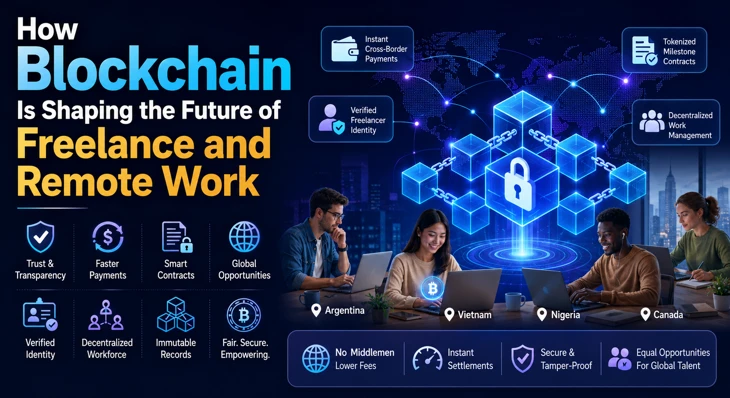
How Blockchain Is Shaping the Future of Freelance and Remote Work
If you’ve ever done freelance work—or even thought about it—you know the drill. Chasing clients for payments. Wondering if that job post is legit. Juggling multiple platforms. And, of course, the endless waiting for money to clear across borders. It wears you down over time. But here’s the surprising twist—blockchain is quietly clearing away those headaches. Let’s unpack how this shift is unfolding and why it could completely reshape freelance and remote work.How Blockchain Gives Freelancers a Fairer Deal
The gig economy isn’t new. Millions already rely on platforms like Upwork, Fiverr, and Freelancer. But here’s the catch—you’re often stuck with high fees, slow payments, and sketchy levels of trust. That’s where gig economy innovation powered by blockchain comes in. Instead of a platform taking a 20% cut, you can connect directly with a client through a blockchain system. Payments clear instantly while agreements sit securely on the blockchain—no room for anyone to “forget” what was promised. Sounds almost too good to be true—but blockchain makes it real. Finally, a system that feels fair to freelancers.Getting Paid Faster With Peer-to-Peer Blockchain Payments
Money delays are the number one frustration. If you’ve ever sat there refreshing your bank app for three weeks waiting on a wire transfer, you know the pain. That’s why peer-to-peer payment systems built on blockchain are such a relief. With cryptocurrency, freelancers receive payments almost instantly. Banks don’t get a chance to drag their feet. Plus, cryptocurrency transactions significantly reduce fees. A designer in India can work with a client in Canada and have payment land in minutes. That’s absolute freedom.Why Blockchain Builds Trust Between Clients and Freelancers
We’ve all heard the horror stories: ghost clients, fake job posts, and payments disappearing. Blockchain changes the freelancing landscape by bringing trust and transparency. How? Because every record becomes part of the immutable work records. No edits, no fraud, no vanishing agreements. Think of it as a personal vault where your resume, contracts, and history live—untouchable, tamper-proof, and always accessible.Managing Freelancers Across Borders With Blockchain
For companies, juggling freelancers across time zones is a logistical nightmare. Hours, milestones, invoices—it’s messy. Enter decentralized workforce management. Picture a company posting a project on a blockchain platform—it automatically tracks milestones and releases payments without the usual HR headaches:- Projects get posted transparently
- Milestones track themselves
- Payments trigger once tasks are verified
Hiring Without Bias: How Blockchain Recruiting Works
Recruitment takes time—and bias creeps in. With blockchain-enabled hiring platforms, companies can verify freelancers' histories in seconds. Skills, past work, and client ratings are all securely locked in. That means a coder in Nigeria gets the same shot as one in San Francisco. Blockchain levels the playing field, putting skill above location.How Blockchain Fixes International Payment Headaches
Ask any freelancer working globally: exchange rates and bank fees sting. By the time money arrives, you’ve already lost a slice of your earnings. Secure cross-border payments through blockchain solve that. Funds go directly into your crypto wallet—fast and safe. Convert to local currency when you want, or hold onto it. Here’s the real game-changer: a student in the Philippines now gets paid just as quickly as someone in New York.Say Goodbye to Fake Freelancers With Blockchain ID
Fake accounts flood freelancing sites. Clients hesitate, freelancers lose opportunities. Blockchain provides digital identity verification for freelancers. Your ID, portfolio, and references have been verified and are secure. No impostors stealing jobs. Just verified professionals with proven skills:- Verified IDs
- Secured portfolios
- Trusted references
Getting Paid Fairly With Tokenized Milestone Contracts
Scope creep and unpaid extra hours—sound familiar? With tokenized work agreements, you don’t get trapped. Each milestone is tokenized. Finish the task, and the token (payment) will be released. It’s simple and automatic—no drawn-out arguments, no awkward payment delays.Remote Collaboration, Reinvented With Blockchain
Remote teams live on Slack, Zoom, and Trello. But what if those tools came with blockchain baked in? Think transparent tracking, tamper-proof logs, and milestone-linked payments. A small app-building team can manage tasks, communication, and payments on a single blockchain dashboard. No confusion, no lost files—just smooth collaboration.How Big Companies Use Blockchain for HR
Large organizations are already testing blockchain in human resource management. The benefits? Resumes that can’t be faked, references that verify themselves, and records that stay permanent. This reduces time, cost, and risk while ensuring a fairer hiring process. It’s HR with trust built in.The Next Generation of Freelance Marketplaces
First came Fiverr and Upwork. The next wave? Platforms shaped by the evolution of freelance job marketplaces on blockchain. These platforms strip out middlemen, reduce fees, and give workers control. Imagine freelancers voting on fees, rules, and platform features because the system itself is decentralized. Power finally shifts toward the talent.Freelancers Finally Get Permanent Work Records
One of freelancing’s most formidable challenges is proving your past work. If a client vanishes, so does your feedback. With immutable work records, that’s no longer a worry. Every project, every testimonial, and every deadline is permanently stored on the blockchain. Whether it’s today or ten years from now, your history is solid.Smart Contracts: The End of Broken Agreements
Vague contracts sink freelancers. That’s why blockchain-powered digital contracts—smart contracts—are so powerful. They automatically execute once conditions are met and deliver the work? Payment drops: no chasing, no begging, no awkward follow-ups.How Blockchain Levels the Playing Field for Global Talent
At its core, freelancing is about independence. With blockchain, it grows into economic empowerment for freelancers everywhere. People in developing regions, previously excluded by payment systems, can now compete on a global scale. Picture a Kenyan student designing logos. They get paid instantly, directly, and securely. No middlemen. Just pure opportunity.Real Stories: Blockchain at Work
- An illustrator in Argentina avoided currency collapse by taking crypto payments directly. While neighbors saw savings vanish, she kept hers safe.
- A software team in Vietnam ran an entire U.S. startup project using blockchain tools. Payments triggered via smart contracts—no chance of being stiffed.
- A freelance writer in Eastern Europe finally stopped chasing invoices. Smart contracts meant her clients couldn’t back out.