📚 Table of Contents
- Affordable Living: Why Tier-2 Cities Make Sense
- Digital Infrastructure: Small Towns, Big Upgrades
- Startup Ecosystem in Emerging Cities
- Escaping Traffic: Time Gains in Tier-2 Cities
- Quality of Life in Tier-2 Cities
- Hybrid Work: A Bridge Between Two Worlds
- Government Push: Policy Meets Lifestyle
- Housing Trends: Beyond Apartments
- Work-Life Balance in Smaller Cities
- Sustainability: The Bigger Picture
- Reverse Migration to Tier-2 Cities
- Economic Growth: A Ripple Effect
- Corporate Policies: The Shift Is Real
- Wrapping It Up: The Future Looks Smaller (In a Good Way)
- Final Thought
Why Tier-2 Cities Are Emerging as Remote Work Hubs
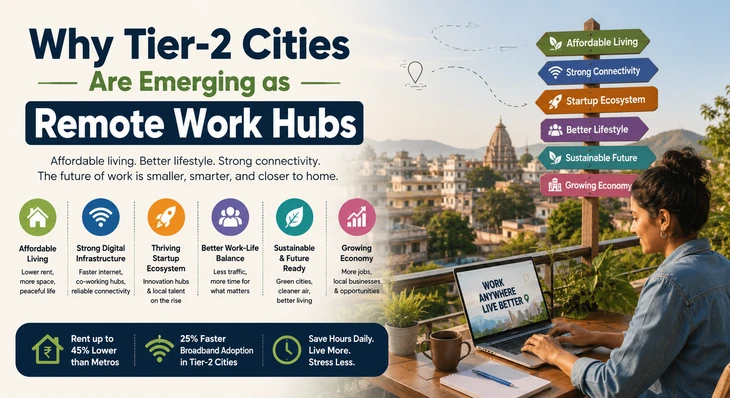
Remote work isn’t just a short-lived pandemic experiment anymore—it’s now shaping where people live, how businesses operate, and what the future of cities looks like. For years, the major metropolitan areas, such as Bangalore, Delhi, or Mumbai, have dominated India’s professional landscape. But today, something interesting is happening. People are packing their bags, moving out of chaotic metros, and choosing Tier-2 cities as their new home base. Why? These smaller cities offer a mix of affordability, a better quality of life, and surprisingly strong digital infrastructure. Let’s break this down together, in plain talk, and see why Tier-2 cities are suddenly turning into the hot spots for remote workers and even companies.Affordable Living: Why Tier-2 Cities Make Sense
If you’ve lived in a metro, you already know how expensive it gets. Rent, food, transportation—it all adds up. You probably know someone paying half their salary just for a tiny apartment in a crowded neighborhood. That’s where affordable housing in Tier-2 cities changes the game.- Lower rent by 40–50%
- More space and greenery
- Peaceful neighborhoods for families
Digital Infrastructure: Small Towns, Big Upgrades
A lot of us assume that smaller cities mean weaker facilities. But not anymore. The last few years have seen considerable improvements in digital infrastructure in smaller towns. We’re talking about fiber internet, co-working hubs, and better access to online services. One of my friends moved from Delhi to Indore during the lockdown. He was nervous at first—“What if the internet keeps breaking during client calls?” But to his surprise, the improved internet connectivity in Indore was solid, often better than what he had in Delhi. TRAI data show that Tier-2 cities have seen a 25% faster broadband adoption rate over the last three years. That’s the hidden advantage—smaller towns are catching up fast, and they’re doing it in a way that supports remote work opportunities.Startup Ecosystem in Emerging Cities
Startups no longer belong only to Bengaluru. The startup ecosystem in emerging cities is getting stronger by the day. Think Jaipur, Kochi, Coimbatore, or Surat—these places now host innovation hubs, co-working spaces, and angel investors looking to back local talent.- Jaipur: growing IT and design community
- Kochi: booming in logistics and tech
- Coimbatore: engineering and manufacturing strength
- Surat: rising fintech and textile startups
Escaping Traffic: Time Gains in Tier-2 Cities
Ever felt drained after a two-hour commute in a metro city? That’s time you’ll never get back. One of the biggest perks of smaller towns is the reduced traffic congestion. You don’t waste hours stuck in jams. Imagine what you can do with that extra time—maybe pursue a hobby, spend time with family, or rest. I know a colleague who moved to Chandigarh. He says the most significant win isn’t just cheaper rent, but the fact that he can pick up his kids from school in 10 minutes instead of battling 90 minutes of traffic.Quality of Life in Tier-2 Cities
Think about life outside metros—cleaner air, more green spaces, and less pressure. That’s the quality of life in non-metro areas. Smaller cities bring balance. They let people escape the “always-on” chaos of metros and rediscover personal well-being. For parents, this means safer neighborhoods for kids. For young professionals, it means the chance to meet people outside the corporate bubble. And for everyone, it’s about living without constant stress.Hybrid Work: A Bridge Between Two Worlds
Of course, not everyone wants to be 100% remote. That’s where hybrid work culture opportunities come in. Hybrid policies are gaining traction—workers can stay based in Tier-2 towns but travel to the big-city office when projects require it. This balance offers workers the best of both worlds: access to big-city networks and events, while enjoying a peaceful lifestyle in smaller towns. Companies are realizing that this flexibility boosts productivity and keeps employees happier in the long run. It also expands remote work opportunities in India, giving professionals freedom to live where they choose without sacrificing career growth.Government Push: Policy Meets Lifestyle
It’s not just individuals making this shift. There’s a bigger hand at play. Government support for smaller cities has been growing. Initiatives such as:- Smart Cities Mission
- IT park development
- Tax and business incentives
Housing Trends: Beyond Apartments
The shift to smaller cities is altering how people perceive housing. There’s now a rising demand for co-living spaces. Why? Because remote workers, freelancers, and even small startup teams want flexible, affordable places to live and work together. And here’s where it gets interesting—digital nomads in India are also fueling this trend. They look for community-style living, shared amenities, and work-friendly environments. These aren’t your old-school PG accommodations. We’re talking modern facilities, shared kitchens, gaming zones, and high-speed internet.Work-Life Balance in Smaller Cities
If you’re wondering how this actually affects you, here’s the simple truth: long hours, long commutes, and high expenses in metros make balance nearly impossible. But in smaller cities, employee work-life balance trends are far more realistic. People get time back. They rediscover weekends. They don’t feel guilty for skipping social events because the culture isn’t as high-pressure. This shift is why so many are saying goodbye to burnout and hello to healthier lifestyles.Sustainability: The Bigger Picture
When we talk about cities, we can’t ignore the planet. Tier-2 cities are becoming test grounds for sustainable urban development. Lower population density allows for more space to plan eco-friendly housing, public transportation, and green spaces.- Solar energy adoption
- Waste recycling programs
- Green housing projects